'News Chori' began before 'Vote Chori': Siddharth Varadarajan while speaking about role of media
Address during launch of Vartha Bharati's Kalyana Karnataka Edition from Kalaburagi
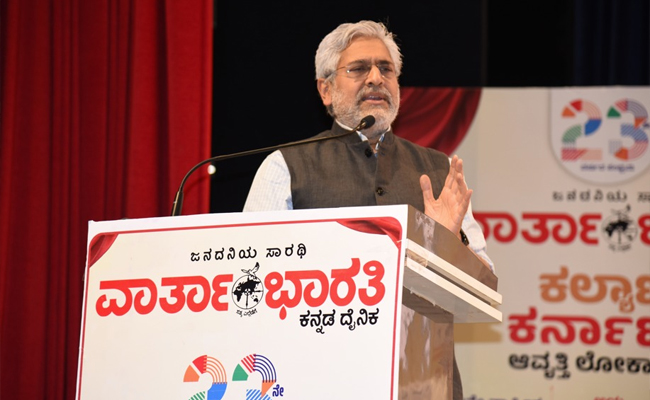
Senior journalist Siddharth Varadarajan, Editor-in-Chief of The Wire, on Saturday delivered a strong and wide-ranging speech on the role of independent media in India, warning that “news theft” had begun much before allegations of vote theft surfaced in public discourse.
Speaking at the official launch of Vartha Bharati's Kalyana Karnataka Edition from Kalaburagi, along with the release of its annual magazine and a booklet of selected editorials, Varadarajan said the event marked an important moment at a time when large sections of mainstream media had failed democracy.
Referring to the frequent use of the term “vote chori” in political debates, Varadarajan said he could not say with certainty whether votes were being stolen or not. However, he asserted that news had definitely been stolen in the country.
He described “news chori” as the act of pushing important news away from people, suppressing it and burying it. He said this trend had been visible since 2014 and had only deepened over the past decade.
According to him, when the country most needed a media that would honestly report people’s problems, question those in power and act as a bridge between citizens and rulers, large sections of mainstream media either disappeared from the battlefield or actively worked against democratic values.
He said big media was not just absent but was contributing to the burial of democracy, the federal structure, constitutional values, and the very ideals for which Indians fought the British.
Varadarajan said that when big media retreats during critical times, it creates a vacuum, and it is only natural for new, independent and responsible media platforms to emerge. He said even if such media was scattered or small, it continued to do meaningful work.
ALSO READ: Vartha Bharati launches Kalyana Karnataka edition, releases 23rd annual special issue in Kalaburagi
Calling Vartha Bharati a living example, he recalled that the newspaper began in Mangaluru, expanded to other cities of Karnataka, and was now reaching people in North Karnataka through its Kalaburagi edition.
He said his own organisation The Wire, launched its website in 2015 in English, Hindi and Urdu, and added Telugu last year. He said he was proud that they were not alone and that many small newspapers, portals and some large digital platforms were doing independent journalism across districts and states.
Responding to the frequent allegation that independent media was anti-government or anti-BJP, Varadarajan said this was a false charge.
He said independent media was not against any party, leader or government. Instead, it stood firmly with the Constitution of India. All rights enjoyed by journalists and citizens, he said, flowed from the Constitution, and it was this document that gave independent media its strength.
He also reminded the audience that the Indian press played a crucial role during the freedom struggle and continued to do so in post-Independence India by carrying people’s voices to those in power.
Varadarajan recalled the sacrifice of Maulvi Muhammad Baqir, whom he described as India’s first journalist martyr. Baqir ran an Urdu newspaper during the 1857 revolt and was sentenced to death by the British after Delhi was recaptured.
He also mentioned Ganesh Shankar Vidyarthi, who was killed in Kanpur, and said several journalists had laid down their lives for truth.
He said freedom fighters such as Bhagat Singh and B. R. Ambedkar were also involved in journalism. Bhagat Singh wrote extensively for newspapers and even launched publications, while Ambedkar started multiple newspapers to educate people about their rights.

He stressed that democracy did not end with voting once every few years. True democracy, he said, must function round the clock, and media had a vital role in making that possible.
Drawing parallels with British-era repression, Varadarajan said colonial authorities frequently slapped sedition charges against journalists, including Mahatma Gandhi.
He said it was ironic that sedition laws were now being used against journalists in independent India. Referring to recent cases filed by Assam Police against senior journalist Karan Thapar and himself, he said he initially laughed, seeing it as proof that journalists were doing their job right.

He said journalists were being targeted because those in power did not want uncomfortable questions or inconvenient truths to reach the public.
He also spoke about the use of stringent laws like UAPA and PSA against journalists such as Siddique Kappan, who spent nearly two years in jail, and Fahad Shah in Kashmir. He said journalists across the country, from Manipur to Delhi, continued to face intimidation but had not bowed down.
Varadarajan then outlined five core principles that independent media must follow.

The first, he said, was fearlessness. Journalists must remove fear from their minds. Governments and politicians would try to intimidate through laws, cases and pressure, but fear would end journalism itself.
The second principle was rejecting helplessness. He said journalists should not feel their work had no impact. The very fact that governments panic and file cases against organisations showed that reporting made a difference. He said digital media had made it easier for stories to reach people far beyond printed pages.
The third principle was rejecting hatred. He said hatred was being spread in society on the basis of religion, caste and language, and sections of media were helping amplify it. Independent media, he said, had a duty to expose those who tried to divide Indians.
ALSO READ: Kalaburagi: ‘Vartha Bharati’ Kalyana Karnataka edition launched
The fourth principle was opposing hero worship. Citing Ambedkar’s warning against “hero cult,” he said placing leaders beyond criticism was dangerous for democracy and media must challenge this culture.
The fifth principle was asking the right questions. He criticised the media for asking trivial or misleading questions while ignoring real issues such as unemployment, pollution, misuse of money power in elections, the role of the Election Commission, environmental destruction, and attacks on federalism.
He said media must question whether India belonged to all its people or only to one religion, and whether natural resources were meant for all citizens or a few corporations.
Varadarajan said there was no competition among independent media outlets and that journalists must stand together. An attack on one journalist or organisation, he said, was an attack on all.
Referring to recent protests by press clubs, including condemnation by the Press Club of India after a journalist’s phone was seized in Delhi, he said such solidarity was crucial.
In his concluding remarks, he appealed to the public to support independent media financially by buying newspapers and subscriptions. He warned that independence would be lost the moment media became dependent on governments or big corporations.
He said independent media could survive only when it was sustained by the people, and urged readers to stand with platforms like Vartha Bharati to protect truthful journalism
Let the Truth be known. If you read VB and like VB, please be a VB Supporter and Help us deliver the Truth to one and all.
Man booked for duping 7 persons of Rs 91 lakh on promise of awarding govt works

Mumbai (PTI): The Mumbai police have registered a case against a man for allegedly duping seven persons of Rs 91 lakhs on the promise of awarding them works of different government departments, an official said on Tuesday.
The accused was identified as Satish Kadam, a resident of Nanded in Marathwada region, an official said.
A complaint was filed by Hanumant Vadje, who alleged that the accused cheated him and six others of around Rs 91 lakh by promising to give them various works of Urban Development and Social Justice Department, he said.
The fraud occurred between 2024 and 2026, with Kadam collecting money in cash and into his accounts, police said, adding he had returned some amount to them partially.
Multiple cheques issued by the accused bounced, prompting the victim to lodge a complaint at the Marine Drive police station. Based on the complaint, a case of cheating and criminal breach of trust was registered against him.
The case is under further investigation, the official said.