NGT directs Karnataka govt to pay Rs 2,900 cr for improper solid, liquid waste management
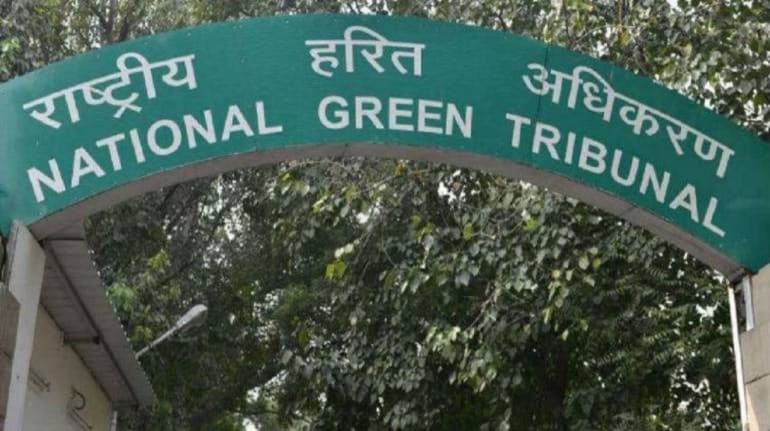
New Delhi, Oct 15: The National Green Tribunal (NGT) has directed the Karnataka government to pay Rs 2,900 crore as environmental compensation for improper management of solid and liquid waste.
A tribunal headed by chairperson Justice Adarsh Kumar Goel said the steps taken by the state of Karnataka for solid waste management and for handling liquid waste were "inadequate."
The NGT bench also comprising Justice Sudhir Agarwal and expert members A Senthil Vel and Afroz Ahmad said that the gap in the generation and scientific handling of solid and liquid waste had resulted in damage to the environment and public health.
Award of compensation had become necessary under Section 15 of the NGT Act to remedy the continuing damage to the environment and to comply with directions of the Supreme Court, the bench said.
It is high time that the state realises its duty to the law and citizens and adopts further monitoring at its own level, the green panel said.
For the gap in treatment in liquid waste or sewage of 1,427.4 million litres daily (MLD), the compensation was Rs 2,856 crores, while for the un-remediated legacy waste of 178.50 metric tonnes (MT), the state was liable to pay compensation of Rs 540 crores, the bench said while determining the compensation amount.
"The total compensation comes to Rs 3,396 crores, or say Rs 3,400 crores and out of the said amount, we deduct the amount of Rs 500 crore levied as compensation vide order dated October 10, 2022," it said.
The Chief Secretary had to evolve an appropriate mechanism for planning, execution and oversight of the programmes for remedial action involving concerned departments within one month, the bench said.
The NGT also said the first change required was to set up a centralized single-window mechanism for planning, capacity building and monitoring of waste management at the state level.
"It should be headed by an officer of the rank of Additional Chief Secretary with representation from concerned departments Urban Development, Rural Development, Environment and Forest, Agriculture, Water Resources, Fisheries and Industries," the NGT said.
"We hope in light of interaction with the Chief Secretary, the state of Karnataka will take further measures in the matter by an innovative approach and stringent monitoring, ensuring that gaps in solid and liquid waste generation and treatment are bridged at the earliest," the NGT added.
For proper solid waste management, legacy waste dump sites had to be suitably fenced and covered till remediation, besides the use of reclaimed land after clearance and establishment of requisite waste processing plants, the green panel said.
For liquid waste management, the sources of clean water had to be maintained, treated sewage water had to be used for non-potable purposes and the established sewage treatment plants (STPs) were required to be fully utilized, the green panel said.
Further, the NGT said the National Mission for Clean Ganga (NMCG) and the Ministry of Urban Development (MOUD) could monitor compliance and utilisation of funds under centrally sponsored schemes.
"A six-monthly progress report with verifiable progress may be filed by the Chief Secretary with a copy to the Registrar General of this tribunal," the green panel said.
Let the Truth be known. If you read VB and like VB, please be a VB Supporter and Help us deliver the Truth to one and all.
Telangana rains: Four farmers dead, three injured as sheds collapse in Mancherial
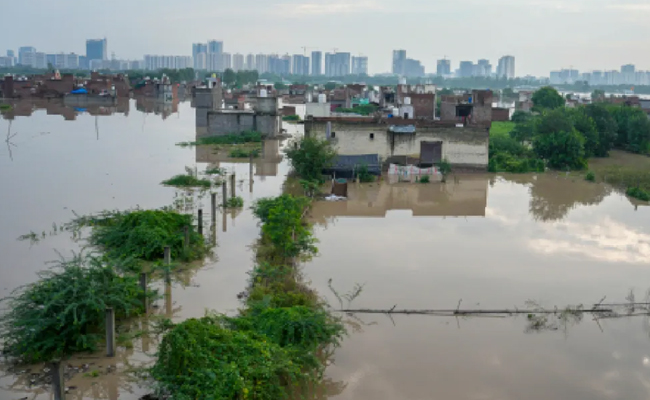
Karimnagar (Telangana) (PTI): Four farmers died, and three others were injured after tin-roofed sheds and dilapidated structures collapsed in two separate incidents in Mancherial district of Telangana, officials said on Wednesday.
The incidents occurred in two villages of Luxettipet mandal late on Tuesday night, when the farmers were taking shelter in the structures following heavy rain and strong winds.
According to officials, two people died when a shed caved in at Kothuru village.
In a separate incident in Gampalapalli village, two more persons died after another structure collapsed, police and district authorities said.
The three injured were shifted to a hospital in Karimnagar for treatment, police said.
Preliminary reports indicate that unseasonal rains accompanied by strong winds weakened the structures, leading to the collapses.
Authorities are assessing the situation, and further investigation is underway.