No greed to become CM again but 'let's see' in next polls: Siddaramaiah
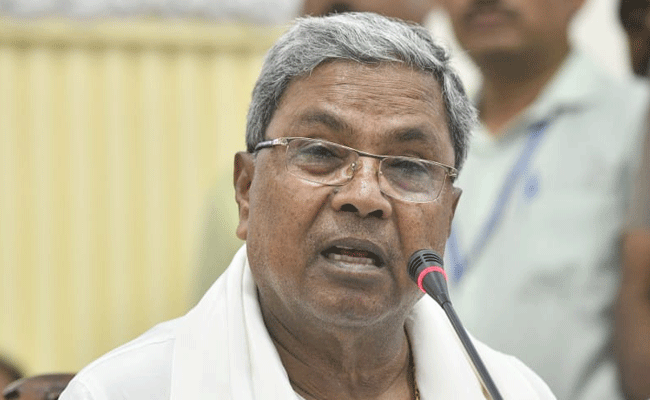
Bengaluru, Oct 26: "Let's see if there are blessings of the people in the next elections," was senior Congress leader Siddaramaiah's refrain Friday when asked if he wants to become Karnataka chief minister again even though he asserted he has no such "greed".
The head of the Congress-JD(S) coalition coordination committee also accused state BJP chief and former chief minister B S Yeddyurappa of being "greedy" to become chief minister once again, as he was growing old.
"... Am I going on claiming that I will become chief minister (like Yeddyurappa)... have I said that? That question does not arise at all at this stage... Let's see if there are blessings of the people in the next election," he said in response to a question about his aspiration to become chief minister again.
Speaking to reporters in Shivamogga, he said, "... If people bless in the next assembly election, let's see it then..."
Noting that he contested the recent assembly polls on the insistence of Congress President Rahul Gandhi, the Congress legislature party leader said there are no such thoughts in his mind as of now.
"I had got an opportunity to become chief minister for five years, we have run a government that has walked its talk, and we have fulfilled the promises made to the people. I have that contentment. I don't have the greed to keep on becoming the chief minister," he added.
Ahead of the May 12 assembly polls, Siddaramaiah had indicated that it could "most likely" be his last election.
Earlier during the 2013 assembly polls also he had said it was his last election.
Chiding the BJP for its claims that the coalition government would not last long, Siddaramaiah claimed Yeddyurappa has greed, and somehow wants to become chief minister, but his desire would not get fulfilled.
"As Yeddyurappa is growing old he some how wants to become the chief minister before the Lok Sabha election, so various kinds of exercises are going on, but their (BJP) attempts will not succeed and this government will not fall, it is stable," he said.
Asserting that results of November 3 bypoll for two assembly and three Lok Sabha segments would have nothing to do with the longevity of the coalition government, he said it was formed to keep the BJP away from power and as the mandate was not clear in favour of any political party in the May polls.
Asked whether the Congress was 'A team' or 'B team' in the coalition government, Siddaramaiah said there is no A or B team.
Let the Truth be known. If you read VB and like VB, please be a VB Supporter and Help us deliver the Truth to one and all.
11-year-old dies by suicide after sexual assault in Bareilly; accused arrested

Bareilly (UP) (PTI): A 26-year-old man has been arrested for allegedly sexually assaulting an 11-year-old girl, who later died by suicide due to trauma, police said on Wednesday.
The post-mortem report confirmed sexual assault and multiple injuries on the minor's body, including bite marks and nail scratches. The cause of death was found to be hanging, they said.
According to ASP (South) Anshika Verma, the incident came to light on 27 April, when the girl, a Class 8 student, was found hanging at her home in Deoria Abdullaganj village under the Mirganj police station area. Initially, the family reported the death as suicide and was reluctant to pursue police action.
"The autopsy report changed the course of the investigation. It confirmed sexual assault and noted severe physical trauma. The cause of death was confirmed as hanging," Verma said.
A breakthrough in the case came from the statement of the victim's younger sister, who told police that the accused, Zeeshan (26), a resident of the same village, frequently loitered near the minor's school and allegedly gave her small sums of money to keep his interactions with her a secret, she said.
Police said that on the day of the incident, the accused allegedly lured the minor and assaulted her. Distressed by the incident, the child later took her own life while her mother was away, police said.
"Based on technical surveillance, CCTV footage, and statements from the family, we established Zeeshan's involvement. He was arrested near the Mirganj weekly market on Tuesday," they said.