Noiseless e-buses blamed for fatal accidents in Bengaluru: Report
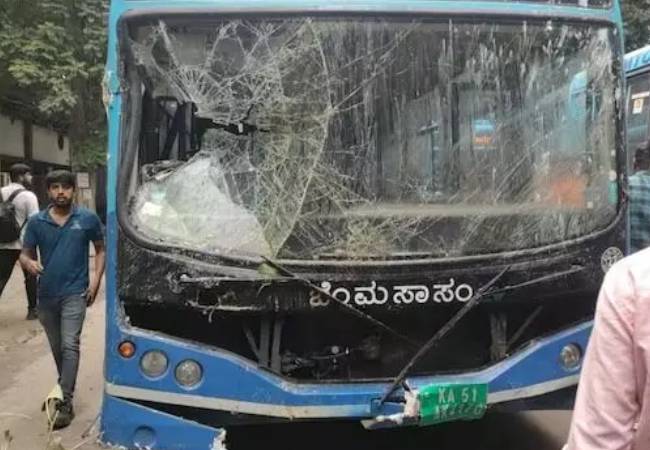
Bengaluru: The Bangalore Metropolitan Transport Corporation (BMTC) has been linked to four fatal accidents involving its buses over the past month.
According to report published by The New Indian Express on Saturday, one of the main contributing factors to these accidents is the use of electric buses, which are noted for their sudden acceleration and harsh braking systems.
Sources quoted in the report pointed out that the drivers of these buses are not appointed by BMTC, but by companies that operate those buses on Gross Cost Contract (GCC).
Nataraj Sharma, president of the Federation of Karnataka Private Transport Associations, which represents private buses, cabs, and autos, highlighted that drivers recruited directly by BMTC have to undergo rigorous tests. “But electric buses are operated by drivers who are hired by private companies. These drivers, who were operating light motor vehicles earlier, are given such big electric buses, leading to accidents,” Sharma alleged.
Another reason for the accidents is the near-noiseless movement of these buses, which makes it difficult for both vehicle users and pedestrians to detect them by sound.
After repeated complaints about the sudden acceleration and harsh braking of electric buses—problems that have led to injuries for both passengers and other road users—BMTC conducted driver workshops earlier this year. However, it appears that the workshops have not been effective in preventing such incidents, added the report.
BMTC’s Chief Traffic Manager (Operations), GT Prabhakar Reddy, defended the corporation, stating that of the four fatalities, three were not caused by the fault of BMTC drivers.
“Every time an accident happens, we analyse footage from all the CCTV cameras fitted in our buses and take action against drivers if they are at fault. But in the three cases, they were not,” TNIE quoted Reddy as saying. He also expressed frustration over BMTC drivers being blamed even when they are not at fault, adding that if everyone followed traffic rules, accidents could be prevented.
In an effort to reduce accidents, BMTC plans to conduct "refresher training" for its 12,000 drivers. The training will focus on three key areas: accident prevention, adherence to traffic rules, and stress management.
“We will play videos on how to avoid accidents. When we train drivers by showing them videos, they understand better. We have enough videos recorded by dash cams of BMTC buses, where our drivers have prevented accidents,” Reddy explained. The training will be conducted in batches of 50 drivers across seven BMTC zonal offices.
Let the Truth be known. If you read VB and like VB, please be a VB Supporter and Help us deliver the Truth to one and all.
Real Madrid fines Valverde and Tchouaméni half a million euros each for altercation

Barcelona (AP): Real Madrid slapped players Federico Valverde and Aurélien Tchouaméni with half-a-million-euro ($588,000) fines on Friday for their altercation during practice.
The massive fines came a day after the midfielders tussled when the team trained. Valverde said in a post on social media on Thursday that no punches were thrown. But Valverde knocked his head on a table and he suffered a small cut that required a brief hospital visit.
On social media, Valverde initially called it a “meaningless fight” with a teammate and said “everything has been blown out of proportion."
His employers, however, considered it a significant enough breach of team discipline to nail both Valverde and Tchouaméni with fines that bite even the bank account of a top soccer player. The half-a-million euro penalties reflect the reputational damage the club was enduring in a chaotic end to a disappointing season.
In a statement, the 15-time European champion said its disciplinary action was concluded after both players expressed to the club “their complete remorse for what happened and apologized to one another.”
Madrid added they also apologized to their teammates, the coaching staff and club supporters, as well as showing their willingness to accept whatever disciplinary action the club deemed “opportune.”
Tchouaméni was back training with Madrid on Friday, two days before they play at Barcelona in a clasico. Madrid has to win otherwise Barcelona will be crowned La Liga champion.
After being notified of the fine, he posted a public apology to the club and its fans on social media.
“What happened this week in training is unacceptable,” Tchouaméni wrote. "I say this while thinking about the example we are expected to set for young people, whether in football or at school.
“Above all, I am sorry for the image we projected of the club.”
Valverde was not at practice due to the head knock.
Both players are set to play in the World Cup next month, with Tchouaméni playing for France and Valverde for Uruguay.
Chaotic end to a poor season
===================
The run-in between the players, who for seasons have played side by side in Madrid's midfield, came after they argued this week in previous training sessions. But tempers boiled over on Thursday. Spanish media was rife with reports that the players previously disagreed over the club's decision to let coach Xabi Alonso go after just months on the job.
It was not the only altercation involving Madrid players during training this week. Álvaro Carreras confirmed he was in a “minor” incident with a teammate. Spanish media said he and fellow defender Antonio Rüdiger got into a scuffle.
Álvaro Arbeloa, the coach who was promoted from Madrid's reserve team when Alonso was fired in January, will face tough questions on what went wrong inside the changing room when he gives a press conference on Saturday ahead of the clasico at Camp Nou.
Madrid is facing a second consecutive campaign without a major trophy amid rumors in the Spanish media that club president Florentino Pérez is considering bringing back Jose Mourinho to straighten out his underperforming team.