Not accused of terrorism, no point keeping me in endless custody, D K Shivakumar tells court
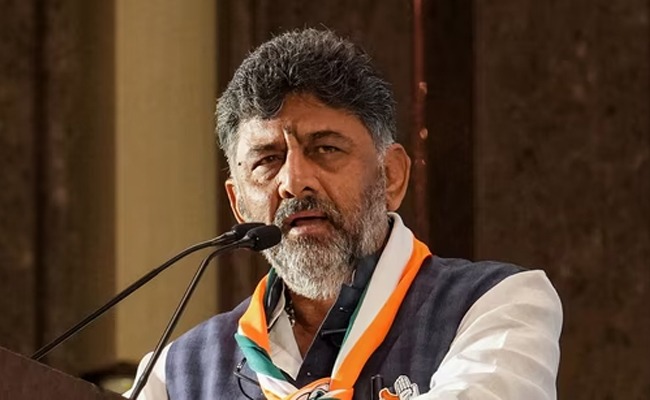
New Delhi, Sep 18: Karnataka Congress leader D K Shivakumar told a Delhi court Wednesday that there was no point keeping him in "endless custody" in the money laundering case, since he was not accused of "terrorism" or any other heinous offence.
Shivakumar's counsels, A M Singhvi and Mukul Rohatgi, told the court that he had already given information about his around Rs 800 crore property in his election affidavit and "if I (politician) gave wrong information, it can lead to prosecution".
Special judge Ajay Kumar Kuhar posted the matter for hearing on September 19 after the Enforcement Directorate's counsel, Amit Mahajan, sought an adjournment.
The agency, also represented by Special Public Prosecutors N K Matta and Nitesh Rana, told the court that Additional Solicitor General K M Nataraj was not available so the matter be posted for Thursday.
During the brief hearing, Shivakumar's counsel told the court that he had disclosed everything in his poll affidavit.
He added that out of Rs 108 crore sent to Shivakumar's daughter Aisshwarya's bank account, Rs 40 crore was loan from him, which was also shown as money laundering.
"Vokalliga community is very prominent in farming, having large amount of agricultural land. These are my family's land which I acquired hereditary. This is again shown as money laundering...
"I am not charged for heinous offences, like terrorism etc. What is point of endlessly keeping him there (custody)," Shivakumar said through his counsel.
Shivakumar was on Tuesday sent to a 14-day judicial custody till October 1.
The sitting MLA from Kanakapura assembly seat is in ED custody since his arrest on September 3.
Let the Truth be known. If you read VB and like VB, please be a VB Supporter and Help us deliver the Truth to one and all.
AIITA welcomes Karnataka’s ban on obscene songs in school events

Bhatkal: The Karnataka unit of the All India Ideal Teachers Association (AIITA) has welcomed the Karnataka government’s decision to strictly ban school children from dancing to obscene songs during educational and cultural programmes in government, aided, and private schools across the state.
AIITA Karnataka State President M. R. Manvi congratulated the government for taking what he termed an important step to preserve the sanctity of education.
“Such decisions to safeguard the dignity of school children and uphold the values of education are the need of the hour. This rule should not be limited to government schools alone but must be strictly implemented in all private educational institutions as well,” he said.
He further urged the government to address other concerns within school programmes.
“The government should not only prohibit obscene dances in the name of school anniversaries, but also ensure that plays and dialogues that incite religious hatred are avoided. Schools should be centres of harmony, not platforms for spreading hatred,” he added.
According to a recent circular issued by the Department of School Education and Literacy, obscene dances are adversely affecting the mental health and moral values of students.
In this regard, schools have been advised to use songs that promote nationalism, positive thinking, the greatness of Kannada culture, and value-based traditions instead of inappropriate content during programmes.
The circular also emphasises that students should be dressed in decent attire.
AIITA also backed the department’s warning that disciplinary action would be taken against head teachers if such guidelines are violated. The association has further demanded that district Deputy Directors of Public Instruction strictly monitor the implementation of these rules.