Not even the air that touches RSS should touch us: Priyank Kharge
Minister lashes out at the organisation soon after DCM D.K. Shivakumar sang an RSS song
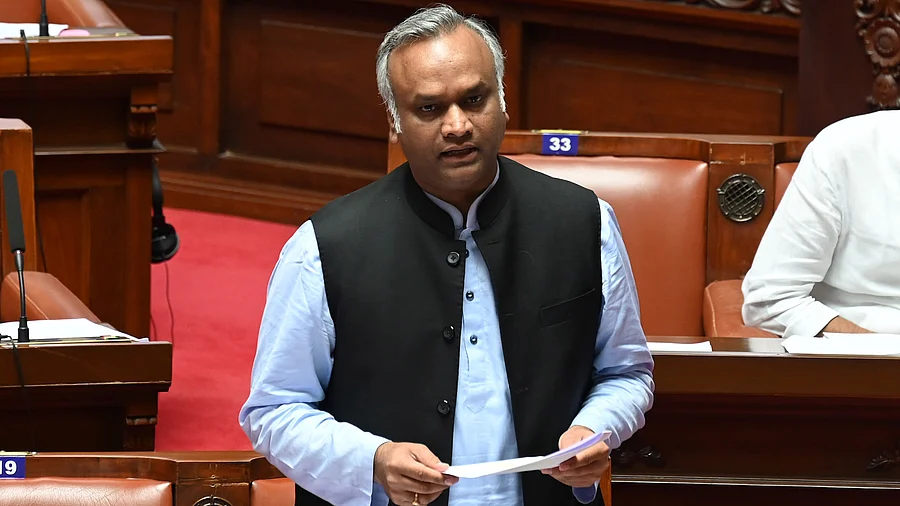
Bengaluru: Karnataka Rural Development Minister Priyank Kharge has launched a sharp attack on the Rashtriya Swayamsevak Sangh (RSS), declaring that “not even the air that touches the RSS should touch us” if India is to truly become enlightened and prosperous.
Speaking shortly after Deputy Chief Minister D.K. Shivakumar was seen singing an RSS song, Kharge accused the organisation of spreading communal hatred and upholding casteist, Manu-centric, and Nazi-like ideologies. “The Congress will always view RSS as an enemy because it is an enemy of the Constitution, of unity, of the national flag, and of the national anthem,” he asserted.
Citing warnings issued decades ago by Dr. B.R. Ambedkar and Sardar Vallabhbhai Patel, Kharge reminded that Patel had once imposed a ban on the RSS in 1948, calling it a threat to national integration. He added that despite later having the ban lifted by pledging loyalty to the Constitution and the tricolour, the organisation continued its “anti-constitutional activities.”
Kharge further challenged the BJP and Sangh Parivar to list ten positive contributions of the RSS in its hundred-year history, claiming instead that the outfit has only endangered the nation. He accused it of disrespecting the Constitution, burning its draft, dishonouring the national flag, and treating women and marginalised groups as “third-class citizens.”
“The RSS is not a helper of India but a danger to it. Every patriot must remember this,” Kharge wrote in his post on X.
Let the Truth be known. If you read VB and like VB, please be a VB Supporter and Help us deliver the Truth to one and all.
Pak police registers case against unidentified gunmen for opening fire on LeT co-founder
_vb_37.jpeg)
Lahore (PTI): Pakistan's Punjab Police on Friday registered a case against unidentified gunmen for opening fire on Lashkar-e-Taiba (LeT) co-founder Amir Hamza, who suffered bullet injuries in the attack in Lahore.
On Thursday, two unidentified gunmen riding on a bike opened fire on the vehicle of the private TV channel 24NewsHD TV, owned by Interior Minister Mohsin Naqvi, on Peco Road in Lahore near the TV channel's office.
In the attack, Hamza suffered bullet injuries.
"The FIR has been registered against unidentified gunmen, but it is sealed forthwith," a senior police officer told PTI.
He said the intelligence agencies have taken over this case from the police, and they are currently investigating the matter.
The channel's religious programme host Justice (retd.) Nazir Ahmed Ghazi and Hamza were in the vehicle when it was attacked. Hamza was shifted to a hospital for treatment.
Punjab police on Friday said that "upon receiving information about the incident, the SSP Operations immediately reached the scene and a high alert was imposed in the area. SSP Operations Tauqeer Naeem also met the affected individuals. Thankfully, all present in the vehicle remained safe during the firing."
It further said senior police officers of the Township and Chung, along with a heavy police contingent, were present at the scene.
"Police collected evidence from the site and initiated an investigation. Efforts to arrest the suspects are underway using CCTV footage and geo-fencing techniques. Search and sweep operations are being conducted at various locations, with scrutiny of suspicious individuals ongoing," police said.
It added that those involved in the incident will be traced and arrested soon.
The police sources said that Hamza has been shifted to his residence in Jauhar Town, Lahore, where police and agency personnel met him.
The leadership of the Pakistan Markazi Muslim League (PMML), a political front of Mumbai attack mastermind Hafiz Saeed's banned Jamat-ud-Dawah (JuD), including Hafiz Saeed's son Hafiz Talha Saeed, also called on him.
TV host retired Justice Ghazi, who remained unhurt in the attack, remained a legal counsel for Hafiz Saeed, they said.
The PMML has strongly condemned the attack on Hamza and demanded that those involved in the incident be arrested immediately.
Hamza is regarded as LeT's second most important leader after its chief Hafiz Saeed, who has been in Lahore's Kot Lakhpat Jail since 2019 after getting convicted for several years in terror financing cases.
Hamza has been designated as a terrorist by the US. In the past, he served as the head of LeT's "special campaigns" department.
In 2018, Hamza formed a fundraising group for the LeT following a ban on the JuD and Falah-e-Insaniat Foundation by the Pakistani government.
_vb_22.jpeg)
_vb_35.jpeg)