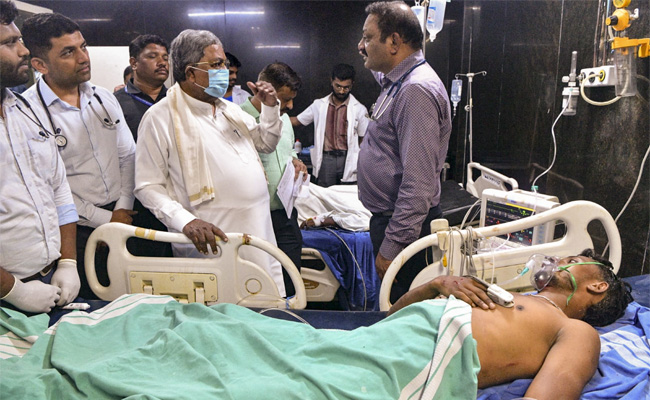
Nothing wrong if they express concerns with CM, DK Shivakumar says about letter written by MLAs
Bengaluru: Deputy Chief Minister of Karnataka, DK Shivakumar, responded to a query regarding a legislator's recent letter to the Chief Minister requesting a meeting to address issues in his and neighboring constituencies. Shivakumar questioned whether it was forbidden for a legislator to express concerns to the Chief Minister.
Speaking to the press near his residence in Sadashiv Nagar, Bengaluru, Shivakumar remarked that legislators often communicate their requests and concerns to the Chief Minister, and there was nothing wrong with this practice. He emphasized that party members were disciplined, and there was no dissatisfaction among legislators with the government. He also noted that some of these perceptions were created by the media.
Regarding private transport companies' call for a protest, citing concerns that the Karnataka government's Shakti scheme was adversely affecting their business, Shivakumar acknowledged being aware of the issue. He mentioned that private bus owners had raised concerns and submitted memoranda to him. He assured that he would discuss the matter with the Chief Minister and the Transport Minister to find a solution to the problems faced by private bus owners.
Shivakumar acknowledged that in many remote areas, the Karnataka State Road Transport Corporation (KSRTC) did not provide transportation services, leaving residents dependent on private buses. He expressed the intention to find a solution considering the severity of the problem.
Let the Truth be known. If you read VB and like VB, please be a VB Supporter and Help us deliver the Truth to one and all.
SC asks Centre to consider amending law on terminating pregnancy of rape survivors
New Delhi (PTI): The Supreme Court on Thursday took strong exception to a plea by AIIMS seeking to set aside its order allowing a 15-year-old girl to medically terminate her 30-week pregnancy, and asked the Centre to consider amending the law to permit rape survivors to terminate unwanted pregnancies even beyond 20 weeks.
The top court said when there is pregnancy due to rape, there should not be a time limit.
Law needs to be organic and in sync with evolving time, it stressed.
A bench of Chief Justice Surya Kant and Justice Joymalya Bagchi said this is a case of child rape and the survivor will have a lifelong scar and trauma if termination is not allowed.
The top court said if the mother does not have permanent disability then it should be carried out.
ALSO READ: Chlorine gas leaks at defunct water purification plant in Pune; 24 persons hospitalised
It asked AIIMS to counsel parents of the survivor over the issue and said the decision has to be of the person concerned.
"There are children for adoption. In this country we have lot of sympathies...There are deserted, abandoned children on the streets and even mafias on it. We have to look at them. This is an unwanted pregnancy of a 15-year-old child.
"This is a curative petition. Unwanted pregnancy cannot be thrusted on a person. Imagine she is a child. She should be studying now. But we want to make her a mother. Imagine the pain, the humiliation the child has suffered in this," the bench said.
Additional Solicitor General Aishwarya Bhati, appearing for AIIMS, mentioned the curative plea, and said the termination of pregnancy is not possible.
"It will be a live baby with severe deformities. Minor mother will have lifelong health issues and cannot reproduce. Minor mother will have lifelong health issues. This child can be given for adoption. It has been 30 weeks now. It is a viable life now," she said.
The top court said the decision on termination has to choice of the survivor and her parents and AIIMS may help them take an informed decision.
On April 24, a bench of Justices B V Nagarathna and Ujjal Bhuyan had allowed the girl to medically terminate her pregnancy of 30 weeks.