One Ajit Pawar will rise from this Karnataka government as well: Eshwarappa
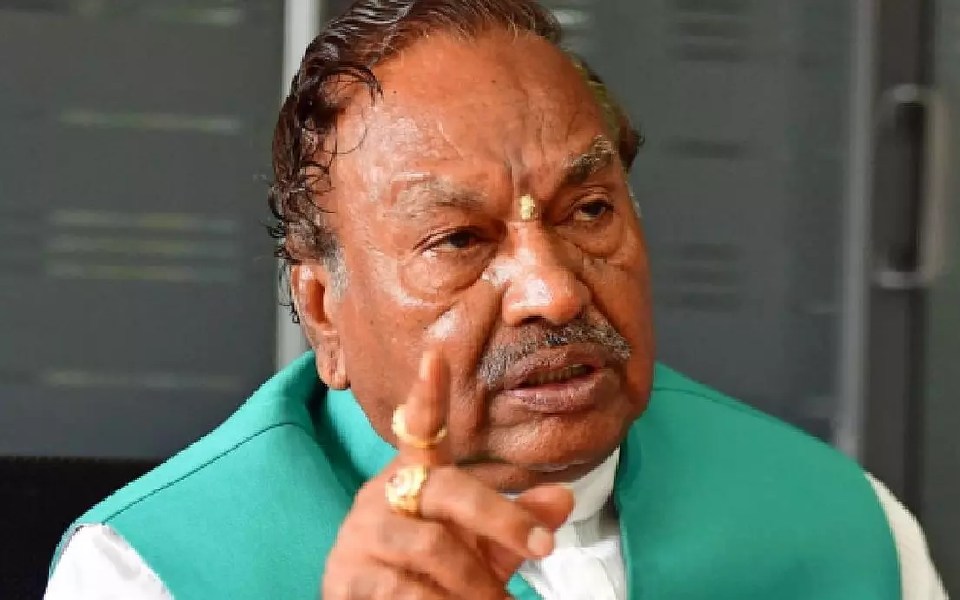
Davanagere: In a press interaction during his visit to Davanagere for MP Siddeshwar's birthday celebration, former minister KS Eshwarappa made bold predictions regarding the longevity of the current Congress government in Karnataka. Eshwarappa claimed that the government's days were numbered, comparing its fate to that of the Ajit Pawar episode in Maharashtra.
Expressing his concerns, Eshwarappa stated that the ruling government had attained power by deceiving its own party MLAs. Drawing parallels with the political turmoil witnessed in Maharashtra, he asserted that similar developments could be anticipated in Karnataka, resulting in the downfall of the current government. Eshwarappa confidently forecasted that the government would not survive beyond a mere three months, urging the public to keenly observe the unfolding events in the state.
Eshwarappa also said that the Leader of Opposition in Karnataka Assembly will be appointed soon along with the party’s state president keeping in mind the upcoming Lok Sabha elections that will be held next year. With these remarks, it is evident the selection process for the Leader of Opposition and State President roles has faced delays, leading to speculations about the party's strategic planning for the upcoming Lok Sabha elections.
Let the Truth be known. If you read VB and like VB, please be a VB Supporter and Help us deliver the Truth to one and all.
Too early to draw definitive lessons from West Asia conflict: Navy Chief Admiral Tripathi
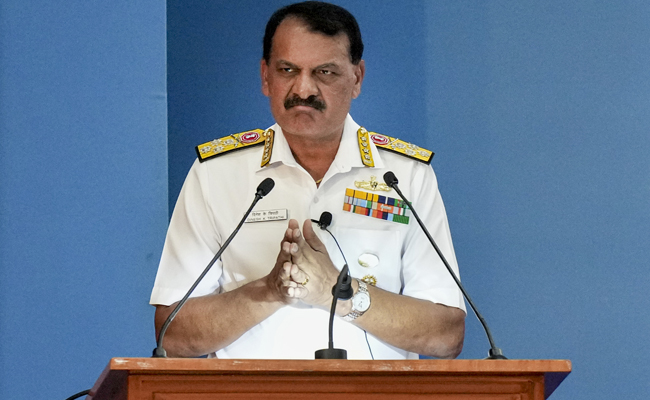
Bengaluru (PTI): Describing the West Asia war as a critical case study in modern warfare, Chief of Naval Staff Admiral Dinesh Kumar Tripathi on Thursday said it was too early to draw definitive lessons from the conflict.
Addressing the 'Ran Samvad' forum on "Maritime Forces -- Visualisation of Multi Domain Operation (MDO)", he said the Indian armed forces were closely tracking developments in the West Asia conflict to derive lessons for future operations.
"It is too early to draw definitive lessons. The war is still going on. We are monitoring what is happening, what is working, what is not working, and learning the correct lessons," Admiral Tripathi said during the question-answer session.
The Navy Chief emphasised that one of the most striking takeaways from the conflict is the heightened vulnerability of military assets across domains.
"Battle space transparency today is so high that anything visible, whether moving or stationary, is inherently vulnerable," he said.
He added that while all platforms, land, sea and space, face exposure, subsurface assets retain a relative advantage due to detection challenges.
The conflict has also underscored the importance of resilience, particularly in sustaining supply chains under prolonged hostilities.
Admiral Tripathi further noted that carrier battle groups continue to remain central to maritime power projection, demonstrating their operational effectiveness even in contested environments, while their vulnerability depends on the adversary's capabilities and the balance of offensive and defensive systems.
The Navy chief said the services are analysing the conflict "on a near 24x7 basis" and will incorporate lessons at an appropriate time, stressing that modern warfare now demands constant adaptation to rapidly evolving technological and operational realities.
Emphasising that maritime forces have always operated across multiple domains but now face a far more complex and interconnected battle-space, Admiral Tripathi said the Indian Navy is reorienting its strategy to deliver integrated multi-domain effects in an era defined by speed, scale and simultaneity.
He highlighted the need to align strategic thought with technological capability amid evolving global security challenges and rapid technological advancements.
"Today, there is no fixed system of war, no rigid doctrine that we can blindly rely upon," Admiral Tripathi said.
The Navy Chief noted that ongoing instability in India's extended neighbourhood, particularly tensions in West Asia and disruptions to maritime traffic, underline the interconnected nature of modern security.
He said distance no longer insulates nations from consequences, while technological advances are compressing decision-making timelines and merging operational domains.
Drawing from India's civilisational strategic thought, he said multi-domain operations are not entirely new, citing Kautilya's concept of integrating diplomacy, deception and force.
"The pursuit of national objectives extends beyond any single form or domain of conflict," he observed.
Explaining the evolving maritime battlespace, Tripathi described it as a "dense yet more transparent, layered yet deeply interconnected grid extending from the seabed to space".
He identified three defining attributes shaping this grid -- speed, scale and simultaneity.
On speed, he pointed to artificial intelligence-driven systems that compress decision cycles.
"Speed is no longer merely an enabler of warfare, but a distinct capability," he said, noting that modern systems can process vast datasets and enable precision strikes in significantly reduced timeframes.
At the physical level, the Navy is restructuring its force to be "capable, resilient, and inherently networked", with seamless integration between sensors and shooters across domains, he noted.
Highlighting indigenous capability, Admiral Tripathi said the Navy's combat management system has evolved into a key enabler of multi-domain operations, integrating inputs across domains for faster decision-making and coordinated engagement.