One nation-one language will never be a reality, says Jairam Ramesh in Bengaluru
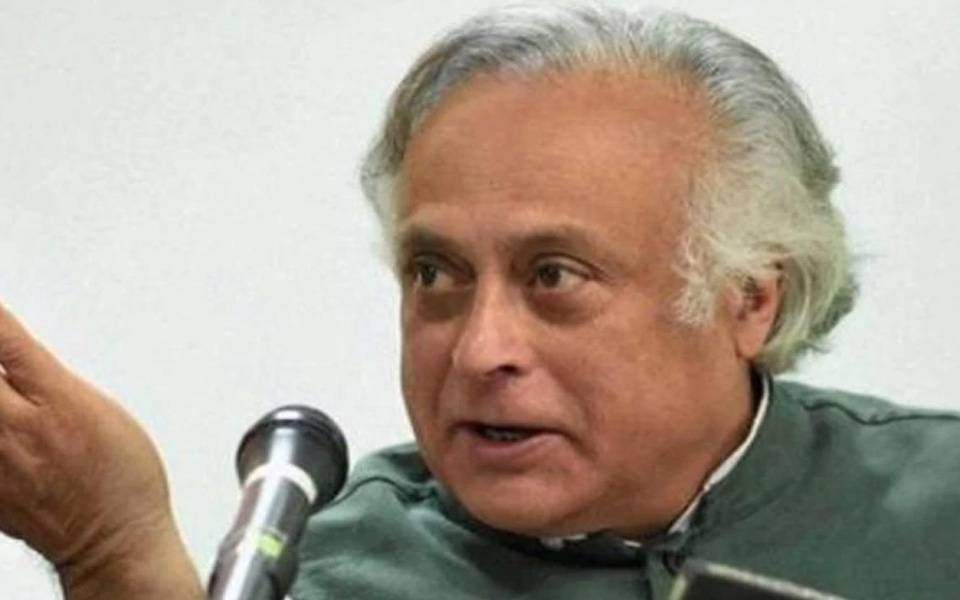
Bengaluru, Sep 15: Amid a raging debate over Hindi as a common language for the country, Congress leader Jairam Ramesh on Sunday said it would never be a reality.
The Rajya Sabha member also noted that former Prime Minister Jawaharlal Nehru was under daily attack by forces out to "denigrate and obliterate" his legacy and the very idea of India would "die" if his ideas were abandoned.
...we may have one nation-one tax, but one nation-one language will never be a reality...we are one nation- we are many languages, we are one nation- many countries," he said.
Ramesh, who began his speech by addressing the dignitaries, including the Governor and Chief Minister and the audience in English Kannada, Hindi, said "I have spoken in three languages in one minute,just to give you a message...."
"We may have one nation-one tax, one nation-one election, but under no circumstances can we have one nation-one culture, one nation-one language," he added.
Union Home Minister Amit Shah on Saturday had pitched for Hindi as a common language for the country, reigniting the debate on the issue as parties in the South said they would oppose any attempt to "impose" the language.
Congress too had cautioned against stirring up "emotive" issues "settled" by those who framed the Constitution, after Shah said that while diversity in languages is India's strength, a national language is needed so that foreign languages and cultures do not overpower the country's own.
Ramesh was delivering the Sir M Visvesvaraya memorial lecture- "A Prime Minister and an Engineer" at an event organized by the Federation of Karnataka Chamber of Commerce and Industry to commemorate the birth anniversary of its founder Visvesvaraya, who was also the Diwan of Mysore state.
Listing out various accounts related to Nehru and Visvesvaraya, Ramesh said he was a perfect model of intellectual integrity and financial probity, both values that are endangered today.
"Today we recall this remarkable man as an annual ritual.
How much our country would gain if we were to follow his example the other 364 days as well," he said.
Ramesh said Nehru, the architect of the modern Indian nation state, had anchored in an open, liberal, representative democracy, secularism, a celebration of diversities amidst unity, scientific temper and planned economic development, all of which was now under 'daily attack' by forces out to 'denigrate and obliterate" his legacy.
"As an unabashed but not uncritical admirer of his, I must say that the very idea of India will die if we abandon the ideas of Nehru.
Recognizing his contributions and standing up for the causes he championed would be the best tribute we would be paying to Visvesvaraya himself," he added.
Karnataka Governor Vajubhai Vala and Chief Minister B S Yediyurappa were present at the event, where Advaith Hyundai Director Dr S V S Subramanya Gupta was conferred with the Bharat Ratna Sir M Visvesvaraya memorial award, 2019.
Referring to Gupta's request to the Chief Minister for better infrastructure in Bengaluru, Ramesh mocked at Deputy Chief Minister Govind Karjola’s recent comment that good roads were responsible for accidents, without taking his name.
"There are some people who think that good roads in Bengaluru lead to more deaths," he said.
Amid calls that the government should first improve road infrastructure before imposing hefty fines for traffic violations, Karjol had recently said good roads were responsible for accidents.
Let the Truth be known. If you read VB and like VB, please be a VB Supporter and Help us deliver the Truth to one and all.
AIITA welcomes Karnataka’s ban on obscene songs in school events
Bhatkal: The Karnataka unit of the All India Ideal Teachers Association (AIITA) has welcomed the Karnataka government’s decision to strictly ban school children from dancing to obscene songs during educational and cultural programmes in government, aided, and private schools across the state.
AIITA Karnataka State President M. R. Manvi congratulated the government for taking what he termed an important step to preserve the sanctity of education.
“Such decisions to safeguard the dignity of school children and uphold the values of education are the need of the hour. This rule should not be limited to government schools alone but must be strictly implemented in all private educational institutions as well,” he said.
He further urged the government to address other concerns within school programmes.
“The government should not only prohibit obscene dances in the name of school anniversaries, but also ensure that plays and dialogues that incite religious hatred are avoided. Schools should be centres of harmony, not platforms for spreading hatred,” he added.
According to a recent circular issued by the Department of School Education and Literacy, obscene dances are adversely affecting the mental health and moral values of students.
In this regard, schools have been advised to use songs that promote nationalism, positive thinking, the greatness of Kannada culture, and value-based traditions instead of inappropriate content during programmes.
The circular also emphasises that students should be dressed in decent attire.
AIITA also backed the department’s warning that disciplinary action would be taken against head teachers if such guidelines are violated. The association has further demanded that district Deputy Directors of Public Instruction strictly monitor the implementation of these rules.