Padma Bhushan winning Kannada writer SL Bhyrappa dies of age-related health issues
_vb_64.jpeg)
Bengaluru (PTI): Popular Kannada novelist and philosopher S L Bhyrappa died due to cardiac arrest at a private hospital here on Wednesday. He was 94 and is survived by his wife and two sons.
"The legendary Indian novelist, philosopher, Padma Shri, Padmabhushana, and Saraswathi Samman awardee Shri S L Bhyrappa suffered a cardiac arrest today at 2.38 pm and reached the lotus feet of the Almighty. Om Shanti !!!," Rashtrotthana Hospital said in a statement.
According to sources, Bhyrappa's body would be kept at Ravindra Kalakshetra in Bengaluru for people to pay their last respects on September 25, and his cremation is likely to be held on September 26 in Mysuru, where he lived for many years.
Expressing grief over Bhyrappa's demise, the Karnataka government has decided to perform his last rites with full state honours.
Prime Minister Narendra Modi mourned the death of Bhyrappa and described him as a "towering stalwart" who stirred people's conscience and delved deep into the soul of India.
"In the passing of Shri S L Bhyrappa Ji, we have lost a towering stalwart who stirred our conscience and delved deep into the soul of India. A fearless and timeless thinker, he profoundly enriched Kannada literature with his thought-provoking works. His writings inspired generations to reflect, question, and engage more deeply with society," Modi said.
"His unwavering passion for our history and culture will continue to inspire minds for years to come. My thoughts are with his family and admirers in this sad hour. Om Shanti," he said.
Bhyrappa has been the bestselling novelist for over 25 years now. His novels are widely translated to English and pan Indian languages.
He is known for depicting fundamental human emotions in his works, along with sharing his knowledge on Indian philosophical and cultural traditions.
Bhyrappa has penned about 25 novels and four volumes of literary criticism and books on aesthetics, social issues, and culture, among others. He is known for his popular novels 'Vamshavriksha', 'Daatu', 'Parva', and 'Mandara', among others.
He was a recipient of Padma Bhushan, Padma Shri, Saraswati Samman, Sahitya Akademi Award,s among other honours.
His works like 'Naayi-Neralu', 'Matadana', 'Vamshavriksha', 'Tabbaliyu Neenaade Magane', have been adapted into films.
Bhyrappa's autobiography is titled Bhitti (Canvas).
Born in Santeshivara, a village in the Channarayapatna taluk of Hassan district on August 20, 1931, Bhyrappa held an MA in Philosophy and a PhD in Aesthetics. He served as a Professor of Philosophy for over three decades at NCERT.
Bhyrappa is often regarded as a "right-wing writer" with pro-Hindutva leanings, particularly for his novel 'Avarana', which deals with the themes of Islamic invasion of India and religious conversion.
Expressing grief, Chief Minister Siddaramaiah in a post on 'X' said, "The literary world has been left poorer by the death of Bhyrappa, who had a huge readership due to his writing style." JDS supremo H D Deve Gowda said, "Bhyrappa's passing away is an irreparable loss to the Kannada literary world, as he gave the world excellent novels and touched the hearts of millions of readers." Union Minister H D Kumaraswamy said, the death of Bhyrappa, who transformed the very way of perceiving and reading the Mahabharata and Ramayana through his novels, Parva and Uttarakanda, has come as a "profound shock".
Deputy CM D K Shivakumar, former CM B S Yediyurappa, Leader of Opposition in Assembly R Ashoka, state BJP President B Y Vijayendra, among others condoled the death.
Writer and Rajya Sabha MP Sudha Murty and her husband Infosys founder N R Narayana Murthy were among those who visited the hospital to pay last respects to Bhyrappa.
"We have lost a literary stalwart. His contribution to Kannada literary work is immense," Sudha Murty told reporters.
Let the Truth be known. If you read VB and like VB, please be a VB Supporter and Help us deliver the Truth to one and all.
DMK seeks separate seating in Lok Sabha after split with Congress alliance
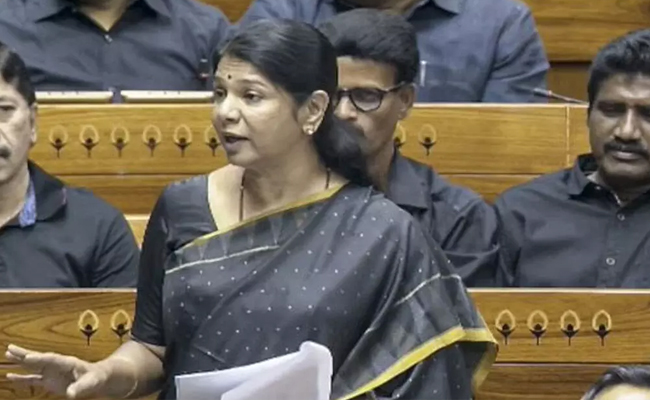
New Delhi: Kanimozhi Karunanidhi has written to the Lok Sabha Speaker seeking a separate seating arrangement for Members of Parliament belonging to the Dravida Munnetra Kazhagam (DMK) following the end of the party’s alliance with the Indian National Congress.
In a letter dated May 7 addressed to the Speaker of the Lok Sabha, Kanimozhi said the changed political situation made it inappropriate for DMK MPs to continue sitting alongside Congress members in the House.
She requested the Speaker to make “suitable changes” in the seating arrangement of the DMK Parliamentary Party and allot separate seating for its MPs.
“In view of the changed political circumstances and as our alliance with the Indian National Congress has come to an end, it may not be appropriate for our Members to continue occupying the present seating arrangement alongside them in the House,” the letter stated.
Kanimozhi further said separate seating would help DMK members effectively discharge their responsibilities in the Lok Sabha.