Party leadership will decide on who will play what role in Rajasthan: Sachin Pilot
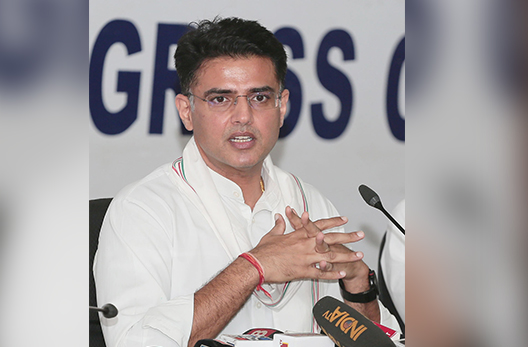
Bengaluru, Sep 1: Former Rajasthan Deputy Chief Minister and Congress leader Sachin Pilot on Wednesday said the party leadership will take a decision on who-will-play-what-role in the future, amid speculation about Cabinet expansion in that state and possible induction of him and his loyalists into the Ministry.
He said he is in touch with the Congress high command over party issues raised by him and hoped that required steps will be taken by the top leadership.
Pilot and 18 other MLAs had rebelled against the leadership of Chief Minister Ashok Gehlot last year. After a month-long crisis, the Congress high command had formed a committee to look into the issues raised by them.
"It's been a year since a committee was formed.....I think the party and the government need to work together to make sure that in 2023 when elections come again we fulfill all our promises made in the manifesto to make sure we come back with a bigger majority," he said in response to a question.
Speaking to reporters here, he said he doesn't want to speculate on reports about him being made Congress in-charge for Gujarat or the next Chief Minister of Rajasthan.
"Who becomes what, who takes over what position, who is Minister, who is party president or the Chief Minister, that decision is taken by the party leadership in Delhi," he added.
Pilot had recently raked up the issue of non-resolution of commitments made to him, and leaders close to him had said they were losing patience over the long wait for getting their due. They had also claimed they were being "pressured" by Chief Minister Gehlot to leave their leader's side.
To a question on whether issues raised by him have been resolved, Pilot said there was a committee formed last year for this, but unfortunately senior leader Ahmed Patel, who was part of it, died, but the other two members and AICC are in constant touch with him.
Stating that Rajasthan is a "strong Congress state" and there are some views he needed to share, he said the Congress president took cognisance of those views and formed a committee, and "we are working towards achieving things".
"I think it is important to share views and thoughts on how we can have a better functioning government where every party worker feels he is a stakeholder in the setup....so those issues (raised by him) are being worked out," he added.
To a question on cabinet expansion in Rajasthan, and about it being postponed repeatedly, Pilot said as far as he knows, AICC and the Chief Minister are discussing it. "As and when we have news on whatever will happen, it will be known." On reports that the Congress high command has given the go ahead for cabinet expansion, he said he is not aware of it and that the party general secretary in-charge of Rajasthan Ajay Maken has held many rounds of consultations with MLAs and leaders.
Asked about factionalism in his party in various states, the former Union Minister said "It is only the Congress party that can challenge and overtake the BJP in general elections. In our party, unlike some other parties, there is room for discussions; of course sometimes discussions are not as pleasant as one would like it to be, but ultimately the voice of the party worker, voice of the state leader, national leader is heard and we come out with a unanimous decision," he said.
Responding to a question on difference of opinion between Congress leader Rahul Gandhi and party's Chief Minister in Punjab Captain Amarinder Singh on revamped Jallianwala Bagh, Pilot said "just because some statements have come, you can't put those two in context, everyone you speak to have an opinion, but ultimately what the AICC says and does is the view of the party."


Let the Truth be known. If you read VB and like VB, please be a VB Supporter and Help us deliver the Truth to one and all.
Allahabad HC orders probe into 'reinstatement' of teacher in UP's Barabanki
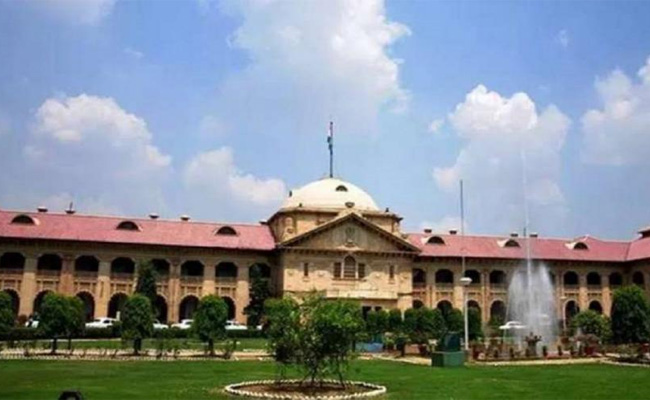
Lucknow (PTI): The Lucknow Bench of the Allahabad High Court on Friday ordered a probe by the special task force (STF) into alleged irregularities in the rejoining of a teacher at City Intermediate College in Barabanki, observing that the reinstatement appeared to be prima facie illegal.
The court also directed the recovery of the salary paid to the teacher during the disputed period.
A bench of Justice Rajeev Singh passed the order on a petition filed by the college management committee. The court expressed doubts over the roles of the District Inspector of Schools (DIOS), Barabanki, the college principal and the teacher concerned and hence, directed a detailed inquiry into the matter.
Taking note of alleged manipulation of records and misleading submissions, the court ordered the immediate transfer of the Barabanki DIOS to ensure a fair probe. It also directed the initiation of disciplinary proceedings against the then joint director of education of the Ayodhya division.
In its order, the court found that the teacher, Abhay Kumar, was initially appointed as an assistant teacher in 2018 but joined an Eklavya Model Residential School in Chhattisgarh as a lecturer in June 2024 without obtaining permission from the management. His subsequent request to retain the lien was rejected.
Despite this, he was allowed to rejoin the Barabanki College in September 2025 on the directions of the joint director of education and the DIOS, and was even paid the salary for October 2025. The court termed the rejoining "wholly illegal" and lacking any legal basis.
The bench also expressed concern over lapses in communication within the education department and directed the Uttar Pradesh chief secretary to ensure that official orders are communicated through email and WhatsApp as well, to prevent disputes.
The matter is next listed for hearing on May 28 when a compliance report is sought.