
PM Modi holds road-show in poll-bound Karnataka
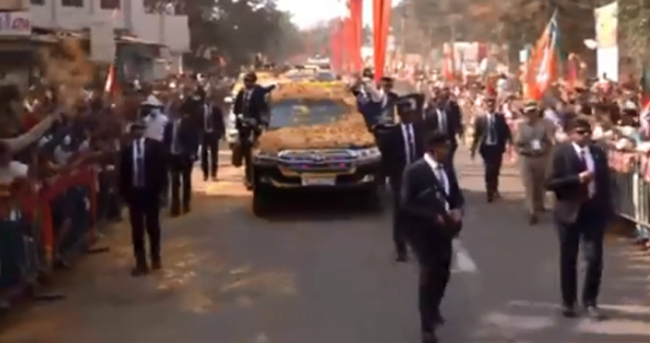
Belagavi, Feb 27: With Assembly polls in Karnataka round the corner, Prime Minister Narendra Modi on Monday held a massive road show in this district headquarters city, waving at a large number of enthusiastic crowd, who had lined up on both sides of the route.
The Prime Minister is in the city to lay the foundation stone and dedicate multiple development initiatives, and also to release the 13th instalment of PM-KISAN worth more than Rs 16,800 crores. Under the Pradhan Mantri Kisan Samman Nidhi scheme launched by the Centre in 2019, all landholding farmer families in the country are provided income support of Rs 6,000 in three instalments of Rs 2,000 each, every four months.
About 10.5-km-long road show route to Malini City (venue of the stage event) was decked up with saffron hues,as BJP flags, posters and banners were seen all along.
Standing on the 'running board' of his moving car, Modi greeted by waving at the crowd gathered on the sides of the roads and on nearby buildings, many of whom were seen chanting 'Modi, Modi' slogans and shouting loud cheers.
At many places, people showered flower petals as his cavalcade passed through the stretch slowly.
Over 10,000 women clad in saree and saffron peta (traditional headgear) accorded a 'purnakumbha' (ceremonial) welcome to Modi, party sources said.
There were also a number of stage shows, some also equipped with LEDs, put up along the route, depicting the culture and traditions of various regions of the country and historic personalities, also programmes of the BJP government, they said.
Karnataka, a BJP governed state, goes to Assembly polls by May.
After Bengaluru Urban with 27 Assembly segments (28 including Anekal), Belagavi, bordering Maharashtra, is the second biggest district in the State with 18 seats.
In 2018, BJP won 13 seats in Belagavi, and emerged as the single largest party with 105 seats in the State.
#WATCH | Prime Minister Narendra Modi holds a roadshow in Belagavi, Karnataka.
— ANI (@ANI) February 27, 2023
(Source: DD News) pic.twitter.com/3VP9OuhPFo
Let the Truth be known. If you read VB and like VB, please be a VB Supporter and Help us deliver the Truth to one and all.
Talks with Iran ended after 21 hours without reaching agreement, says US Vice President Vance
_vb_41.jpeg)
Islamabad (PTI): US Vice President JD Vance said on Sunday that the Islamabad Talks with Iran failed as the two sides could not bridge the gulf of differences despite hectic efforts spreading more than 21 hours.
Vance addressed a press conference here after “substantive discussions” in direct talks between the two sides -- the first since 1979 at this level --mediated by Pakistan.
“We have been at it now for 21 hours, and we have had a number of substantive discussions, that’s the good news,” Vance said.
“The bad news is that we have not reached an agreement,” he added.
“We have made very clear what our red lines are, what things we are willing to accommodate them on and what things we are not,” the US vice president said, adding that the Iranian delegation had “chosen not to accept our terms”.
He was asked to elaborate the main sticking points of what did the Iranians reject but he refused to go into specifics.
“I won’t go into all the details because I don’t want to negotiate in public after we negotiated for 21 hours in private. But the simple fact is that we need to see an affirmative commitment that they will not seek a nuclear weapon and that they will not seek the tools that would enable them to quickly achieve a nuclear weapon,” Vance said
He said stopping Iran from getting a "nuke" was the “core goal of the US president, and that’s what we have tried to achieve through these negotiations”.
Vance also praised Pakistan Prime Minister Shehbaz Sharif and Chief of Army Staff Field Marshal Asim Munir, terming them “incredible hosts”.
“Whatever shortcomings were in the negotiations were not because of Pakistanis, who did an amazing job and really tried to help us and the Iranians bridge the gap and get to a deal,” he said.
Separately, the spokesperson for Iran’s Ministry of Foreign Affairs, Esmaeil Baqaei, in an X message also confirmed that the two sides failed to make a deal and “numerous messages and texts have been exchanged between the two sides".
“In the past 24 hours, discussions were held on various dimensions of the main negotiation topics, including the Strait of Hormuz, the nuclear issue, war reparations, lifting of sanctions, and the complete end to the war against Iran and in the region,” he wrote.
“The success of this diplomatic process depends on the seriousness and good faith of the opposing side, refraining from excessive demands and unlawful requests, and the acceptance of Iran’s legitimate rights and interests.”
Baqaei also expressed appreciation to the “government and the warm-hearted and noble people of the Islamic Republic of Pakistan for hosting the negotiations and their benevolent efforts in advancing this process”.
_vb_48.jpeg)

_vb_17.jpeg)