Politically-influential Lingayats in Karnataka call 'caste census' unscientific, demand fresh survey
Bengaluru, Nov 9: After Vokkaligas, now Lingayats, the other dominant community in Karnataka, too on Thursday expressed disapproval of the Socio-Economic and Education Survey, popularly known as the 'caste census', calling it unscientific, and demanded a fresh survey.
The decision was taken at a meeting of the All India Veerashaiva Mahasabha, which is the apex body of Veerashaiva Lingayats.
In 2015, the then Siddaramaiah-led Congress government had commissioned the Socio-Economic and Education Survey at an estimated cost of Rs 170 crore in the state, the findings of which have not been made public yet.
The state Backward Classes Commission under its then chairperson H Kantharaj was tasked with preparing the caste census report.
After the Bihar government released findings of its caste survey recently, pressure is now mounting on the Siddaramaiah government, from certain sections, to make public the state's Socio-Economic and Education Survey. The Karnataka chief minister had recently said a decision would be taken once he receives the report -- which is expected later this month.
However, with the strong disapproval of two dominant communities, the issue may turn out to be a political hot potato for the Congress government, as it may set the stage for a confrontation, with Dalits and OBCs among others demanding for it to be made public.
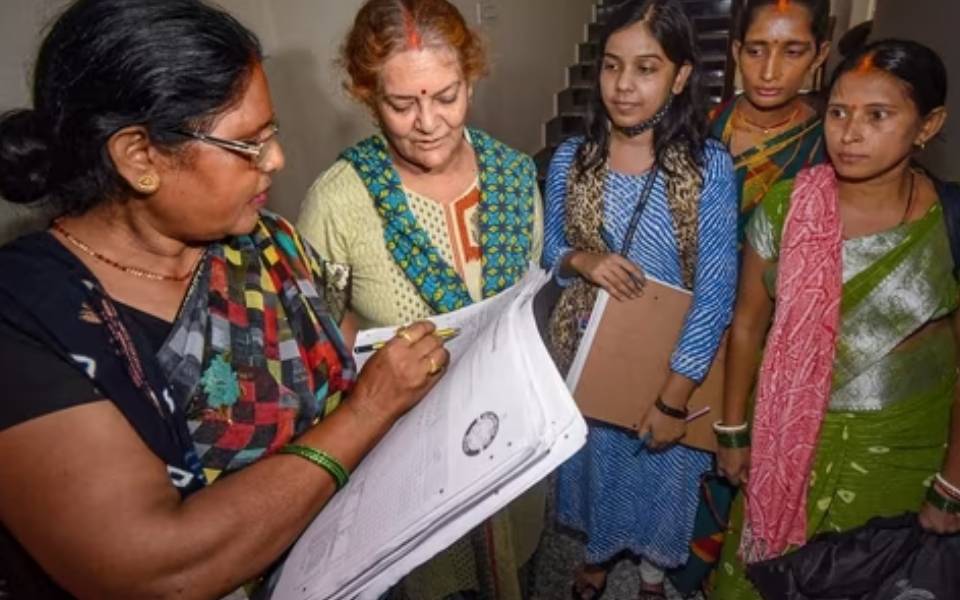
"No we are not happy, it is not scientific. It was done sitting here; they had not visited houses. It was done eight years ago. So, our opinion is that it should be done once again scientifically," Mahasabha President Shamanuru Shivashankarappa, who is a veteran Congress leader and MLA, said.
Speaking to reporters here, he said there are complaints that those who conducted the survey did not visit houses to collect the data. He also shared the community's concern stating, "There are reports that Lingayat population has been shown as smaller in the survey."
"So, using modern technology, a fresh census (survey) has to be done. This is our opinion," he said, adding that Lingayats are not opposed to the caste census, but want it to be scientific.
Last week, Vokkaliga leaders at a meeting that was also attended by Deputy CM D K Shivakumar and seers from the community, had passed a resolution urging the government to "reject" the caste census.
However, federations representing Dalits, tribal people and other backward classes (OBC) on Wednesday demanded that the findings of the caste census, kept under wraps, be made public.
Accusing both the dominant communities of trying to block the caste census from coming out, leaders of the Karnataka State Backward Castes Federation and the Karnataka Marginalised Communities Federation threatened to hold agitations.
To a question about some persons claiming that this is not a caste census, Shivashankarappa said, "Yes, it is a Socio-Economic and Education Survey; it is not the caste census. So let the new caste census be done."
Asked if there will be joint agitation, with Vokkaligas too disapproving of the survey, he said, "Let's see...we will decide about the agitation in the future."
When it was pointed out that the government would get the survey report from the Karnataka State Commission for Backward Classes this month, the Lingayat leader said, "Let them get the report...but it should not be accepted or revealed."
Karnataka State Commission for Backward Classes Chairperson K Jayaprakash Hegde last month said he would submit the caste census report to the state government in November.
According to some analysts, successive governments have been shying away from releasing it as the findings of the survey are allegedly contrary to the "traditional perception" of the numerical strength of various castes in Karnataka, especially the dominant Lingayats and Vokkaligas, making it a political hot potato.
Political parties in the state have indulged in a blame game for not accepting the survey and not making it public.
Officials have also cited the then member-secretary of the State Commission for Backward Classes not signing the final report as the technical hurdle that has hindered the release of the report.
They said the caste census report is currently with the Karnataka State Commission for Backward Classes, and once it submits it, the cabinet would take a call.
Let the Truth be known. If you read VB and like VB, please be a VB Supporter and Help us deliver the Truth to one and all.
Maharashtra sets up state vaccination task force to strengthen immunisation programme

Mumbai (PTI): The Maharashtra government has set up a State Vaccination Task Force to strengthen the regular immunisation programme and review the progress of related campaigns, a health department official said on Monday.
The State Vaccination Task Force will comprise at least 29 members and will be headed by the administrative head of the health department, he informed.
The government has also constituted separate district-level and municipal vaccination task forces to improve implementation and address challenges at the grassroots level, he said.
Municipal task forces, chaired by respective civic commissioners, have been constituted in view of the vast urban population in Maharashtra and the role of civic bodies in implementing different health programmes.
The district-level task forces will function under the chairmanship of collectors.
"Complete immunisation of children at the appropriate age is an extremely simple, cost-effective and highly effective measure to reduce child mortality and the prevalence of diseases among kids. Immunisation is a powerful tool for reducing illness in children," maintained the official.
To ensure full vaccination of all children, the state government implements various campaigns from time to time as per the central government guidelines, he pointed out.
"Active participation and cooperation of other relevant government departments are essential (in making these campaigns successful)," according to the official.
The state-level body will review the regular immunisation programme, associated campaigns and vaccine-preventable diseases in detail. It will also conduct focused assessments of high-risk districts and municipal corporations, including vacancies at district, municipal and sub-district levels, availability of cold chain equipment, resource gaps and training requirements, he noted.
The state task force will review allocation and utilisation of funds for immunisation and ensure timely action by officers concerned based on reports from district and municipal task forces and state-level monitoring mechanisms, the official said.
It will also ensure active coordination and participation of other government departments in immunisation drives, while district and municipal task forces will carry out similar functions at their respective levels, the official added.