Potholes on Bengaluru's arterial roads to be filled in next 10 days: Minister R Ashoka
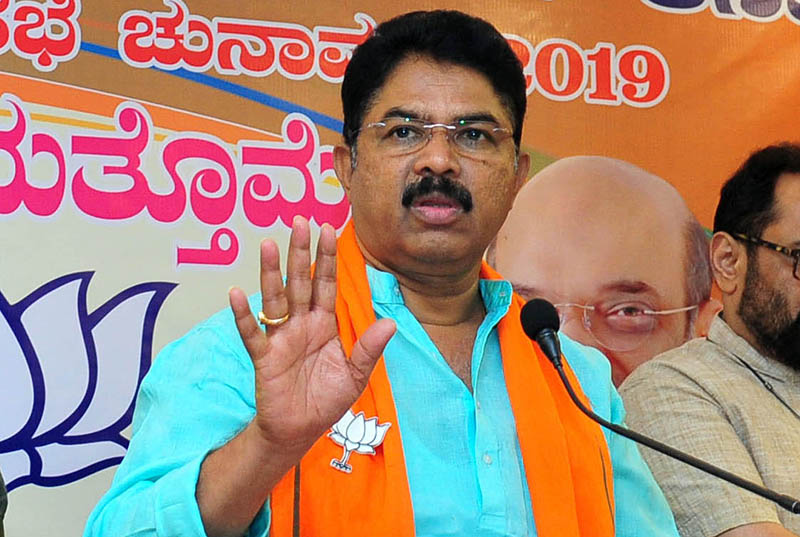
Bengaluru, Sep 30: Karnataka Revenue Minister R Ashoka on Thursday said potholes on the city's arterial roads will be filled in the next 10 days.
The Minister today held a meeting with Bruhat Bengaluru Mahanagara Palike (BBMP) officials on filling potholes under its limits.
"Earlier, I had set a deadline of September 30 to fill all the potholes. In fact, I had personally visited many sites. The plant which supplies hot mix used to supply 16 loads every day. Officials have told me that due to heavy rainfall, the supply was disrupted for 12 days. As a result, the potholes could not be fixed on time," Ashoka said.
Noting that so far, potholes have been filled in 246 km of major roads, he said overall, there are 13,874 kilometre roads in BBMP limits. Of this, 1,344 kilometre roads are categorised as arterial and sub-arterial roads.
"Of them, 895 kilometres are in good condition while 449 kilometres of road have been partially damaged. I have asked the officials to fill the potholes on all the major roads within 10 days. To increase the hot mix supply, we have instructed the officials to ensure 30 loads every day," he added.
"Currently, we are getting supply from only one agency and we will look for another agency as well." The Minister said for the other roads, local contractors will be used to fill the potholes in the next 20 to 25 days.
In 110 villages, Bangalore Water Supply and Sewerage Board (BWSSB) is laying pipe and sewage lines. "The State government has released Rs 1,000 crore to asphalt the roads for which tenders have been called. These roads will be repaired in the next 20 to 30 days. We will also blacklist contractors if there is poor quality of road works."
Ashoka also said that BBMP had already conducted a survey and identified 185 buildings as dilapidated which need to be demolished.
"So far, 10 such buildings have been razed. Now, I have asked the BBMP to issue notices and demolish the remaining dilapidated buildings. We will ask the Bangalore Electric Supply Co (BESCOM) to disconnect power connection to such buildings and the buildings will be razed with the help of police," he said.
Further stating that he has asked BBMP to conduct a fresh survey, he said, "I have also asked officials not to permit construction of buildings by digging up land deep without a safety wall as it will endanger the neighbouring buildings as well. If the corporation personnel demolish the building, then the building owner has to cough up the money which will be added to his property tax."
He requested the public to inform the BBMP if they have any knowledge of dilapidated buildings.
Let the Truth be known. If you read VB and like VB, please be a VB Supporter and Help us deliver the Truth to one and all.
Union government assumes full control over TV ratings, TRAI role curtailed: Report

New Delhi: The Union government has assumed full control over television audience measurement, removing the Telecom Regulatory Authority of India (TRAI) from oversight of the ratings system that underpins the country’s ₹36,000 crore television advertising market, according to a report published on Wednesday.
The report in Mint said the Ministry of Information and Broadcasting (MIB) now has exclusive authority over the framework governing how television ratings are measured and regulated. TRAI had been entrusted with oversight of TV ratings in 2012 during the UPA government’s tenure. TRAI is no longer mentioned in the relevant policy document, effectively vesting sole authority in the MIB.
The report said TRAI will continue to regulate other aspects of broadcasting, including channel pricing, advertising caps, interconnection and distribution norms, service quality and compliance standards. Its role in determining how ratings agencies track viewing behaviour has been withdrawn.
Television Rating Points (TRPs), which reflect viewership patterns, guide advertisers in deciding where to allocate spending across channels and time slots.
A government source quoted in the report said the ministry could modify TRAI’s decisions even when the regulator oversaw broadcasting.
A former CEO of Prasar Bharati told the newspaper that the MIB has historically regulated rating agencies through licensing and guidelines, and by holding them accountable under existing norms.
During its tenure overseeing ratings, TRAI had taken decisions affecting the broadcast sector, which included capping advertising time at 12 minutes per hour following complaints about excessive commercial breaks and it now remains unclear how these matters will be addressed under the revised arrangement.
Satya N. Gupta, former principal advisor at TRAI, was quoted as saying that merging regulatory functions with policy oversight and removing an independent regulator from the process was a retrograde step.
TRAI’s involvement in broadcasting had earlier attracted criticism as well. In 2012, its consultation paper on quantitative limits on television advertising was viewed by some as overlapping with the Advertising Standards Council of India’s code. Subsequent recommendations covering television audience measurement, ownership of news channels and issues such as paid news had also raised concerns among sections of the industry.
Television ratings have faced scrutiny in recent years, including during the controversy involving the Broadcast Audience Research Council (BARC), where officials of the ratings body were prosecuted over allegations of manipulation of viewership data.