Prevention of Love Jihad does not require special law: Home Minister Araga Jnanendra
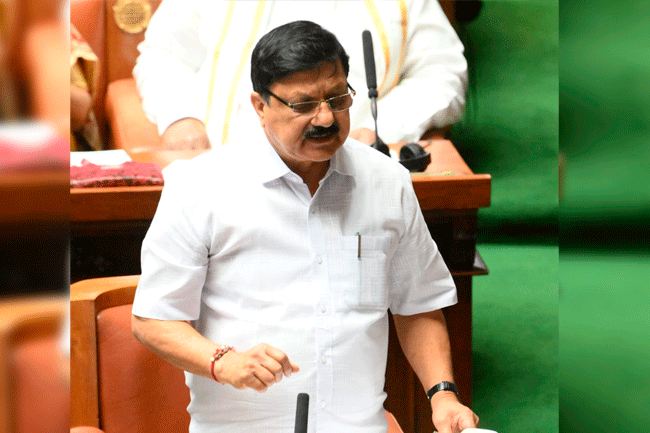
Chitradurga: In the background of demands by Hindutva groups to formulate new laws against Love Jihad, Home Minister Araga Jnanendra said that the anti-conversion law consisted of sections that additionally aimed to prevent ‘Love Jihad’. Therefore, a special law to prevent it is not required, he informed.
On Wednesday, the Minister was responding to questions from the media regarding certain sections of Sangh Parivar’s demand for a new law against Love Jihad. Concerning this, Araga Jnanendra said, “There is no need to formulate specific laws and create a special task to prevent Love Jihad in the state”, he clarified.
“The anti-conversion law currently enforced in the state consists of sections against this. Therefore, the requirement for a specific law or task force in this regard does not arise. Despite this, we will scrutinize this subject”, he said.
Let the Truth be known. If you read VB and like VB, please be a VB Supporter and Help us deliver the Truth to one and all.
NIA court to complete framing of charges against 2010 hand-chopping case accused on May 15

Kochi (PTI): A special court here will complete proceedings for framing charges against the prime accused in the 2010 hand-chopping case involving professor T J Joseph, in which PFI activists were accused of attacking him at Muvattupuzha.
Ernakulam Special Court for NIA cases judge P K Mohandas, on April 30, heard the arguments of counsel for accused Savad and Shafeer C and decided to proceed with framing charges against the duo.
A group chopped off Thodupuzha Newman College professor Joseph's right hand in July 2010, accusing him of religious blasphemy in a question paper he had prepared.
The case, later taken over by the National Investigation Agency (NIA), resulted in the conviction of 19 accused.
The first accused, Savad, who allegedly chopped off Joseph’s palm, was arrested in Berram in Mattannur, Kannur, in January 2024, where he had allegedly been hiding under the pseudonym Shajahan.
The NIA also arrested Shafeer, who allegedly arranged shelter and provided logistical support to Savad at Chakkad and Mattannur in Kannur since 2020.
On April 30, the court heard the counsel for the accused and the NIA prosecutor on framing charges against the duo.
"On going through the documents and evidence in the case and on hearing the counsel for the accused and the prosecutor, I am of the opinion that there are grounds for presuming that the first accused has committed offences punishable under provisions of the IPC, the Explosive Substances Act and the Unlawful Activities (Prevention) Act, and that the second accused has committed offences punishable under the IPC and the UAPA, and there are materials for framing charges under these provisions against the accused," the court said.
The court directed that Savad be produced and Shafeer, who is on bail, appear before it on May 15 for recording their pleas as part of the charge-framing process.
After framing the charges, the court will schedule the trial in the case.