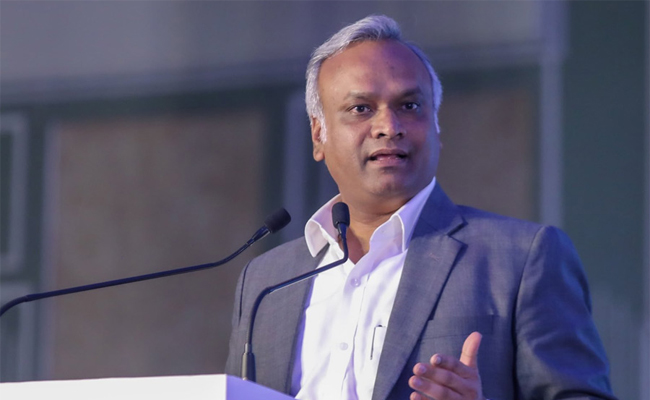
Bengaluru (PTI): Karnataka Minister Priyank Kharge has urged Chief Minister Siddaramaiah to impose a ban on all RSS activities in government institutions and public premises across the state, stating that such actions are contrary to India’s unity and the spirit of the Constitution.
In a letter to the Chief Minister dated October 4, Kharge — son of Congress president Mallikarjun Kharge — alleged that the Rashtriya Swayamsevak Sangh has been conducting its 'shakhas' in government and government-aided schools, as well as on public grounds, where "slogans are shouted and negative ideas are instilled in the minds of children and youth."
The CMO shared the letter with the media on Sunday.
Priyank said the RSS’s belief system "was contrary to India's ideals of unity and secular framework."
"When divisive forces that sow hatred among the people raise their heads, our Constitution, founded on the core principles of integrity, equality, and unity, grants us the authority to curb such elements and uphold the secular values of the nation," the minister wrote.
He further alleged that "without obtaining police permission, aggressive displays are being carried out while wielding sticks," which, he claimed, "could have a harmful psychological impact on children and young people."
Calling for strong government intervention, Priyank said, "In the interest of the well-being of the country’s children, youth, the public, and society as a whole, I earnestly request that a ban be imposed on all types of activities conducted by the RSS, whether under the name of 'shakha', 'sanghik', or 'baithak'."
He added that the ban should extend to "government schools, government-aided schools, public playgrounds, parks, temples under the Muzrai Department, sites under the Archaeology Department, and any other government premises."
He emphasised that the Constitution empowers both citizens and the State to act against forces that spread division, ensuring that secular and democratic values remain protected.
Let the Truth be known. If you read VB and like VB, please be a VB Supporter and Help us deliver the Truth to one and all.
United Nations (PTI): It is not the UN’s role to regulate AI, Secretary General Antonio Guterres has emphasised as he pointed to an annual global dialogue being planned at the international organisation on AI with participation from all countries, governments, private sector as well as civil society.
Guterres will soon be arriving in New Delhi to attend the India AI Impact Summit, the first-ever summit on Artificial Intelligence hosted in the Global South.
In an exclusive interview to PTI ahead of his visit to India for the Summit, Guterres outlined efforts by the international organisation aimed at global cooperation on Artificial Intelligence (AI), emphasising that these are “perfectly in line” with the strategy demonstrated by India in its leadership of the AI summit.
Guterres highlighted three key areas under the Global Digital Compact initiated at the UN to contribute towards the global AI architecture.
ALSO READ: Modi invites Bangladesh PM to visit India, says looking forward to working closely
The first is the creation of a new high-level Independent International Scientific Panel on Artificial Intelligence comprising 40 experts from around the world.
The UN General Assembly last week appointed the 40 members recommended by Guterres to the independent panel.
Head of the Department of Data Science and Artificial Intelligence (DSAI) at IIT Madras Balaraman Ravindran is among the global group of 40 distinguished experts recommended by Guterres to serve on the panel for a three-year term from date of appointment.
Guterres said that through the panel, “We will have a totally independent and universal…scientific body (that will be) able to tell the world at each moment where are we in relation to AI? What are the advances that were made? What are the discoveries that were established? What are the risks of (various) mechanisms or instruments, and to do it in a totally independent way.”
He described this as a “fantastic source” of information for governments to take the right decisions in policies and measures in relation to AI and “for the people at large to know public opinions, in democratic countries like India that is very important.”
Guterres also pointed to an annual global dialogue being planned at the UN on AI with participation from all countries, governments, private sector as well as civil society.
Emphasising that it is not the UN’s role to regulate AI, Guterres said the global dialogue will be a “platform where everybody can come and everybody can discuss, and where we can learn with each other and eventually come to some possible consensus on the best way to maximise the opportunities of AI and minimise its risks.”
Lastly, he expressed hope that his proposal of a fund will be approved.
“There was an agreement in the General Assembly in order to support developing countries to build capacity to be able to benefit from AI. So these are three very important contributions of the UN and I believe that these contributions are perfectly in line with the strategy that India has demonstrated in the leadership in the preparation of the present Summit,” he said.
The UN chief has proposed a voluntary global fund of up to three billion dollars to support countries in the field of AI capacity building.
The Global Digital Compact, adopted at the 2024 Summit of the Future, had set out a shared vision for an open, safe and inclusive digital future.
Among its commitments was the creation of an Independent International Scientific Panel on AI to advance scientific understanding and ensure that international deliberations are informed by the best available evidence, the UN has said.
Stéphane Dujarric, Spokesperson for the Secretary-General, told reporters that Guterres is scheduled to participate in the Summit’s opening ceremony, a plenary with heads of state and government, as well as a session on the role of science in international AI governance.
The Secretary-General will have bilateral meetings with President Droupadi Murmu, Prime Minister Narendra Modi and will also meet with other global and tech leaders attending the Summit, as well as members of the International Scientific Panel on Artificial Intelligence.
While in India, Guterres is also scheduled to take part in a roundtable organised by the UN to discuss renewable energy and energy transition.
"With India emerging as a global leader in renewable energy expansion, the discussion will bring together senior figures from industry, finance, policy and civil society to identify concrete steps to further accelerate renewable energy deployment, strengthen grids and storage, and mobilise investment at scale.
“This engagement is part of the Secretary-General’s continued efforts to advance a faster, fairer and more inclusive global energy transition, aligned with the Paris Agreement,” Dujarric said.
United Nations India said in a statement that over 30 events organised by the UN system are scheduled during the five-day summit, and will include sessions on AI for resilient agriculture, health systems innovation, ethical AI governance, women’s leadership in technology, digital capacity-building in the Global South and responsible business practices.
The statement by the UN in India said that discussions will focus on “how AI can accelerate progress towards the Sustainable Development Goals while safeguarding human rights and addressing emerging risks”.
At the Summit, Guterres will be joined by senior UN leaders, including UN High Commissioner for Human Rights Volker Türk; Under-Secretary-General and UN Secretary-General’s Envoy on Technology Amandeep Singh Gill and Special Representative of the Secretary-General for Disaster Risk Reduction Kamal Kishore.
Also participating are Managing Director of the International Monetary Fund Kristalina Georgieva; Director-General of the International Labour Organisation Gilbert Houngbo and Secretary-General of the International Telecommunication Union Doreen Bogdan-Martin.