Priyank Kharge’s call to ban RSS activities on government premises sparks social media spat with BJP
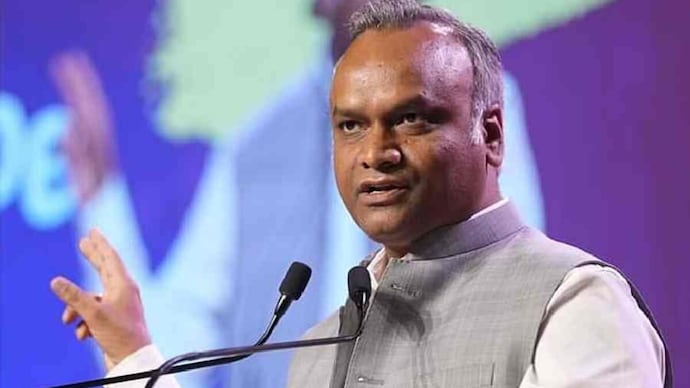
Bengaluru: A political row erupted on social media after Karnataka IT-BT Minister Priyank Kharge wrote to Chief Minister Siddaramaiah seeking a ban on Rashtriya Swayamsevak Sangh (RSS) activities on government premises, accusing the organisation of spreading divisive ideology through its programmes.
In his official letter, Kharge alleged that the RSS conducts ‘shakhas’ and gatherings in government schools, playgrounds, and temples, promoting an ideology that, he claimed, was unconstitutional and against the spirit of national unity. He urged the Chief Minister to prohibit RSS events on government property, asserting that such activities violate secular principles and undermine constitutional values.
Reacting to Kharge’s statement, the BJP Karnataka unit shared an old photograph of Congress President Mallikarjun Kharge attending an RSS event in Nagavara, Bengaluru, in 2002. Posting the image on its official X handle, the party wrote in Kannada, “Look here, @PriyankKharge! Your father personally visited the camp, appreciated the RSS’ social service activities, and extended full cooperation. Are you putting on an act today to impress the high command?”
Responding sharply, Priyank Kharge dismissed the post as BJP’s propaganda, clarifying that his father, then serving as Home Minister of Karnataka, had visited the venue only to ensure law and order during the RSS event.
“He had come with the then Police Commissioner of Bangalore City, Sri. Sangliana. If you recall correctly, he made it clear: either abide by the law of the land or be prepared to face the consequences,” the minister wrote on his personal X account on Monday.
Dear dimwits at @BJP4Karnataka, in case your memory fails you,
— Priyank Kharge / ಪ್ರಿಯಾಂಕ್ ಖರ್ಗೆ (@PriyankKharge) October 13, 2025
Sri. Kharge ji was the Home Minister at the time.
He visited the RSS event site after chairing a peace committee meeting with officials and representatives of all communities, to caution your people against… https://t.co/UJqZpgAQd6
Let the Truth be known. If you read VB and like VB, please be a VB Supporter and Help us deliver the Truth to one and all.
Surveillance intensified in Bengal border districts as killers of Suvendu's PA may flee out of state

Kolkata (PTI): Police stations in border districts of West Bengal intensified surveillance and searches as investigators suspect the involvement of professional shooters from neighbouring states in the killing of BJP leader Suvendu Adhikari's close aide, a senior officer said on Friday.
The police are also investigating the role of local criminals who might have provided logistical support to the assailants, he said.
More than 36 hours after Adhikari's personal assistant Chandranath Rath was assassinated by motorcycle-borne gunmen at Madhyamgram in North 24 Parganas district, the police are yet to make any arrest.
“A detailed investigation is underway. The manner in which the attack was carried out suggests extensive reconnaissance and the possible involvement of hired sharpshooters from outside the state,” a senior police officer told PTI.
He also said all police stations in border districts have been alerted.
"Checks are being carried out at multiple points, and CCTV footage from areas along Jessore Road is being thoroughly scanned,” another senior officer said.
According to probe findings, the gunmen allegedly followed Rath’s vehicle before launching the attack.
“The escape route of the gunmen indicates that they were familiar with the locality, or local criminals might have assisted them. Without local support, fleeing through the lanes so quickly would have been difficult,” the officer added.
The police, however, are yet to ascertain the motive behind the murder.
The police and detective department officers have launched extensive searches in and around Madhyamgram near Kolkata.
Heavy deployment of police and central forces has also been made in the area since the murder occurred on Wednesday night.
"A motorcycle used in the crime was registered in 2012 in the name of a resident of Burnpur in Asansol. However, the police found that no person by that name currently resides at the address given during the vehicle registration process," another officer said.