Prohibitory orders extended in riot-hit areas of Bengaluru
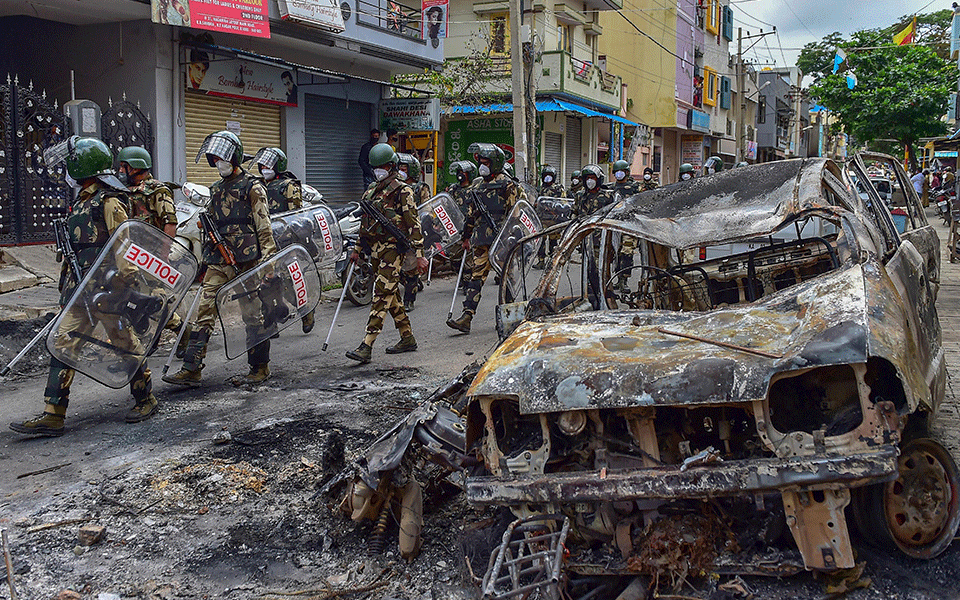
Bengaluru: Prohibitory orders clamped in parts of the city after the violence last week led to police firing, killing three people, have been extended from Sunday to Tuesday.
The order would be in force from the morning of August 16 to the morning of August 18.
Bengaluru Police Commissioner Kamal Pant, in his order, said there is a ban on more than two persons gathering at any place, carrying of any kinds of weapons and convening any public meetings.
Violators would be prosecuted, he said.
Three people were killed after police opened fire to quell a mob that went on a rampage in D J Halli and adjoining areas on Tuesday night over an inflammatory social media post allegedly put out by P Naveen, a relative of Pulakeshi Nagar MLA R Akhanda Srinivasa Murthy.
The MLAs residence and a police station at D J Halli were torched by the rioters who also set many police and private vehicles afire. About 200 people have been arrested so far in connection with the incident and many others have been detained.
Let the Truth be known. If you read VB and like VB, please be a VB Supporter and Help us deliver the Truth to one and all.
Congress using hijab issue to pacify minority anger, alleges Karnataka LoP R Ashoka

Bengaluru: Leader of Opposition in the Assembly R. Ashoka has accused the Congress government of using the hijab issue to placate what he described as discontent among minority voters after the Davanagere by-election.
In a post on X on Wednesday, Ashoka alleged that the state government, instead of addressing issues such as price rise, corruption, farmers’ distress and law and order, was attempting to retain its minority vote base by reviving the hijab issue.
Referring to the 2022 dress code introduced by the BJP government, which prohibited hijab in schools and colleges, Ashoka said the Karnataka High Court had upheld the policy and emphasised the importance of discipline in educational institutions.
He questioned the Congress government’s move to revisit the issue and asked whether setting aside the court-backed policy to benefit one community could be described as secularism.
Ashoka further alleged that while the government was willing to permit hijab, it continued to prohibit saffron shawls.
He accused the government of dividing students on religious lines rather than treating schools and colleges as spaces of equality.
Drawing a comparison with Mamata Banerjee’s government in West Bengal, Ashoka claimed that excessive appeasement politics had harmed the state and warned that the Congress in Karnataka could face a similar political response.
He said voters in Karnataka would teach the Congress a lesson for what he termed “vote-bank politics” and for compromising constitutional and judicial principles.