Protest over ATM staff shooting ends after assurance from MP Sagar Khandre
Bidar: A major protest erupted in front of the district government hospital following a deadly shooting incident involving State Bank of India ATM staff. One staff member was killed, and another critically injured when unidentified assailants opened fire as they attempted to deposit money at the ATM.
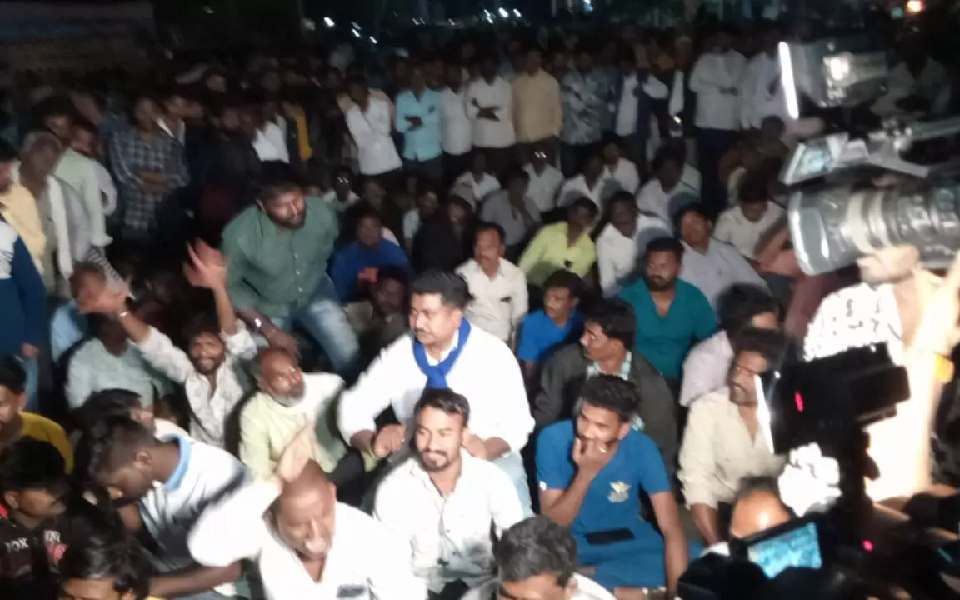
The incident drew public outrage, with family members of the victims and local residents gathering outside the hospital. They demanded immediate compensation, job security for a family member, and expedited post-mortem procedures, criticizing the absence of senior officials and government representatives earlier in the day.
ALSO READ: Robbers shoot and kill security staff, decamp with Rs 93 lakh SBI ATM cash in Bidar
MP Sagar Khandre later arrived to offer condolences and address the protesters' concerns. Responding to demands, he assured that he would discuss the matter with the Chief Minister to arrange for two acres of land and a government job for the victim’s family. Additionally, he confirmed that since the case falls under the Atrocity Act, the Social Welfare Department would provide Rs. 8 lakh in compensation.
Following his assurances, the protest was called off, bringing temporary relief to the tense situation. Police investigations into the robbery and shooting are ongoing, with senior officials, including IGP Ajay Hiroli, overseeing the case.
Let the Truth be known. If you read VB and like VB, please be a VB Supporter and Help us deliver the Truth to one and all.
Delhi: Father, son held for killing 19-year-old woman in suspected honour killing

New Delhi (PTI): The Delhi Police has arrested a man and his son for allegedly murdering his 19-year-old daughter in west Delhi's Hari Nagar area, an official said on Friday.
The case first came to light on April 1 after a PCR call was received around 2 pm, alleging that a woman had been killed by her family members and her body was being taken for last rites, he said.
The accused, identified as Mohammad Maneer (55), a vegetable vendor, and his son Meraj Ali (19), were arrested in connection with the case, the officer said.
The victim had been in a relationship with a man from her native place for the past two years, which was opposed by her father, Maneer and brother Meraj, he said.
"When the girl did not end the relationship despite objections, the family killed her," the officer said.
On April 1, the police said that when their team reached the spot, they found that the woman's body was being taken for burial.
Acting on the input, the burial process was stopped over suspicion of honour killing.
"Police intercepted the family members and took possession of the body," he said.
Police said that the man who had made the PCR told them that the woman was in love with his cousin.
During the inquiry, police also interacted with the PCR caller, who said his cousin, a friend of the deceased, had informed him about the situation and suspected foul play, prompting him to alert the police control room.
The body of the woman was subsequently shifted to the mortuary of Deen Dayal Upadhyay Hospital for preservation and postmortem.
Police said that both the crime team and the forensic science laboratory (FSL) team were called to inspect the scene and collect evidence.
Police said that, as per the postmortem report, the cause of death was identified as smothering, indicating that the woman was suffocated.
A preliminary inquiry also revealed that the family had initiated preparations for the last rites soon after the woman's death, raising suspicion about the circumstances.
Initial investigation pointed to the family's opposition to the woman's relationship.
"The family members of the woman saw her with the man, and she was taken back home. We got to know that she was beaten up and even locked inside the house for some days," a source said.
Further investigation into the matter is underway, police added.