Proud moment for Karnataka's Samashti Gubbi as PM lauds her efforts to popularise Sanskrit
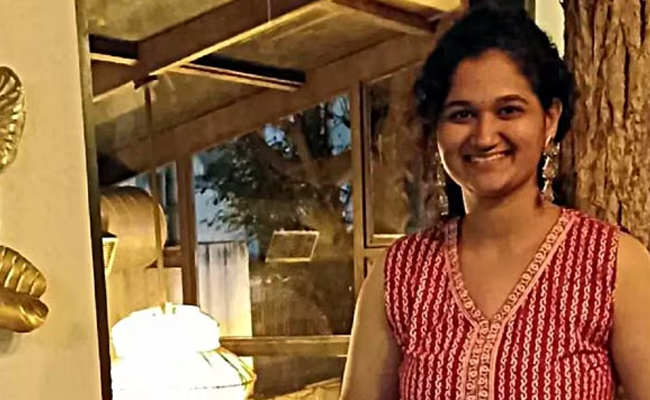
Bengaluru (PTI): For over three years Bengaluru's Samashti Gubbi has been striving hard to popularise Sanskrit, one of the oldest languages of India.
Her efforts paid off on Sunday when she received a big boost with praise from Prime Minister Narendra Modi.
In his 'Mann Ki Baat' radio address, Modi specifically referred to Gubbi's silent efforts to make Sanskrit a spoken language.
Speaking about Sanskrit, the Prime Minister said the language has played a big role in the progress of ancient Indian knowledge and science.
He said nowadays, many people are making such an effort in Bengaluru.
"There is a park in Bengaluru - Cubbon Park! In this park, the people here have started a new tradition. Here, once a week, every Sunday, children, youth and elders talk to each other in Sanskrit," Modi said.
He also pointed out that many debate sessions are also organised in Sanskrit.
"The name of this initiative is Sanskrit Weekend! It has been started by Samashti Gubbi ji through a website. This initiative which started a few days ago has become very popular among the people of Bengaluru," Modi said.
If we all join such efforts, we will get to learn a lot from such an ancient and scientific language of the world, he noted.
Samashti Gubbi's joy knew no bounds when Prime Minister Modi asked countrymen to take a cue from her in promoting the ancient language.
"It's a joyous moment for me when the Prime Minister appreciated my efforts. I have been working to popularise Sanskrit for the past many years," Samashti Gubbi told PTI.
An M.A in Sanskrit, Gubbi has been teaching this language.
She said she started a portal called sthaayi.in in 2021 for the promotion of Sanskrit.
"We organise bike rides for Sanskrit speakers. We also have a Sanskrit band where we translate Bollywood and Kannada film songs into Sanskrit and play them," Gubbi said.
Her 'Sanskrit Weekend' at Cubbon Park had seen the participation of 800 to 900 people.
Is the knowledge of 'Vyakarana' (Sanskrit grammar) a must to learn spoken Sanskrit? To this, Gubbi said, "We don't learn grammar of any language as a child. We just pick up the language."
Let the Truth be known. If you read VB and like VB, please be a VB Supporter and Help us deliver the Truth to one and all.
Thane court sentences man to life imprisonment for bludgeoning wife to death

Thane (PTI): A court in Maharashtra's Thane district sentenced a man to life imprisonment for the brutal murder of his wife, whom he attacked 22 times with a hammer in front of his children, based on the testimony of his 13-year-old daughter.
Principal district and sessions judge S B Agrawal found the accused, Vijay Mishra alias Samir Shaikh, guilty under sections 302 (murder) and 324 (voluntarily causing hurt by dangerous weapons) of the Indian Penal Code (IPC).
The court sentenced him to life imprisonment and a three-year term to be served concurrently. It also imposed a fine of Rs 1 lakh for the murder charge and an additional Rs 10,000 for injuring his minor daughter and mother-in-law, who had tried to intervene during the fatal attack.
Additional public prosecutor Rashmi Kshirsagar informed that 11 prosecution witnesses, including the accused's daughter, were examined during the trial.
According to the prosecution, the victim, Zarin Israr Ansari, had been living with her mother, along with her daughter and a six-year-old son, for two years following prolonged domestic violence and disputes.
The accused, who had converted to Islam to marry Zarin 14 years prior, harboured deep resentment over her living separately and suspected her character.
On the afternoon of September 28, 2023, the accused stormed into his mother-in-law's residence in Mumbra with a hammer concealed in a bag, cornered his wife on the mezzanine floor, dragged her down, locked the main door, and repeatedly bludgeoned her.
The court defended the testimony of the victim's 13-year-old daughter, who was an eyewitness and had sustained injuries herself, noting that minor inconsistencies do not degrade the core truth of an innocent child's account:
"...they are not of any significant consequence since it is not expected from such a witness of 10 years of age to have a total photographic memory to be reproduced before the court. But as far as the incident is concerned, evidence of this witness is totally free from any reasonable doubt."
The prosecution had also stated that the accused had locked his family inside and threatened a neighbour by brandishing a "bomb-like thing" and declaring he would blow up the building if anyone intervened.
The victim's brother eventually broke down the latched door, disarmed the accused, and pinned him down until the police arrived.
The post-mortem report revealed that the victim had suffered 22 brutal injuries and had died due to severe head wounds.