Public movement needed against SIR: Shivasundar
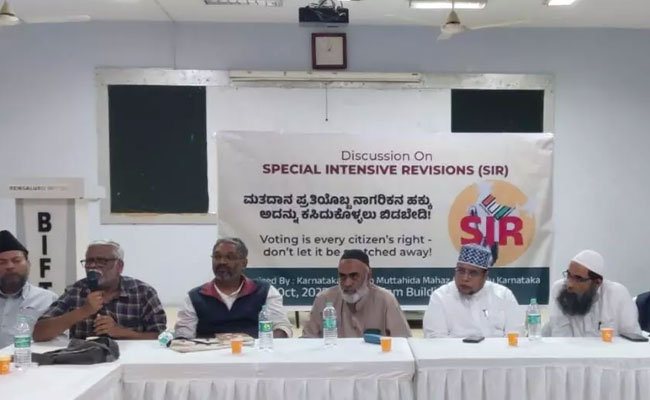
Bengaluru: Columnist and activist Shivasundar has called for the formation of a public movement against the Special Intensive Revision of the Electoral Roll (SIR) being carried out by the Election Commission of India in 12 states. Karnataka is also expected to begin the SIR process by February next year, he warned.
Speaking as the chief guest at a special discussion on SIR organised by the Muslim Muttahida Mahaz at the BIFT auditorium in Darussalam building, Queens Road, Bengaluru, on Saturday, Shivasundar said that preparations must begin immediately to resist what he termed a potentially harmful exercise.
He stated that the coming three months are crucial for ground-level mobilisation: adding names to the voter list, ensuring documents are in order, creating public awareness against SIR, and being ready for protests if required.
Referring to Bihar, he said that when SIR was implemented there, Aadhaar was initially not accepted as a valid identity document, which would have resulted in nearly two crore people losing their voting rights. It was only due to street protests that the Supreme Court intervened and directed the Election Commission to accept Aadhaar, he added.
As a result, among 65 lakh voters whose names were removed, 35 lakh were able to vote again because Aadhaar was recognised. “This is the strength of public struggle — it influences the judiciary,” Shivasundar asserted.
He pointed to previous mass movements, including nationwide protests against CAA, NRC and NPR, the farmers’ movement, and demonstrations across Karnataka after the Mangaluru police firing, saying that several states later passed resolutions due to public pressure.
Shivasundar stressed that voter records must be corrected at the booth level. He alleged that in Madhya Pradesh, RSS workers are assisting Booth Level Officers (BLOs) in deciding whose names are included or deleted from the electoral rolls. “Here, even if we ask Congress workers to help, they say there is no cadre,” he remarked.
He urged that in addition to the 11 documents listed by the Election Commission, available IDs such as Aadhaar, bank passbooks, NREGA cards and ration cards should also be accepted.
The programme was attended by advocate Vinay Sreenivasa, Muslim Muttahida Mahaz convener Masood Abdul Khader, Jamaat-e-Islami Hind state president Dr Muhammad Saad Belagami, secretary Maulana Yusuf Kanni, Maulana Ejaz Ahmed Nadvi, Maulana Zulfikar Noori and others.
Let the Truth be known. If you read VB and like VB, please be a VB Supporter and Help us deliver the Truth to one and all.
CM Siddaramaiah alleges ‘criminal conspiracy’ in Sringeri recount, vows legal action
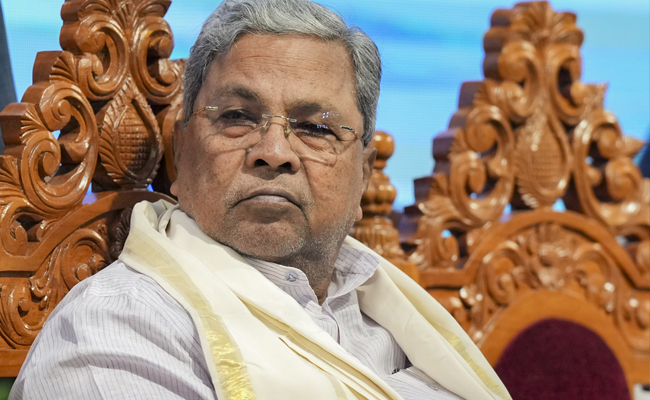
Bengaluru (PTI): Alleging a “criminal conspiracy” by BJP candidate D N Jeevaraj in the Sringeri Assembly poll recounting, Karnataka CM Siddaramaiah on Tuesday said the outcome was manipulated after valid postal ballot votes in favour of Congress leader T D Raje Gowda were tampered with during the recounting process.
Following a Karnataka High Court order on an election petition filed by Jeevaraj, challenging Raje Gowda’s election, the reverification and recounting were conducted on Saturday.
After the reverification and recount of postal ballots for the Sringeri Assembly constituency, votes polled in favour of Raje Gowda were reduced by 255, the returning officer said.
A report on the matter has been submitted to the Election Commission of India for further action, the officer added.
Congress leader Raje Gowda had won the 2023 Assembly polls from Sringeri by 201 votes, defeating his nearest rival Jeevaraj.
Addressing a press conference in Bengaluru, Siddaramaiah said the High Court had directed the recounting of postal ballots and that irregularities were noticed during the exercise conducted on May 2.
“This is a clear case of criminal conspiracy,” Siddaramaiah said, alleging that valid votes cast in favour of Raje Gowda were altered after being accepted by counting agents of all parties, including Congress, BJP, and JD(S).
He claimed that during the recounting of postal ballots, 255 votes were initially accepted as valid by all agents but were later tampered with by subordinate officials.
“There is a second mark on the votes polled in favour of Raje Gowda. They had accepted these as valid votes. Subsequently, another mark was made by officials. This is a clear case of criminal conspiracy,” he said.
When asked who was behind the alleged conspiracy, the CM replied, “It was hatched by Jeevaraj and others. It is planned.”
Siddaramaiah further alleged that the returning officer acted improperly by declaring the result despite the presence of an Election Commission observer during the recounting.
“Immediately after the counting, the returning officer announced the result. He should not have done so; this is against the law,” he said.
He pointed out that Raje Gowda had originally won by 201 votes, but after the recounting, the BJP candidate was declared the winner by 52 votes.
“The BJP has committed a criminal act of conspiracy. This is not vote chori but vote dacoity,” he alleged.
The CM said a police complaint had already been filed by Raje Gowda’s election agent, Sudhir Kumar, and emphasised the need for electoral integrity.
“We want transparency and free and fair elections. That is what our Constitution mandates,” he added.
Stating that the government would pursue legal remedies, Siddaramaiah said, “We are preparing an appeal challenging the returning officer’s announcement in a court of law.”
Responding to a separate query on elections in other states, the CM said there appeared to be an anti-incumbency factor in West Bengal, while results in Tamil Nadu were “surprising,” adding that Vijay’s party was emerging as the largest there.
Following the victory of party candidates in Bagalkote and Davanagere South, Siddaramaiah expressed confidence about future electoral prospects in Karnataka.
“Even in 2028, we will win the Assembly elections. We will come back,” the CM said.
Siddaramaiah added that he would order a forensic examination into the alleged tampering of postal ballots.