Rahul Gandhi promises unemployment aid, filling up 2.5 lakh govt job vacancies in poll-bound K'taka
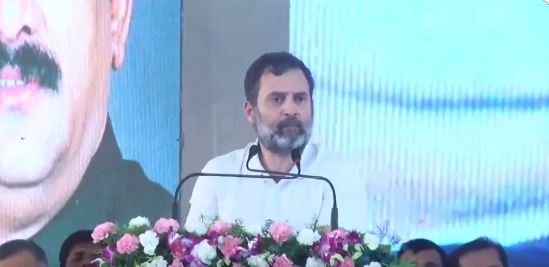
Belagavi (K'taka), Mar 20: Congress leader Rahul Gandhi on Monday called on party leaders in poll-bound Karnataka to fight the BJP in a united manner as he exuded confidence about "sweeping" the upcoming assembly elections.
The party also wooed the youth with promises of unemployment allowance -- its fourth poll 'guarantee' -- and filling up of vacancies in government jobs, in the event of the party coming to power in the State, where Assembly elections are due by May.
While thanking people of Karnataka for supporting his 'Bharat Jodo Yatra' and making it successful, Gandhi took a dig at the BJP-led government at the Centre.
"The Yatra sent out a message that this country belongs to everyone, not just to select two to three, not Adaniji's (industrialist Gautam Adani). This country belongs to farmers, labourers, the poor and youth," the Wayanad MP said.
He dubbed the Basavaraj Bommai-led BJP government in Karnataka as "most corrupt in the country" and a "40 per cent commission government".
"We will fight the election together. All Congress leaders will fight together. Congress will sweep this election, because the BJP government is a 40 per cent commission government, and the people of Karnataka want to get rid of this government. They want a government that will work for poor, downtrodden, middle class, small traders," Gandhi said.
Taking into account the message of the youth that they are not getting jobs, the Congress has decided to give Rs 3,000 per month to every graduate, and Rs 1,500 per month to every diploma holder, for two years as unemployment allowance, he said. "We understand your (youth) problem and BJP is not giving you jobs."
He said the Congress government in the state will provide jobs to 10 lakh youth in five years, and assured that 2.5 lakh government vacancies will be filled up.
Addressing the youth convention 'Yuva Kranti Samavesha' organised by the party's state unit here, he said,: "We will defeat BJP together and make Congress win with a huge majority."
His message of unity to party leaders and workers, ahead of ticket distribution, gains significance amid speculation that disgruntlement may surface within the party following the selection of candidates. Also, there is already a game of one-upmanship between top leaders for the Chief Minister post in the event of it coming to power.
This was the former AICC President's first visit to poll-bound Karnataka, months after the 'Bharat Jodo Yatra', led by him, marched its way through parts of the state.
During the foot march, there was a clear message against hate, he said, adding: "In the market of hate, lakhs of people had opened shops of love. This is our Hindustan."
Noting that during the yatra, he got two to three clear messages from the people of Karnataka, Gandhi said the youth told him that the state government has failed in providing jobs.
The party has already announced three poll guarantees' 200 units of free power to all households (Gruha Jyoti), Rs 2,000 monthly assistance to the woman head of every family (Gruha Lakshmi), and 10 kg of rice free to every member of a BPL household (Anna Bhagya), on coming to power.
AICC President Mallikarjun Kharge, General Secretaries K C Venugopal and Randeep Singh Surjewala, the party's state unit chief D K Shivakumar, Legislature Party leader and Leader of the Opposition Siddaramaiah among several leaders were part of the mega rally.
Highlighting the major message he got from the people of the state during the Yatra that the incumbent Karnataka administration is the "most corrupt government in the country" with "40 per cent commission" sought in public works, Gandhi said the letters written by the contractors' association and school managements' association to Prime Minister Narendra Modi complaining about the extortion charges "has not got response".
Listing out alleged corruption scandals in the state, he said BJP MLA Madal Virupakshappa's son was caught with Rs 8 crore in the cash-for-contract scam-hit KSDL Corporation, "but no action has been taken, and the government is protecting him".
Also, there were job scams relating to recruitment of Police Sub Inspectors (PSI), Assistant Professor, Assistant Engineers, he further said, adding that there is a list. "This is the most corrupt government in the whole country."
Corruption is happening because all benefits are going to just two to three people, Gandhi said, while noting that he spoke about Adani (following the Adani-Hindenburg issue) in Parliament. "All the businesses and industries in the country are being given to him, whether it is airports, ports, roads, are all being given to Adaniji, the same thing is happening here (in Karnataka)."
"Select few people who are BJP government's friends, all the benefits are being given to them. Because of this, there is rampant corruption in the state," he alleged.
Gandhi also urged the BJP government that it should fulfil its promise of hiking the reservation of SCs from 15 to 17 per cent and STs from 3 to 7 per cent by implementing it.
BJP's 40% Commission Sarkar wiped away jobs & opportunities.
— Rahul Gandhi (@RahulGandhi) March 20, 2023
Congress’ #YuvaNidhi will empower Karnataka’s unemployed Youth
✅ ₹3000/month for Graduates
✅ ₹1500/month for Diploma holders
✅ 2.5 lakh Govt jobs in 1 year
✅ 10 lakh Pvt sector jobs
That’s a Congress Guarantee! pic.twitter.com/eNmXvIa5lr
Congress' promise to the youth of Karnataka-
— Congress (@INCIndia) March 20, 2023
🔹₹3,000/month to all the unemployed graduates for 2 Years
🔹₹1,500/month for all diploma holders for 2 Years
🔹Employment for 10 lakh youth
🔹Filling up 2.5 lakh vacant government posts within one and a half years pic.twitter.com/s5vC9YAt6X
Let the Truth be known. If you read VB and like VB, please be a VB Supporter and Help us deliver the Truth to one and all.
US–Iran first round direct talks conclude in Islamabad: Report
_vb_48.jpeg)
The first round of direct talks between the United States and Iran, held in Islamabad, has concluded, Al Jazeera reported citing sources close to the development.
According to the report, following the discussions, delegations from both sides agreed to exchange written documents, a move aimed at ensuring clarity and consensus on the understandings reached during the meeting.
Both the Iranian and US delegations arrived in Islamabad on Saturday, April 11, amid high security for the peace talks.

_vb_17.jpeg)