Rare Kalyani Chalukya-era stepwell discovered in Karnataka’s Gadag district
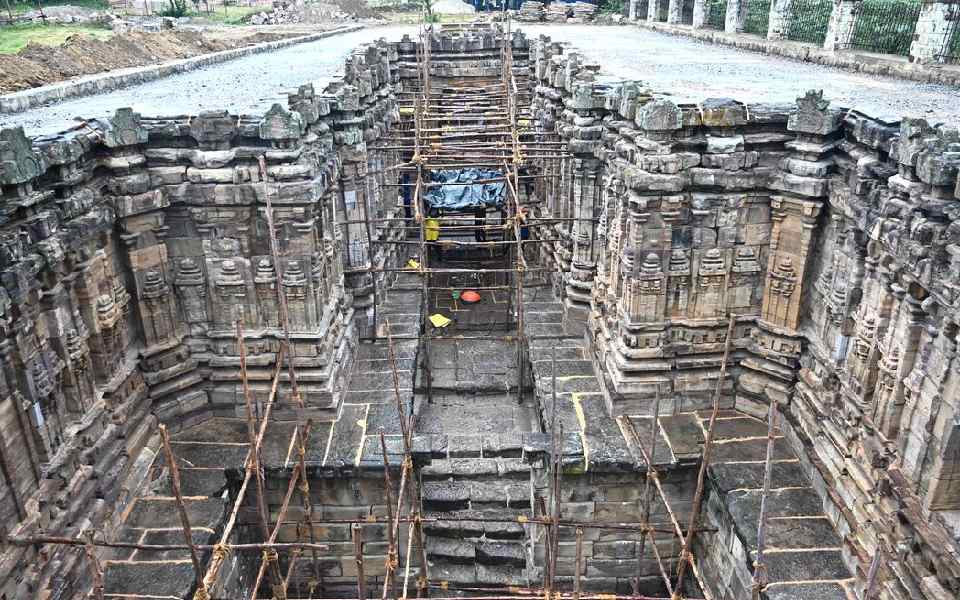
Gadag: A centuries-old stepwell from the Kalyani Chalukya period is discovered into public in Sudi, a remote village in Karnataka’s Gadag district. The Nagakunda Pushkarani, dating to the 10th-11th century CE, is undergoing extensive restoration under the Department of Archaeology, Museums and Heritage’s ‘Adopt a Monument’ scheme.
The stepwell was focal point of community life and craftsmanship under the reign of Akkadevi, sister of Chalukya king Jayasimha II. It shows the dynasty’s mastery of architecture and water management. Its interior walls are carved with the precision of temple façades, setting it apart from most surviving stepwells in southern India, linking it stylistically to examples in Gujarat and Rajasthan.
After centuries of neglect left its sculptures weathered and its waters dry, the site is now being revived by the Deccan Heritage Foundation India in partnership with Heritage Matters, the Gandipet Welfare Society and the Water Literacy Foundation according to a report published by The HIndu. Work includes structural repairs, removal of invasive vegetation, dredging, stone resetting and landscaping, alongside the restoration of an adjacent mantapa with a large Ganesha idol.
Heritage architect B. Sarath Chandra noted, the project is as much about functionality as aesthetics, with water recharge efforts already underway. Funded by Gandipet Welfare Society founder Rajashree Pinnamenni, the restoration is slated for completion by late 2025, followed by a second phase linking the stepwell to the Jodu Kalasadagudi temple through landscaped pathways.
The report mentions that officials say the revival of Nagakunda Pushkarani could not only reintroduce Sudi’s Chalukya heritage to a wider audience but also serve as a model for conserving other lesser-known monuments across Karnataka.
Let the Truth be known. If you read VB and like VB, please be a VB Supporter and Help us deliver the Truth to one and all.
Congress using hijab issue to pacify minority anger, alleges Karnataka LoP R Ashoka

Bengaluru: Leader of Opposition in the Assembly R. Ashoka has accused the Congress government of using the hijab issue to placate what he described as discontent among minority voters after the Davanagere by-election.
In a post on X on Wednesday, Ashoka alleged that the state government, instead of addressing issues such as price rise, corruption, farmers’ distress and law and order, was attempting to retain its minority vote base by reviving the hijab issue.
Referring to the 2022 dress code introduced by the BJP government, which prohibited hijab in schools and colleges, Ashoka said the Karnataka High Court had upheld the policy and emphasised the importance of discipline in educational institutions.
He questioned the Congress government’s move to revisit the issue and asked whether setting aside the court-backed policy to benefit one community could be described as secularism.
Ashoka further alleged that while the government was willing to permit hijab, it continued to prohibit saffron shawls.
He accused the government of dividing students on religious lines rather than treating schools and colleges as spaces of equality.
Drawing a comparison with Mamata Banerjee’s government in West Bengal, Ashoka claimed that excessive appeasement politics had harmed the state and warned that the Congress in Karnataka could face a similar political response.
He said voters in Karnataka would teach the Congress a lesson for what he termed “vote-bank politics” and for compromising constitutional and judicial principles.