Ready to discuss Mekedatu project implementation with TN, says CM Siddaramaiah
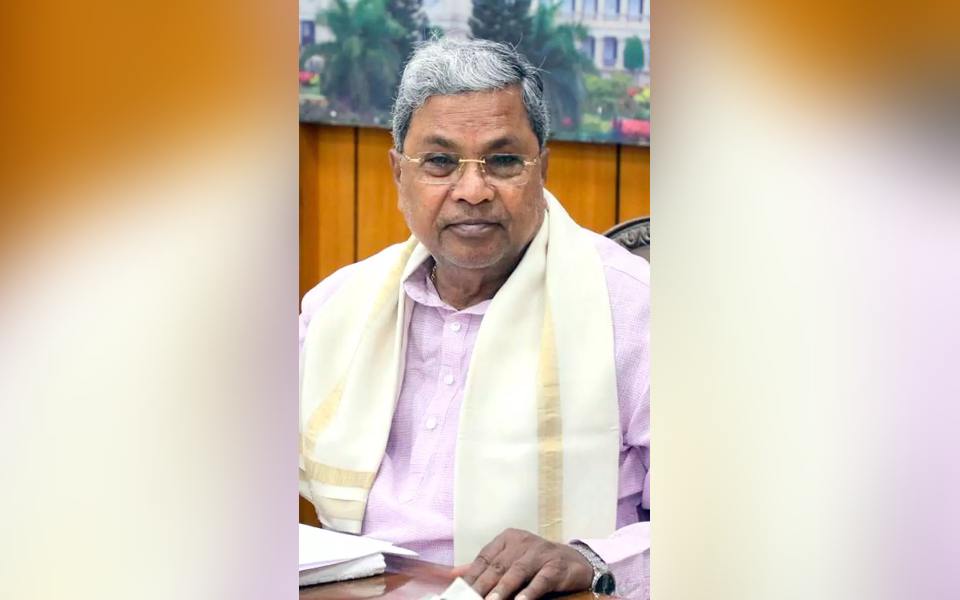
Mysuru, Jul 29: Karnataka Chief Minister Siddaramaiah on Monday said his government was ready to discuss with Tamil Nadu regarding implementation of Mekedatu project across river Cauvery, but the neighbouring state was not coming forward despite it not "causing any problem to them".
If the Centre gives necessary permissions, the State is ready to implement the project, he told reporters here.
Siddaramaiah along with Deputy Chief Minister D K Shivakumar, several Ministers and officals today offered 'bagina' (traditional thanksgiving) to river Cauvery at Krishnaraja Sagar (KRS) dam in Srirangapatna taluk in Mandya district.
It is customary to offer a 'bagina' to the rivers in the state, when the dams are filled to their maximum capacity.
"We are ready to discuss. Despite Mekedatu not causing any problem to them (Tamil Nadu), they are not ready to discuss. If the central government gives permission we are ready to construct the Mekedatu reservoir," Siddaramaiah said.
ALSO READ: CM accuses Nirmala Sitharaman of "lying", says BJP trying taint Karnataka as "corrupt state"
He was responding to a question on whether he will hold discussions with Tamil Nadu or the Centre for a "concrete programme" as a lot of water is flowing into the sea, with Mettur dam in Tamil Nadu expected to fill up in a couple of days.
Shivakumar, who is also the Water Resources Minister, had recently made a passionate appeal to the Tamil Nadu government to cooperate with the implementation of the Mekedatu project, stating that it would be more beneficial to the neighbouring State.
Mekedatu is a multi-purpose (drinking water and power) project proposed by Karnataka, which involves building a balancing reservoir near Kanakapura in Ramanagara district (now renamed as Bengaluru South district).
Tamil Nadu has been opposing the project, raising apprehensions that the state would be affected if the project takes shape.
The project, once completed, is aimed at ensuring drinking water to Bengaluru and neighbouring areas (4.75 tmcft); it also can generate 400 MW power, and the estimated cost of the project is Rs 9,000 crore (2019 rates), according to Karnataka officials.
A separate Project Division and two Sub-Divisions have already been set up to implement the ambitious 'Mekedatu Balancing Reservoir and drinking water project of Cauvery river' valley, Siddaramaiah had said, presenting the state budget in February.
"A survey to identify land that will be submerged under this project and the counting process of trees have already been initiated," he had also said, adding, "action will be taken on priority to commence the work early after obtaining remaining necessary clearances from the competent authorities."
Let the Truth be known. If you read VB and like VB, please be a VB Supporter and Help us deliver the Truth to one and all.
RCB secure IPL playoff berth with 23-run win against Punjab Kings
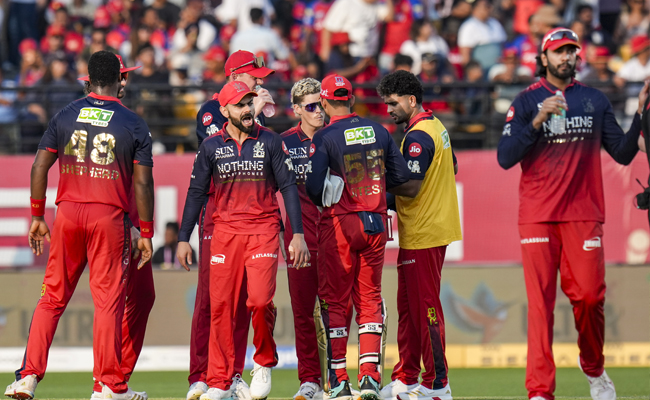
Dharamsala (PTI): Royal Challengers Bengaluru rode on fluent half-centuries from Virat Kohli and Venkatesh Iyer, along with a decisive opening spell from pacer Bhuvneshwar Kumar, to thrash Punjab Kings by 23 runs and seal a playoff berth in the IPL here on Sunday.
Kohli (58 off 37 balls), Iyer (73 not out off 40 balls) and Devdutt Padikkal (45) produced impactful knocks as RCB piled up 222 for 4 in 20 overs.
Bhuvneshwar (2/38) then removed the dangerous Punjab Kings opening pair of Priyansh Arya (0) and Prabhsimran Singh (2) early to all but shut the door on the opposition, who eventually managed 199 for 8 in their allotted 20 overs.
Pacer Rasikh Salam (3/36) compounded Punjab Kings' misery by dismissing skipper Shreyas Iyer (1) in the fourth over as the hosts slumped to 19 for 3.
Late-order batters Shashank Singh (56 off 27 balls) and Marcus Stoinis (37 off 25 balls) attempted to revive the innings with a counter-attacking effort, but the towering RCB total ultimately proved far beyond PBKS' reach.
Earlier, Kohli stitched together a 76-run stand with Devdutt for the second wicket to lay the foundation before adding another 60 runs with Venkatesh for the third wicket as table-toppers RCB delivered yet another authoritative batting display.
Brief Scores:
Royal Challengers Bengaluru: 222 for 4 in 20 overs (Virat Kohli 58, Devdutt Padikkal 45, Venkatesh Iyer 73 not out; Harpreet Brar 2/35).
Punjab Kings: 199 for 8 in 20 overs (Cooper Connolly 37, Suryansh Shedge 35, Marcus Stoinis 37, Shashank Singh 56; Bhuvneshwar Kumar 2/38, Rasikh Salam 3/36).