Redevelopment projects worth Rs 810 crore give Hubballi a face lift
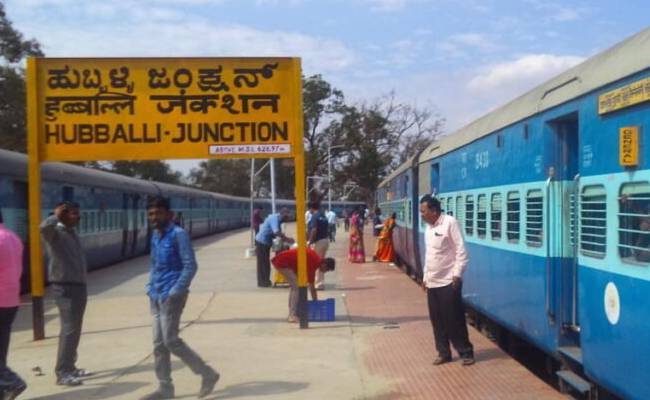
Hubballi (PTI): Hubballi-Dharwad administration here in Karnataka has completed several redevelopment projects worth Rs 810 crore, including the restoration of a "dying" lake and building a green mobility corridor, under the the smart city mission of Ministry of Housing and Urban Affairs, officials said on Tuesday.
Under the Centre's smart city mission, 63 redevelopment projects were undertaken for the 11 lakh people of Hubballi-Dharwad in a bid to improve the ecology of the city and boost the local economy. Fifty-nine projects of these have been completed, they said.
Tolankere Lake (Tolan means fox, kere means lake), a dying water body with hardly any marine inside or terrestrial life around it, has become a hub of visitors after its redevelopment, officials said.
They said that there was excessive silt collection and very little water holding capacity in the lake and the entire area had become barren and dry.
The project took nearly four years to be completed from October 2018 to April 2022. It got delayed due to the Covid pandemic, Managing Director of Hubballi-Dharwad Smart City Limited (HDSCL) Rudresh Ghali told PTI.
Torenkele Lake is easily the most loved community space in Hubballi and is an excellent example of how a nearly dead lake was brought to life, officials said.
Since its opening, over 500 people visit it during the weekdays, and the number swells to 1,500 on weekends. It has also become the starting or ending point of every public awareness or fitness rally held in Hubballi. Given its popularity, property prices around the lake have quadrupled since its rejuvenation, they said.
"The lake has an area of 39 acres, which was developed at a cost of Rs 25 crore. We have amenities for all age groups, including a children's play area, open area for exercises, food court and an open theatre. A lot of planting has also been done in the area to make the landscape beautiful.
"We have installed proper electric poles and aerators for maintaining the water quality, and keep them on during mornings and evenings. We had a lake here, but there was no landscape, play area and walkway. We now have a walkway around seven metres wide, which has a length of around 1.25 kilometres," Ghali said.
A dedicated area has been earmarked for the physically handicapped to do exercise. From 6 am to 9 am, using Tolankere is free for walkers but after 9 am, the charge is Rs 20 for adults and Rs 10 for kids, he said.
Two artificial islands were created inside the water body, in addition to the already existing island, to attract migratory birds, Deputy General Manager for HDSCL Basavraj Dharmanti told PTI. He added that the park has a basketball court and a volleyball court too.
Mahesh, a local resident, said earlier the place looked like a haunted road, but has now turned into a beautiful spot to visit with ones' families.
"We used to roam here around five to six years ago when I was a student. It was like a haunted road earlier. Now, it has shops everywhere and the road has also been built. A fountain has been constructed between the road which makes it more beautiful and attractive. Earlier, people used to be scared to go to the area. They are now spending time here with family members," Mahesh said.
The high-quality refurbishment of a glass house at the Mahatma Gandhi Park, a landmark lung space in Hubballi filled with large heritage trees spread over a sprawling 7.42 hectares, has made it a popular destination for gatherings and weekend family outings, with people visiting the place from across the city.
A grand glass house is present inside the park due to which it is popularly known as the Indira Gandhi Glass House. The park was constructed in 1977.
It also has a toy train with a 960-metre long track and a musical fountain, with water jets dancing to popular Kannada and Hindi songs, the officials said.
The MG Park has generated a revenue of Rs 20.67 lakh from May 2022 to March 2023, despite a low entrance fees of Rs 20, they said.
The administration has created the Green Mobility Corridor (GMC) in the city in which an unclean, inaccessible urban drain has been converted into a clean, thriving public green space with a dedicated non-motorised corridor.
"There are three things in GMC. We are strengthening the drains by properly constructing the walls to protect it. We can reduce the flood-prone area and by this, 18 areas will be prevented from flooding. We are keeping the drains clean by diverting sewage water. We have built a sewage treatment plant (STP) so that sewage gets treated and the treated water is again released in the drains.
"We have made non-motorised transport (NMT) along the drain where people can walk and ride bicycles. The total length is 9.4 km. It starts from Unkal Lake and a total of 4.5 km stretch has been developed. It is beneficial for people and also time saving," Ghali said.
In the monsoon of 2022, Hubballi received extremely high levels of precipitation but the newly constructed retaining walls were effectively able to control the floods, ensuring zero flooding along the banks, they said.
A three-metre high chain-link fence is erected all along the drain and at all the 12 bridges as a way to earmark the land extent of the GMC. It also ensures protection for the corridor from its misuse after dark, preventing the dumping of solid waste into the drain which was a regular practice prior to the corridor, the officials said.
Officials also said the entire stretch is lit with aesthetic street lights. CCTV cameras are also installed at several places, which are monitored 24/7 by the smart city's Integrated Command and Control Centre (ICCC), making it a safe space especially for women and children, they said.
"The apartment in which I live was flooded during the heavy rains in 2019. Though the rains were as heavy in 2021 and 2022, the GMC project has prevented flooding. We are also happy that a bicycle corridor has been constructed just outside our house connecting important parts of the city," said Dr Vijayalakshmi, professor at KLE Technological University.
Let the Truth be known. If you read VB and like VB, please be a VB Supporter and Help us deliver the Truth to one and all.
Davangere South bypoll: Congress ahead by narrow lead after 14th round
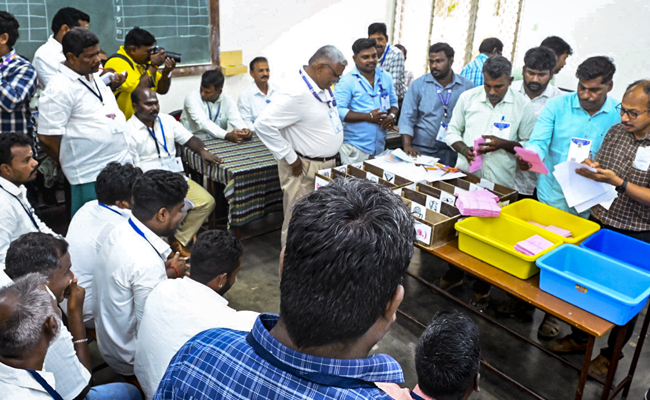
Davangere: The Congress candidate is leading in the Davangere South Assembly by-election after the completion of the 14th round of counting.
According to the latest figures, the Congress has secured 46,460 votes, while the BJP stands at 39,037 votes, trailing by 7,423 votes.
The SDPI candidate has polled 15,303 votes so far.
Counting is still underway, and final results are awaited.