Resign respectfully before court verdict: BJP leader BS Yediyurappa to CM Siddaramaiah
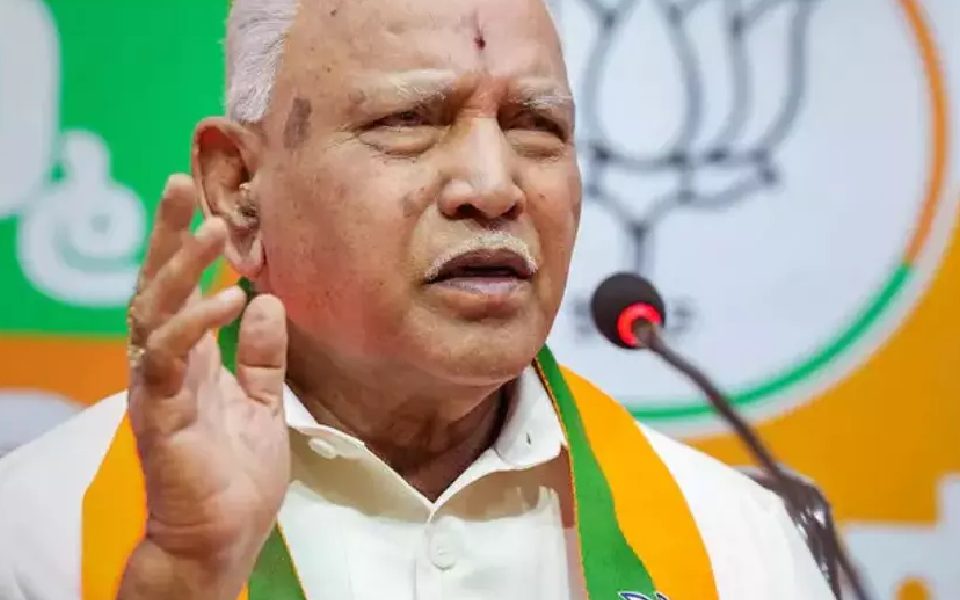
Shivamogga (Karnataka), Sep 4: Veteran BJP leader B S Yediyurappa on Wednesday sought to nudge Chief Minister Siddaramaiah to resign from the post "respectfully", before the court delivers its verdict on the Governor granting permission to prosecute him in connection with the Mysuru Urban Development Authority (MUDA) site allotment issue.
The former Chief Minister claimed that Siddaramaiah would face a situation to resign after the court verdict.
"After the court verdict, a situation will come for Chief Minister Siddaramaiah to resign one hundred per cent. I advise him to respectfully resign before the court verdict comes. As all the scams he is involved in are proved, there is no chance for him to escape. Let's see what happens," Yediyurappa said.
"There is no need for any more fight, things in a way have reached a final stage, and naturally a situation will come for him (CM) to resign," he told reporters here.
ALSO READ: ‘Bellad showed right way to new generation politicians’, says CM on BJP MLA’s apology
The Karnataka High Court on Monday extended till September nine the interim stay on trial court proceedings against the Chief Minister in the MUDA case.
The Court adjourned for a week the hearing on Siddaramaiah's petition challenging the legality of Governor Thaawarchand's sanction for his prosecution in the case.
The Governor on August 16 accorded sanction under Section 17A of the Prevention of Corruption Act, 1988 and Section 218 of the Bharatiya Nagarik Suraksha Sanhita, 2023 for the commission of the alleged offences as mentioned in the petitions submitted to him by Pradeep Kumar S P, T J Abraham and Snehamayi Krishna.
On August 19, Siddaramaiah moved the High Court challenging the legality of the Governor's order.
On the possibility of the Cabinet on Thursday deciding to book a criminal case based on retired Karnataka High Court Justice John Michael D'Cunha-headed inquiry commission report on alleged irregularities in Covid-19 management when the BJP was in power, Yediyurappa said: "there is no meaning to it. They are free to make any decision. We will face it, within the framework of law."
Let the Truth be known. If you read VB and like VB, please be a VB Supporter and Help us deliver the Truth to one and all.
11k litres of milk poured into Narmada river after religious event; environmentalists see red
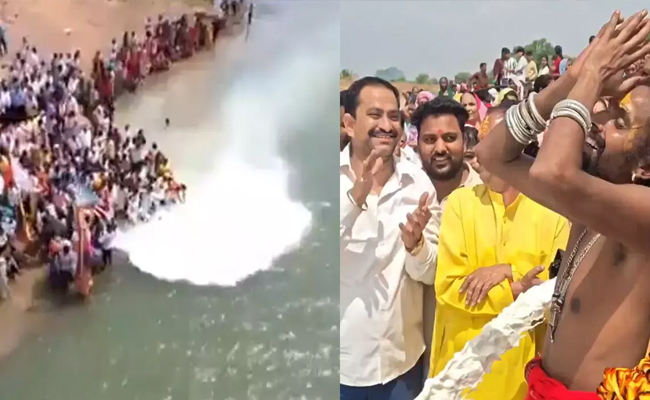
Sehore (PTI): Around 11,000 litres of milk were poured into Narmada river, often called the lifeline of Madhya Pradesh, in Sehore district on the culmination of a 21-day religious event as part of a sanctification ritual, prompting environmentalists to flag its negative impact on the ecosystem.
The event concluded at Satdev village in Bherunda area, located about 90 km from the district headquarters, with a 'mahayagna' on Wednesday.
The milk was offered to the river as part of rituals and prayers for the purity of the waters, the well-being of pilgrims and prosperity, organisers said.
The milk was brought in tankers to the riverbank and later poured into the flowing water amid chanting of mantras in the presence of a crowd of devotees.
However, environmentalists raised concerns over the practice, warning of its potential ecological impact.
"Such large quantities of organic matter can deplete dissolved oxygen in water, adversely affecting the river ecosystem. These impact local communities dependent on the river for drinking water and threaten aquatic life as well as domestic animals," noted environmentalist and wildlife activist Ajay Dube said.
Religious offerings should be symbolic and mindful, he asserted.
Renowned environmentalist Subhash Pandey said 11,000 litres of milk acts as a significant organic pollutant.
"It is highly oxygen-demanding and can lead to oxygen depletion, aquatic mortality, eutrophication (process of plants growing on river surface) and loss of potability. These effects are predictable from dairy-effluent chemistry and have been documented in similar incidents worldwide," Pandey pointed out.
Narmada originates at Amarkantak in the state and traverses 1,312 km westward to Maharashtra and Gujarat, emptying into the Arabian Sea via the Gulf of Cambay.
It is the largest west-flowing river in the peninsula, passing through a rift valley, and acts as a crucial water source for irrigation in MP, Gujarat and Maharashtra.