Rs 178 Cr package for coconut growers
Cabinet takes a decision
Bengaluru, October 04: The Cabinet on Thursday decided to release Rs 178 crore package for the coconut growers whose coconut plantations have become unproductive due to continuous drought in the state.
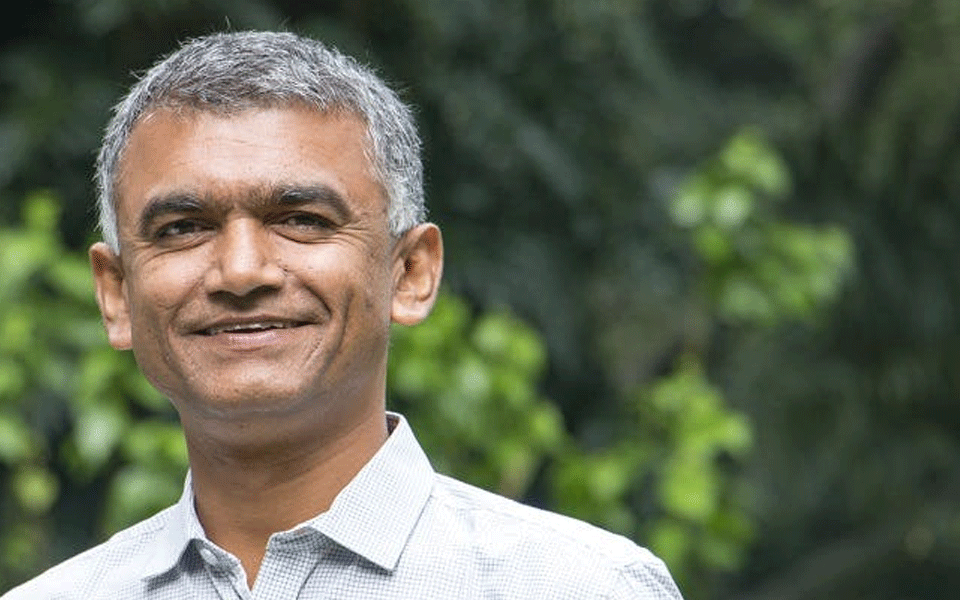
After the Cabinet meeting chaired by Chief Minister H.D. Kumaraswamy at Vidhana Soudha here, Law and Parliamentary Affairs Minister Krishna Byre Gowda said that it was decided to give Rs 400 per tree or Rs 18,000 per hectare of plantation as relief package, for which, the Horticulture department would submit a proposal . The state government had submitted a proposal to the central government for incentive for the coconut growers a year ago. But nothing was happened. So, it was decided to give incentive to the farmers and this would help the growers in Chitradurga, Tumkur, Hassan, Chamarajnagar, Mandya and other places, he said.
As the agreement between the state government and the GVK Company to provide 108 ambulance service was expired, it was decided to continue the old agreement for one more year with the company. Within next one year, tender process for the fresh agreement and ambulance service would be completed, he said.
The Cabinet has given administrative approval to take up various development works at Hassan government engineering college at a cost of Rs 50 crore. It was also approved to set up a super speciality hospital on the premises of the Hassan Institute of Medical Sciences at a cost of Rs 129.75 crore and in the first phase, Rs 50 crore would be released immediately, he said.
The Cabinet also decided to set up Government Tool Room and Training Centre in Yadagiri, Humnabad, Lingasugur and Hospet in collaboration with Dassault Systemes India Private Limited at a cost of Rs 224.08 crore, of which, the government would invest Rs 21.7 crore and the rest would be borne by the Dassault company, he said.
The Cabinet also decided to withdraw the proposal submitted to the Central government in 2016 on appointing retired IAS officer V. Umesh as the State Administrative Tribunal Member and set up State Horticulture Excellent Centres Agency in the state. The Cabinet also decided to give Rs 2,000 monthly pension for five years along with Rs 5 lakh compensation to the family of those who were killed from wild animals attacks, he said.
The Cabinet also decided to handover 4.7 acre of land belonging to KSRTC Hassan Regional Workshop to Hassan Cooperative Milk Union and withdraw 14 criminal cases booked against Raita Sangha, Pro-Kannada activists and general public in various police stations across the state, the Minister added.
It was decided to start cardiac treatment unit with Cath Lab facility in Bidar Institute of Medical Sciences at Rs 7.25 crore and cardiac treatment centre along with the Cath Lab facility at Super Specialty Hospital of Shivamogga Institute of Medical Sciences at a cost of Rs 7.81 crore, he said.
Let the Truth be known. If you read VB and like VB, please be a VB Supporter and Help us deliver the Truth to one and all.
Two former Chinese defence ministers sentenced to death for corruption
Beijing (PTI): Two former Chinese defence ministers, Wei Fenghe and Li Shangfu, were sentenced to death with a two-year reprieve over graft charges on Thursday, official media reported.
Their sentences were separately handed down by China's military court, the state-run Xinhua news agency reported.
Wei was convicted of accepting bribes, while Li was convicted of both accepting and offering bribes, the agency reported, citing the court rulings.
Wei and his successor Li, who worked under President Xi Jinping's watch, were expelled from the ruling Communist Party in 2024. They were also former members of the Central Military Commission headed by Xi.
Wei served as Defence Minister from 2018 to 2023, and Li barely served a few months as his successor.
Both Wei and Li headed the People's Liberation Army's all-important Rocket (Missile) Force, established in 2015 as part of Xi’s military overhaul.
Wei, who headed the rocket force from its inception until 2017 and later served as the defence minister, was detained and expelled from the ruling Communist Party over corruption charges.
Li was personally picked up for the top defence post by Xi himself.
After Li’s sacking, several of its top officials were removed and charged with corruption.
Since he came to power in 2012, President Xi has carried out a massive anti-corruption campaign in which over a million officials, including several generals, have been punished.