Rs 500 crore irregularities during BJP rule in K'taka found in audit of KEONICS: Priyank Kharge
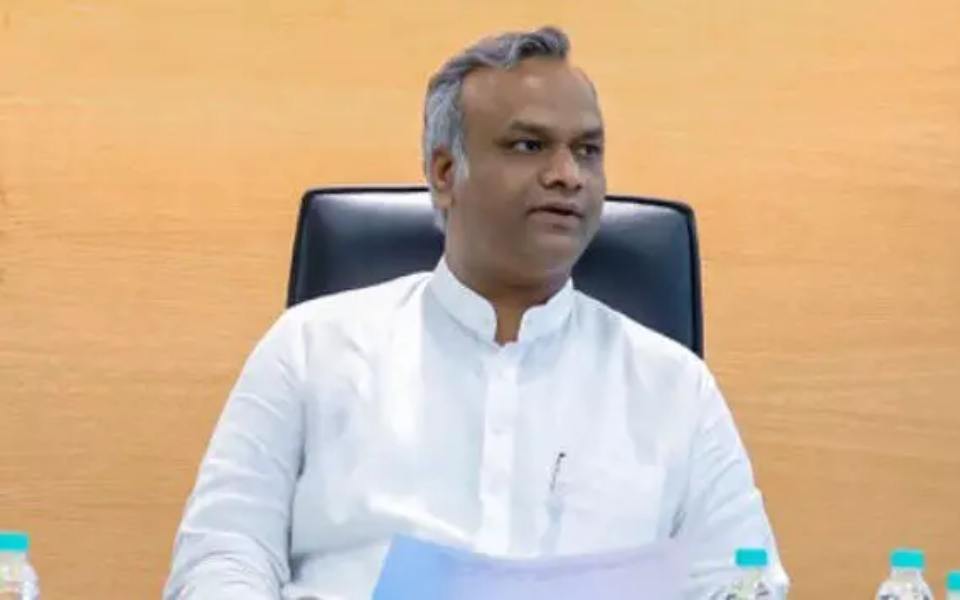
Bengaluru, Nov 9: Karnataka Information Technology and Biotechnology Minister Priyank Kharge on Thursday alleged that there were close to Rs 500 crore of financial irregularities in the Karnataka State Electronics Development Corporation Limited (KEONICS) during the previous BJP government.
The IT-BT minister claimed that the then BJP government did not merely charge a 40 per cent commission', as his party had claimed during the assembly election, but had collected a commission of more than 400 per cent.
He also asserted that ever since he took over as a minister after the Congress came to power, not a single order was passed in KEONICS nor did any procurement take place through the agency.
"The audit report shows financial irregularities close to Rs 500 crore, which have taken place from 2019 to 2023. The previous BJP government was not a mere '40 per cent commission government' but it had gone up to 400 per cent commission. This is not me but the audit report that is saying this," Kharge said at a press conference.
The minister's statement came as some BJP leaders alleged that a KEONICS official demanded a bribe of Rs 38 crore to clear bills to the tune of Rs 300 crore. They even accused Kharge of being involved in it.
Kharge said an investigation has been ordered, and that the changes in the rules for accountability and transparency that the Congress government is introducing will create trouble for many former ministers and MLAs. This is why they are making these baseless allegations, he said.
"The BJP has been alleging that bill payment is not being done. Ask them how many bills are pending. Have they done any home work or produced any document to support their allegation? The pending bill is worth Rs 16.27 crore. Ever since we came to power, payments were made to only manpower agencies," the minister explained.
According to him, only those bills are pending where third-party inspection has not taken place.
He also charged that after Congress came to power, we stopped the business' that was going on for the past three to four years, which annoyed them," adding, "If we go into the roots to find out the origin of this accusation, we know on whose beat they are dancing."
Admitting that some bills may not have been cleared, the minister said that genuine vendors whose bills are due have not raised an issue. Stating that government never holds back the money of any individual, he said they will get the money after verification.
In a press note, the minister revealed some of the findings of the Accountant General Audit Team.
There was an extra burden of Rs 47.76 crore on the client departments' due to procurement of items and goods at higher rates between 2018 and 2023, he said, giving the details.
For example, KEONICS spent Rs 24.15 lakh on each of the computer labs set up in the tribal welfare department, whose market value was only Rs 5.09 lakh. KEONICS procured 40 such units which led to a financial implication' (loss) of Rs 7.63 crore, he explained.
A payment of Rs 76.5 crore was made without conducting a third-party inspection. Further, Rs 71.5 crore was paid without obtaining photo proof and the inspection report.
Using a forged third-party inspection report towards the supply of material, payment of Rs 9.98 crore was made. The auditors also found two sets of delivery challans before and after the supply of goods, he said.
Let the Truth be known. If you read VB and like VB, please be a VB Supporter and Help us deliver the Truth to one and all.
Maharashtra sets up state vaccination task force to strengthen immunisation programme

Mumbai (PTI): The Maharashtra government has set up a State Vaccination Task Force to strengthen the regular immunisation programme and review the progress of related campaigns, a health department official said on Monday.
The State Vaccination Task Force will comprise at least 29 members and will be headed by the administrative head of the health department, he informed.
The government has also constituted separate district-level and municipal vaccination task forces to improve implementation and address challenges at the grassroots level, he said.
Municipal task forces, chaired by respective civic commissioners, have been constituted in view of the vast urban population in Maharashtra and the role of civic bodies in implementing different health programmes.
The district-level task forces will function under the chairmanship of collectors.
"Complete immunisation of children at the appropriate age is an extremely simple, cost-effective and highly effective measure to reduce child mortality and the prevalence of diseases among kids. Immunisation is a powerful tool for reducing illness in children," maintained the official.
To ensure full vaccination of all children, the state government implements various campaigns from time to time as per the central government guidelines, he pointed out.
"Active participation and cooperation of other relevant government departments are essential (in making these campaigns successful)," according to the official.
The state-level body will review the regular immunisation programme, associated campaigns and vaccine-preventable diseases in detail. It will also conduct focused assessments of high-risk districts and municipal corporations, including vacancies at district, municipal and sub-district levels, availability of cold chain equipment, resource gaps and training requirements, he noted.
The state task force will review allocation and utilisation of funds for immunisation and ensure timely action by officers concerned based on reports from district and municipal task forces and state-level monitoring mechanisms, the official said.
It will also ensure active coordination and participation of other government departments in immunisation drives, while district and municipal task forces will carry out similar functions at their respective levels, the official added.