Rs 550 cr in Karnataka budget for sustainable farming
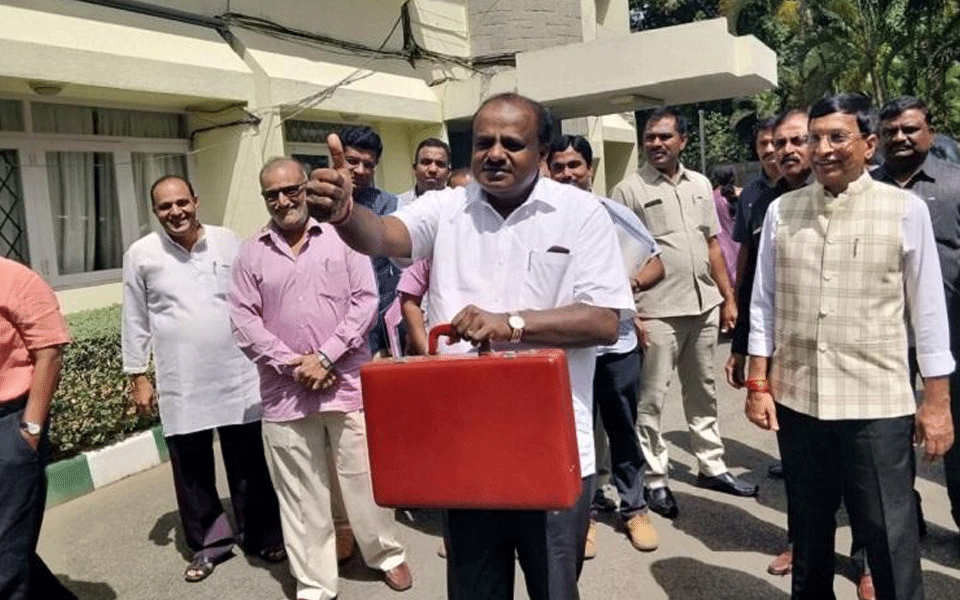
Bengaluru, July 5: The Karnataka budget for 2018-19 on Thursday allocated Rs 550-crore for progressive and sustainable farming after waiving a whopping Rs 34,000 crore loans of 17-lakh farmer families across the state.
Presenting a pro-farmer budget in the assembly, Chief Minister H.D. Kumaraswamy, who holds the Finance portfolio, told lawmakers that Israeli model of sustainable irrigation could suit the state's farmers in improving their lives.
"I visited Israel last year and studied their farm practices myself. I have no doubt that Israeli model of irrigation would protect the crops and make farmers' lives better," he said in his two-hour long budget speech.
The budget allocated Rs 150 crore for creating Israeli model of irrigation, which makes use of drip irrigation methods to conserve water, in 5,000 hectares of dry land in each of the districts of Kolar, Chitradurga, Koppal and Gadag.
Another Rs 150 crore has been set aside to implement the same model of farming in 5,000 hectares land in each of Karwar, Tumkur, Yadgir and Haveri districts.
The Chief Minister proposed that the state implements zero budget natural farming on the lines of Andhra Pradesh for better yields with lesser investment.
Rs 50 crore was allocated to implement zero budget natural farming in the state, with the support of United Nations Environment Programme which is offering technical assistance through Sustainable India Finance Facility.
The budget also made Rs 190 crore provision for coconut farmers, who have been witnessing unproductive crops due to shortage of rain in the state.
In health sector, the budget made provisions of Rs 10 crore for strengthening drug control, Rs 30 crore for heart, kidney, liver transplantation for the poor, Rs 40 crore for a 300 bed super speciality hospital in Ramanagara, and Rs 200 crore for new hospitals in Gadag, Koppal, Chamarajanagar, Hassan, Belagavi, Mysuru and Kalaburagi.
Mother and child health services and mental health protection services will be integrated with the Emergency Response Services available through ambulance and helpline numbers, Kumaraswamy said.
The Chief Minister announced Rs 150 crore package for infrastructure repairs of state-run primary schools, high schools and pre-university college buildings.
Another Rs 250 crore was set aside for development and infrastructure repairs of state-run graduate and post-graduate colleges.
Classes in English medium will be held along with Kannada in 1,000 state-run primary schools on an experiment basis, which will attract children to state-run schools, Kumaraswamy said.
The budget provided Rs 5 crore to install biometric instruments in all 48,000 government schools of the state to monitor the attendance of teachers and students.
Through the 'Chief Minister's Mathrusree Scheme' announced in the budget, Rs 1,000 per month will be transferred to the bank account of pregnant women from below poverty line (BPL) families for three months prior to the delivery and three months for the lactating mother, Kumaraswamy said.
Rs 350 crore has been earmarked for the scheme, which will be implemented from November 1.

Let the Truth be known. If you read VB and like VB, please be a VB Supporter and Help us deliver the Truth to one and all.
Three company directors held in Rs 100-crore investment fraud in Kochi

Kochi (Kerala) (PTI): Police on Sunday arrested three directors of a firm accused of cheating hundreds of investors of over Rs 100 crore through a fake investment scheme linked to agricultural tourism here, officials said.
The accused were identified as Muraleedharan, Ashik Murali and Akhil Murali, all natives of Thrissur.
The arrests were made by the Kalamassery police in connection with a fraud involving ATCOS (Agri Tourism Cooperative Society), a firm headquartered at Pathadipalam here.
Police said the company had promised high returns by collecting investments from the public in the agricultural tourism sector, but allegedly cheated hundreds of people and fled with the money.
ATCOS was registered under the Multi-State Cooperative Societies Act and operated 13 branches across various districts in Kerala, besides a branch in Coimbatore in Tamil Nadu, officials said.
When investors failed to receive their promised returns or the invested amount, complaints were filed with the police.
Officials said around 54 cases have been registered against the firm in 32 police stations across the state, including 29 cases at the Kalamassery police station alone.
Following instructions from Kochi City Police Commissioner K S Mahesh Kumar, a special investigation team was formed under the supervision of Deputy Commissioner of Police (Law and Order) Shehensha and Thrikkakara ACP Manoj Kumar.
The team traced the accused to an apartment in Amala Nagar in Thrissur, where they had been hiding after secretly renting the flat, officials said.
The bank accounts of the accused have been frozen, and steps have been initiated to trace their assets, officials said.
Police also conducted a raid at the company’s office at Pathadipalam and seized several documents related to the case.
The accused were produced before the Judicial First Class Magistrate Court in Kalamassery, which remanded them to judicial custody and sent them to Kakkanad jail.
Police said they would seek the custody of the accused for further interrogation as the investigation continues.