
Lokayukta recovers Rs 6 crore unaccounted cash from BJP MLA's son's house
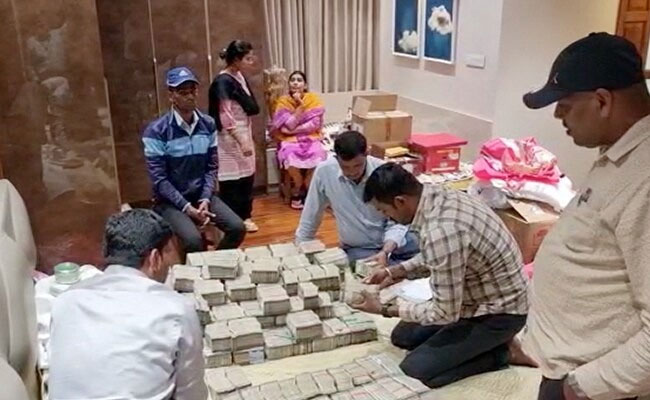
Bengaluru (PTI): Lokayukta sleuths recovered unaccounted cash of more than Rs six crore from the house of BJP MLA K Madal Virupakshappa's son Prashanth, close on the heels of his arrest after allegedly accepting a bribe of Rs 40 lakh.
Following the Lokayukta action against his son, the BJP MLA tendered his resignation as KSDL Chairman, even as he claimed that the raid by the anti-graft agency was a conspiracy against him and his family.
Chief Minister Basavaraj Bommai promised an impartial probe into the matter.
Prashanth, the chief accountant of the Bangalore Water Supply and Sewerage Board, was caught red-handed on Thursday evening while accepting the bribe from a contractor at the Karnataka Soap and Detergents Limited (KSDL) office.
Within hours of the trap, a team of Lokayukta officials raided his house and recovered the unaccounted cash.
Virupakshappa, MLA from Channagiri constituency in Davanagere district, is the chairman of KSDL and Prashanth was allegedly receiving "first installment" of the bribe on behalf of his father, according to Lokayukta sources.
Virupakshappa on Friday tendered his resignation from the post.
In his resignation letter sent to the chief minister, he said there is no "relation" between him and the Lokayukta raid, which he termed as a conspiracy against him and his family.
"Despite that since an allegation has been levelled against me, I am taking moral responsibility and submitting my resignation from the post of KSDL Chairman". he said.
Karnataka Lokayukta Justice (Retd) B S Patil said on Friday Rs 2.02 crore was recovered from the KSDL office and Rs 6.1 crore from Prashanth's house.
"Five persons (including Prashanth) have been apprehended and they have been taken into custody", he said. FIR has been registered. Meanwhile, Bommai promised an impartial inquiry and said those who have committed any wrongdoing must be punished. "This is the stand of the government".
He pointed out the incumbent government re-established the Lokayukta to check corruption.
"In the absence of the anti-corruption institution so many incidents had taken place during the Congress regime and were also hushed up", the Chief Minister said.
"Congress ministers and MLAs had 59 charges (against them) but it was hushed up as there was (only) ACB (Anti-Corruption Bureau). Once that is enquired by the Lokayukta, truth will come out", he said.
The action against Prshanth was proof that the Lokayukta has been revived to contain corruption unlike the previous Congress regime which created a separate ACB apart from the Lokayukta to "cover up their wrong deeds," Bommai said.
Due to the lack of a strong Lokayukta in the past, many corruption cases during the Congress regime could never get investigated, Bommai told reporters in Bengaluru.
"We have been repeatedly saying we will conduct impartial probe. Our stand in this case as well is that the independent Lokayukta institution will carry out impartial investigation and whoever has done wrong will face action. There is no change in our stand," Bommai said.
"All the information and the money found there everything is now with the Lokayukta. Let an independent and justified investigation take place. Our objective is that the truth should come out like whose money it was and for what purpose it was meant," he added.
Regarding Congress state president D K Shivakumar's statement that this incident was a proof that the current BJP government is 40 per cent commission government, Bommai said there were many corruption charges against Congress MLAs and ministers but they covered it up by creating the ACB.
He also said many corruption cases during the Congress regime have been given to the Lokayukta, which will investigate and bring out truth.
Let the Truth be known. If you read VB and like VB, please be a VB Supporter and Help us deliver the Truth to one and all.
Talks with Iran ended after 21 hours without reaching agreement, says US Vice President Vance
_vb_41.jpeg)
Islamabad (PTI): US Vice President JD Vance said on Sunday that the Islamabad Talks with Iran failed as the two sides could not bridge the gulf of differences despite hectic efforts spreading more than 21 hours.
Vance addressed a press conference here after “substantive discussions” in direct talks between the two sides -- the first since 1979 at this level --mediated by Pakistan.
“We have been at it now for 21 hours, and we have had a number of substantive discussions, that’s the good news,” Vance said.
“The bad news is that we have not reached an agreement,” he added.
“We have made very clear what our red lines are, what things we are willing to accommodate them on and what things we are not,” the US vice president said, adding that the Iranian delegation had “chosen not to accept our terms”.
He was asked to elaborate the main sticking points of what did the Iranians reject but he refused to go into specifics.
“I won’t go into all the details because I don’t want to negotiate in public after we negotiated for 21 hours in private. But the simple fact is that we need to see an affirmative commitment that they will not seek a nuclear weapon and that they will not seek the tools that would enable them to quickly achieve a nuclear weapon,” Vance said
He said stopping Iran from getting a "nuke" was the “core goal of the US president, and that’s what we have tried to achieve through these negotiations”.
Vance also praised Pakistan Prime Minister Shehbaz Sharif and Chief of Army Staff Field Marshal Asim Munir, terming them “incredible hosts”.
“Whatever shortcomings were in the negotiations were not because of Pakistanis, who did an amazing job and really tried to help us and the Iranians bridge the gap and get to a deal,” he said.
Separately, the spokesperson for Iran’s Ministry of Foreign Affairs, Esmaeil Baqaei, in an X message also confirmed that the two sides failed to make a deal and “numerous messages and texts have been exchanged between the two sides".
“In the past 24 hours, discussions were held on various dimensions of the main negotiation topics, including the Strait of Hormuz, the nuclear issue, war reparations, lifting of sanctions, and the complete end to the war against Iran and in the region,” he wrote.
“The success of this diplomatic process depends on the seriousness and good faith of the opposing side, refraining from excessive demands and unlawful requests, and the acceptance of Iran’s legitimate rights and interests.”
Baqaei also expressed appreciation to the “government and the warm-hearted and noble people of the Islamic Republic of Pakistan for hosting the negotiations and their benevolent efforts in advancing this process”.
_vb_48.jpeg)

_vb_17.jpeg)