RTI Act 20th anniversary: Congress warns against its erosion

Bengaluru (PTI): Marking the 20th anniversary of the Right to Information (RTI) Act, the Congress on Sunday reaffirmed the party's commitment to protect and strengthen the law, calling it one of the "greatest democratic reforms" of modern India and warned that its erosion amounts to an erosion of democracy itself.
In a statement, Deputy Chief Minister D K Shivakumar said the historic RTI Act came into being on October 12, 2005, during the UPA government led by Manmohan Singh.
The Act was a milestone in empowering citizens to access information, ensuring transparency and accountability in governance, and acting as a lifeline for the most marginalised sections of society.
However, since 2014, he said, “RTI has been consistently eroded.”
The 2019 amendments “weakened independence and increased executive influence” by giving the Union Government control over the tenure and service conditions of Information Commissioners.
“RTI has been one of the greatest democratic reforms of modern India, enabling citizens to hold power accountable and its erosion is an erosion of democracy itself,” said Shivakumar, also the Congress state chief.
Further, the 2023 Digital Personal Data Protection Act broadened the scope of ‘personal information’, effectively turning it into an absolute exemption from disclosure.
“By treating critical public data as private, this undermines public audit and scrutiny,” the note added.
The Deputy CM also flagged the weakening of Central and State Information Commissions, pointing out that the Central Commission currently has only two members against a sanctioned strength of 11, and that as of June 2024, over 4.05 lakh appeals and complaints were pending nationwide.
“No answers were given when RTIs sought details on the PM’s foreign tours or the functioning of the PM CARES Fund,” it observed.
The note highlighted attacks on RTI activists, including the killings of Shehla Masood and Satish Shetty, and criticised the non-implementation of the Whistle Blowers Protection Act, calling it a 'deliberate refusal' by the government.
Reiterating RTI’s role as a way of constitutional and social empowerment, the Congress demanded restoration of Information Commissions’ independence, amendment of DPDP Act provisions, filling of vacancies, performance reporting, protection for RTI users and whistleblowers, and inclusion of journalists, activists, and women in Commissions.
Let the Truth be known. If you read VB and like VB, please be a VB Supporter and Help us deliver the Truth to one and all.
Vijay secures majority support, set to stake claim to form Tamil Nadu govt
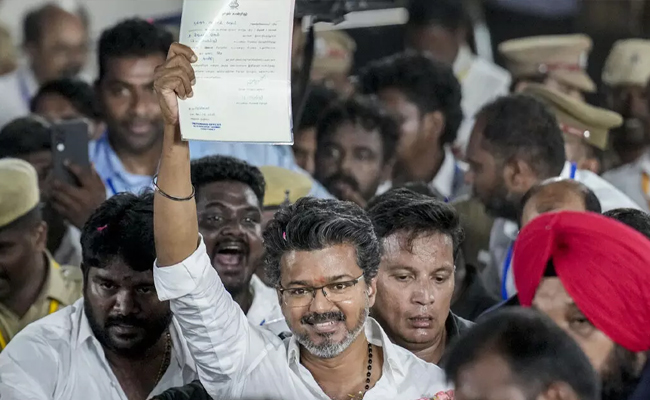
Chennai: After four days of political uncertainty and intense negotiations in Tamil Nadu, actor-politician Vijay is learnt to have secured the numbers required to form the government, sources said.
Supporters gathered outside Vijay’s residence in Chennai on Friday evening, raising slogans in support of Tamilaga Vettri Kazhagam soon after reports emerged that the party had managed to secure majority support.
Sources said Vijay is expected to meet Tamil Nadu Governor R. V. Arlekar on Friday evening to stake claim to form the government. The meeting is likely to take place around 6 pm.
In its electoral debut in the Tamil Nadu Assembly elections, TVK won 108 out of the 234 seats, dealing a major blow to the 62-year political dominance of Dravida Munnetra Kazhagam and All India Anna Dravida Munnetra Kazhagam.
However, Governor Arlekar had reportedly made it clear that the party would not be invited to form the government without proving a clear majority. Even after two rounds of discussions on Wednesday and Thursday, the Governor is learnt to have maintained his stand that letters of support from at least 118 MLAs must be submitted in the 234-member Assembly.
Apart from Vijay, TVK had the backing of 107 MLAs. Vijay had contested from Tiruchy (East) and Perambur constituencies and won both seats, meaning he would have to resign from one seat before taking oath. This increased the need for additional support.
Amid the political developments, five MLAs from the Congress party, which reportedly moved away from the DMK-led alliance, extended support to Vijay. Vijay also held discussions with leaders of Viduthalai Chiruthaigal Katchi, Communist Party of India (Marxist) and Communist Party of India.
The VCK, CPI(M) and CPI had so far been allies of the DMK. At the same time, political discussions intensified in the state over speculation that the DMK could even explore a post-poll understanding with its long-time rival AIADMK to prevent an alternative government from taking shape.
Reports had been circulating since Friday afternoon that the VCK and Left parties were likely to support Vijay. Sources later said that the VCK, CPI(M) and CPI agreed to extend the support of two MLAs each, helping TVK cross the required majority mark.
All eyes are now on the Governor’s next move and the official announcement regarding the formation of the new government in Tamil Nadu.