Sangh Parivar fanning agitations of various communities demanding reservation: Siddaramaiah
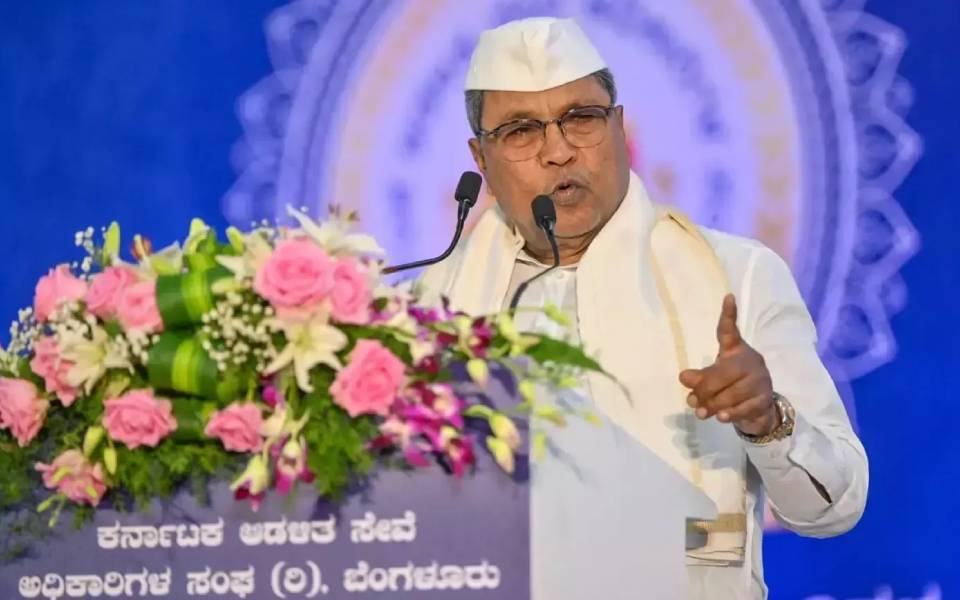
Bengaluru, Feb 14: Former Karnataka Chief Minister Siddaramaiah on Sunday alleged that Sangh Parivar leaders were fanning the agitation of various communities in the state demanding reservation, to 'mislead' their struggle for social justice.
Various communities led by their seers have intensified their ongoing agitation in Karnataka, demanding reservation and categorisation as Scheduled Caste/Scheduled Tribes.
In a series of tweets, the Congress stalwart advised people not to fall prey to the "mischievous misdeeds' of the Sangh Parivar" who are trying to create conflict in society."
"Always opposed to reservation, is the BJP leaders' out cry for reservation to various communities a genuine one? Or is it another political tactic to mislead the struggle for social justice?" Siddaramaiah asked.
It was not clear who the outfits, allegedly backed by BJP, were targetting, since it was the party led government at the state and Centre, he said.
"Why is the Sangh Parivar sponsoring the congregation of various castes which had organised a Hindu Samajotsava", he asked.
Various communities such as Panchamasali Lingayat,Valmiki, Kuruba and Idigas have intensified their demand for more reservation in government jobs and other sectors.
The Panchamasali sect has been demanding Category 2A status within Other Backward Communities, the Kurubas for ST status and Idigas, for SC status.
The Valmiki community wants reservation for them to be increased from three per cent to 7.5 per cent.
Let the Truth be known. If you read VB and like VB, please be a VB Supporter and Help us deliver the Truth to one and all.
Car driver alleges assault by auto drivers after minor road incident in Bengaluru
Bengaluru (PTI): In a suspected case of road rage, a car driver was allegedly chased and assaulted by two autorickshaw drivers following a minor road incident on Sarjapur Road here, police said on Monday.
The incident occurred on March 25 around 8.20 pm when Shriraj Bhardwaj, a native of Ajmer in Rajasthan, and his colleague were driving on Sarjapur Road and allegedly encountered an autorickshaw coming from the wrong side of the road, they said.
The victim later lodged an online complaint regarding the incident on March 26.
A senior police officer said that in this connection, a Non-Cognisable Report (NCR) has already been registered at the Bellandur Police Station and further investigation into the matter is underway.
Registration of NCR means the complaint has been noted in the station diary, but a formal FIR and investigation will require further legal steps or magistrate approval, police said.
Following the incident, Bhardwaj took to 'X', recalling the episode and claiming that it began with a negligible touch between the vehicles that caused no damage.
"What followed was not an argument, it was a chase. The auto driver started aggressively chasing us, trying to block our car multiple times in moving traffic, hitting the vehicle, and attempting to open the doors. We chose not to engage and instead tried to reach a safe place," he alleged.
According to him, the situation escalated when another autorickshaw joined the chase. Together, they allegedly blocked their path near Sarjapur Bridge, and one of them picked up a concrete stone and smashed the windshield of his car while they were still inside.
"We somehow managed to reach RGA Tech Park, thinking a gated office space would mean safety. It didn't. Both drivers followed us inside. Before I could even step out of the car, I was physically assaulted, repeatedly hit in the face, leaving me injured," he alleged.
"Only after things calmed down did the main accused flee. When the police arrived, the second driver apologised in front of them," Bhardwaj further alleged.
He said that following the incident, he has made up his mind to leave Bengaluru and never return.
Bellandur police said they have registered a non-cognisable report and traced the autorickshaw driver.
"The complainant is yet to record his statement for further action. We have been trying to contact him but he informed us that he is out of state. Further inquiry into the matter is underway," the officer said.
The auto driver, however, has alleged that his vehicle was damaged and that he was asking them to stop the car to resolve the issue, but they did not stop, which led to the incident.