SC quashes complaint against Karnataka IPS officer Devaraj in illegal detention, assault case
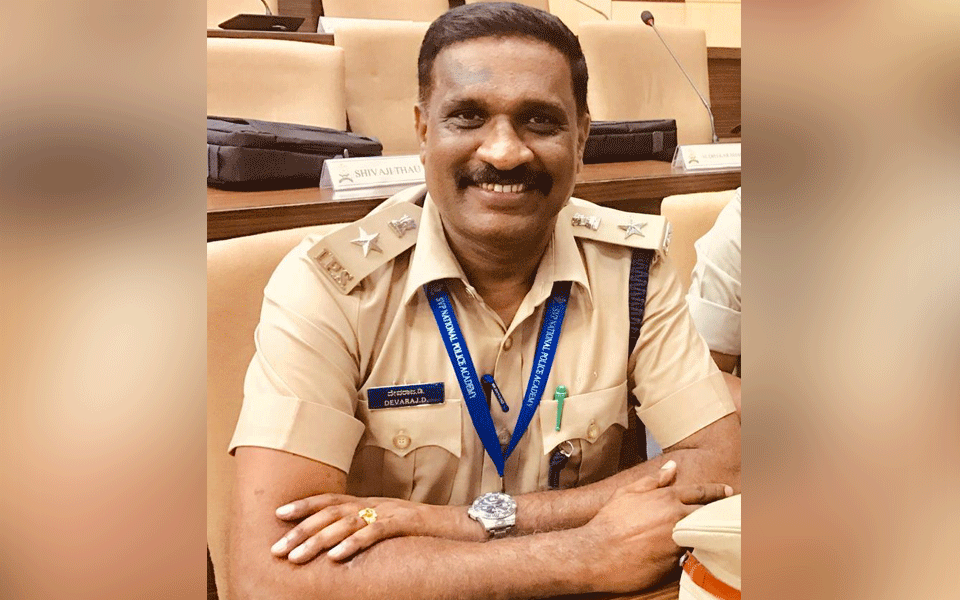
New Delhi: The Supreme Court on Thursday quashed the complaint filed against Karnataka IPS officer D Devaraj, for allegedly assaulting a man during the investigation of a case while he was serving as SP, Bangalore Metropolitan Task Force (BMTF) in 2013.
Devaraj is presently serving as the SP, CID had earlier approached the apex court to stay the criminal proceedings against him in the case challenging the Karnataka High Court’s order that had declined to stay the proceedings. The apex court had then in April 2018 stayed the criminal proceedings against the officer.
The officer had then submitted that high court, as well as the trial court, ignored that so far public servants were concerned, the cognizance of any offence is barred by Section 197 unless sanction was obtained from the appropriate authority, if the offence, alleged to have been committed, was in discharge of the official duty.
In his petition, the police officer contended that Hussain, after his arrest in a criminal case, was produced before the magistrate court on February 28, 2013. He was specifically asked as to whether there was any ill-treatment and no complaint was made by him. The doctor, who examined him on March 4, 2013, found that no abnormalities and no injuries were found on him, he had said.
Hussain had filed a private complaint against Devaraja, retired ACP H Siddappa, inspector Puneeth Kumar R, sub-inspector V R Deepak, and police constable Hanumesh for the offences of criminal conspiracy, assault among others. The court of Additional Chief Metropolitan Magistrate, Bengaluru had on December 27, 2016, taking cognizance of the complaint against them. The high court had refused to allow their plea under Section 482 of the CrPC for quashing the complaint. It had directed them to appear and seek discharge from the trial court.
Hussain had alleged that he was 'illegally detained and booked for a theft he never committed.' Hussain from New BEL Road had claimed that he was harassed after the police barged into his house in February 2013, by breaking open the door. They beat, abused, and arrested him for a theft case registered in Halasuru police station, he had alleged.
On Thursday, the Supreme Court set aside the Karnataka High Court order and quashed the complaint. It observed “Significantly, the High Court has by its judgment and order observed “it is a well-recognized principle of law that sanction is a legal requirement that empowers the Court to take cognizance so 35 far as the public servant is concerned. If at all the sanction is an absolute requirement, if it takes cognizance it becomes illegal therefore an order to overcome any illegality the duty of the magistrate is that even at any subsequent stages if the sanction is raised the Magistrate has to consider”.
“In our considered opinion, the High Court clearly erred in law in refusing to exercise its jurisdiction under Section 482 of the Criminal Procedure Code to set aside the order of the Magistrate impugned taking cognizance of the complaint, after having held that it was a recognized principle of law that sanction was a legal requirement which empowers the Court to take Cognizance. The Court ought to have exercised its power to quash the complaint instead of remitting the appellant to an application under Section 245 of the Criminal Procedure Code to seek discharge” the Court observed as it quashed the complaint against Devaraj.
Let the Truth be known. If you read VB and like VB, please be a VB Supporter and Help us deliver the Truth to one and all.
Real Madrid fines Valverde and Tchouaméni half a million euros each for altercation

Barcelona (AP): Real Madrid slapped players Federico Valverde and Aurélien Tchouaméni with half-a-million-euro ($588,000) fines on Friday for their altercation during practice.
The massive fines came a day after the midfielders tussled when the team trained. Valverde said in a post on social media on Thursday that no punches were thrown. But Valverde knocked his head on a table and he suffered a small cut that required a brief hospital visit.
On social media, Valverde initially called it a “meaningless fight” with a teammate and said “everything has been blown out of proportion."
His employers, however, considered it a significant enough breach of team discipline to nail both Valverde and Tchouaméni with fines that bite even the bank account of a top soccer player. The half-a-million euro penalties reflect the reputational damage the club was enduring in a chaotic end to a disappointing season.
In a statement, the 15-time European champion said its disciplinary action was concluded after both players expressed to the club “their complete remorse for what happened and apologized to one another.”
Madrid added they also apologized to their teammates, the coaching staff and club supporters, as well as showing their willingness to accept whatever disciplinary action the club deemed “opportune.”
Tchouaméni was back training with Madrid on Friday, two days before they play at Barcelona in a clasico. Madrid has to win otherwise Barcelona will be crowned La Liga champion.
After being notified of the fine, he posted a public apology to the club and its fans on social media.
“What happened this week in training is unacceptable,” Tchouaméni wrote. "I say this while thinking about the example we are expected to set for young people, whether in football or at school.
“Above all, I am sorry for the image we projected of the club.”
Valverde was not at practice due to the head knock.
Both players are set to play in the World Cup next month, with Tchouaméni playing for France and Valverde for Uruguay.
Chaotic end to a poor season
===================
The run-in between the players, who for seasons have played side by side in Madrid's midfield, came after they argued this week in previous training sessions. But tempers boiled over on Thursday. Spanish media was rife with reports that the players previously disagreed over the club's decision to let coach Xabi Alonso go after just months on the job.
It was not the only altercation involving Madrid players during training this week. Álvaro Carreras confirmed he was in a “minor” incident with a teammate. Spanish media said he and fellow defender Antonio Rüdiger got into a scuffle.
Álvaro Arbeloa, the coach who was promoted from Madrid's reserve team when Alonso was fired in January, will face tough questions on what went wrong inside the changing room when he gives a press conference on Saturday ahead of the clasico at Camp Nou.
Madrid is facing a second consecutive campaign without a major trophy amid rumors in the Spanish media that club president Florentino Pérez is considering bringing back Jose Mourinho to straighten out his underperforming team.