SC reserves verdict on ex-CM Yediyurappa's plea against revival of corruption case
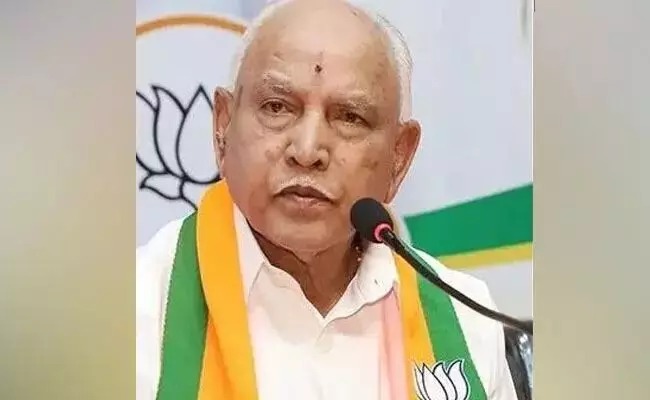
New Delhi(PTI): The Supreme Court has reserved its verdict on a plea of senior BJP leader and former Karnataka chief minister B S Yediyurappa against an order reviving a corruption case against him.
The Karnataka High Court, on January 5, 2021, allowed a plea of complainant A Alam Pasha, who hails from Bengaluru, and revived his complaint.
Pasha alleged corruption and criminal conspiracy against Yediyurappa and former Industries minister Murugesh R Nirani and Shivaswamy KS, former managing director of Karnataka Udyog Mitra.
The high court ruled the absence of prior sanction for prosecution—leading to the quashing of an earlier complaint—did not bar the filing of a fresh complaint once the accused had demitted office.
It, however, did not allow criminal prosecution of V P Baligar, a retired IAS officer and former principal secretary of the state government, in the corruption case.
On April 4, a bench comprising Justices J B Pardiwala and Manoj Misra concluded the hearings and framed several key legal questions for its adjudication including whether after a judicial magistrate has ordered probe under Section 156(3) of Code of Criminal Procedure (CrPC), would a prior sanction of the appropriate government authorities be still required under Section 17A of the Prevention of Corruption (PC) Act.
Section 156 (3) of the CrPC permits a judicial magistrate to order a police investigation into a complaint and it may include order for a preliminary inquiry or registration of an FIR.
Section 17A of the PC Act says, “No police officer shall conduct any enquiry or inquiry or investigation into any offence alleged to have been committed by a public servant under this Act, where the alleged offence is relatable to any recommendation made or decision taken by such public servant in discharge of his official functions or duties, without the previous approval...”
The top court framed seven crucial legal questions, primarily focusing on the interplay between various provisions of the PC Act and the CrPC on the issue of prior sanction to prosecute a public servant and power of the judicial magistrate to entertain a private complaint and order probe and an FIR.
“What are the relevant considerations as contemplated by Section 17A of the Prevention of Corruption Act, 1988 which the appropriate authority or government is expected to look into before the grant of approval for initiation of any enquiry, inquiry, or investigation by the police?” read the first question the bench framed.
Whether the considerations which weigh with the appropriate authority or government while granting approval under Section 17A of the PC Act are fundamentally so different from the one that a magistrate is ordinarily expected to apply while passing an order under Section 156(3) of the CrPC, read the second issue.
“In other words, whether the considerations under Section 17A of the PC Act are of such a nature that they are necessarily beyond the ambit or scope of consideration by a Magistrate while directing an investigation under Section 156(3) of the CrPC,” the bench said.
The top court asked if it could be said that once a magistrate has applied his mind under Section 156(3) of the CrPC, the requirement of a prior approval under Section 17A of the PC Act is meaningless, redundant and no longer necessary.
“Could it be said that a police officer, despite a direction under Section 156(3) by a Magistrate, would remain inhibited from conducting any enquiry, inquiry, or investigation without prior approval as required by Section 17A,” it added.
Whether a magistrate could proceed with inquiry under Sections 200 (examination of private complainant) and 202 (postponement of a criminal case) of the CrPC without prior sanction, and whether such actions are limited only to the pre-cognizance stage, read another question.
The top court asked the counsel of the senior BJP leader to file the written submissions within two weeks, along with relevant case laws addressing not just the framed questions, but any additional issues that may arise.
Pasha had initially filed a complaint alleging Yediyurappa and others conspired to forge documents to revoke the high-level clearance committee’s approval for allotting 26 acre of industrial land to him at Devanahalli Industrial Area.
The complaint, which invoked provisions under the IPC and the PC Act, was initially investigated by the Lokayukta Police, but in 2013, the high court quashed the complaint for a lack of mandatory sanction under Section 19 of the PC Act.
Subsequently, after the accused officials vacated their offices, Pasha filed a fresh complaint in 2014, arguing that sanction was no longer required in light of Supreme Court judgment in the A R Antulay case.
The special judge dismissed the second complaint in 2016, again citing lack of sanction.
Challenging this dismissal, Pasha approached high court which passed a partly favourable ruling.
Let the Truth be known. If you read VB and like VB, please be a VB Supporter and Help us deliver the Truth to one and all.
Galgotias accused of displaying commercial robot as own at AI Summit; clarifies after backlash
In another clip, University professor claims “developed by Galgotias”
New Delhi: A Noida-based private University, Galgotias has come under severe criticism after allegedly showcasing a china-made robotic dog at the India AI Impact Summit 2026 in New Delhi.
Social media users accused the university of purchasing a commercial robot from China and presenting it as its own creation at the summit.
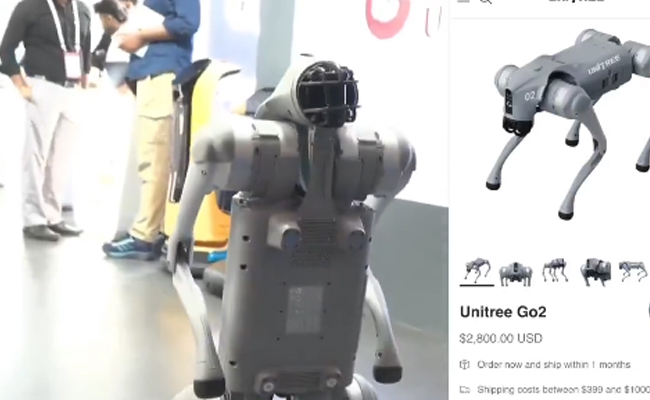
Reports claimed that the university showcased the Unitree Go2 robotic dog, an AI-powered device available on Chinese platforms for Rs 2–3 lakh, under the name “Orion” during the event in New Delhi.
“So Galgotia university purchased a commercially available robot worth Rs 2.5 lakhs, called it their own and passed it off in the Delhi AI Summit as a part of their 350 crore AI ecosystem..I literally have no words left,” wrote ‘X’ user Roshan Rai, sharing a video in which a DD News reporter interviewed a university official about the robotic dog.
So Galgotia university purchased a commercially available robot worth ₹2.5 lakhs, called it their own and passed it off in the Delhi AI Summit as a part of their 350 crore AI ecosystem 😭😭
— Roshan Rai (@RoshanKrRaii) February 17, 2026
I literally have no words left.
pic.twitter.com/tTozvotO5m
The viral post claimed that the robot closely resembles Unitree Go2, a quadruped robotic dog developed by Chinese company Unitree Robotics.
Screenshots attached to the post compared the robot displayed at the summit with the Unitree Go2 listing, priced at roughly 2,800 dollars (around Rs 2.3–2.5 lakhs).
According Unitree Robotics, The Unitree Go2 is widely used as a programmable quadruped robot for research, education, inspection, and development purposes, and is a common learning platform in universities and robotics labs worldwide.
Several users reiterated the claim.
🚨 Galgotias University again.
— Mr Sharma (@sharma_views) February 17, 2026
Showcased a commercially available $2,800 robot as an “AI breakthrough.”
No evidence of ₹350 crore original R&D.
This is how credibility erodes.
STOP EMBARRASSING INDIA ON THE WORLD STAGE. pic.twitter.com/SyJyIntRLa
This is Unitree Go2, an AI-powered Chinese robo dog that you can buy from Chinese websites for ₹2–3 lakh.
— THE SKIN DOCTOR (@theskindoctor13) February 17, 2026
Galgotias University, Gr Noida, presented it as their multi-crore AI innovation by naming it Orion at the AI Summit. Even Ashwini Vaishnaw, the concerned minister, used… pic.twitter.com/0ZoIAJCors
Government of India funds for filing patents
Meanwhile, concerns were raised about alleged misuse of government funds.
User @sky_phd highlighted, “Galgotias University is once again in the spotlight. Under the guise of research and innovation, they are raking in plenty of money.”
The user claimed that the university took money under government funds, and wrote, “The Government of India provides incentive funding of up to five lakh rupees for filing patents.”
“To understand the patent filing process and the games being played with it, take a look at the list of top Indian institutions filing patents. All the Indian Institutes of Technology (IITs) together file only 803 patents, while institutions like Lovely Professional University, Jain Deemed-to-be University, Galgotias University, and Teerthanker Mahaveer University have filed more than a thousand patents each,” the user wrote, sharing a chart of patent filings by these universities.
“The basic international patent filing fee is $285–400. Through patent filings alone, these institutions are reportedly earning more than fifty crore rupees annually. However, while these universities file patents, they often do not pursue them further, and most patents ultimately do not get granted. This inflates filing numbers but does not reflect real innovation or recognized intellectual property,” the user added.
Galgotias University एक बार फिर चर्चा में है। रिसर्च और इनोवेशन के नाम पर खूब पैसा बना रहे है। भारत सरकार पेटेंट फाइल करने के लिए पाँच लाख रुपये तक की प्रोत्साहन राशि देती है।
— Santosh Yadav, Ph.D. (@sky_phd) February 17, 2026
पेटेंट फाइलिंग की प्रक्रिया और इसके खेल को समझने के लिए टॉप पेटेंट फाइल करने वाले भारतीय संस्थानों की… pic.twitter.com/6gv6HzwM1l
Another user pointed out about the selection criteria of the summit. The user questioned, “What exactly was the selection criteria for participation in this AI summit? .”
“Platforms meant to showcase India’s innovation should represent genuine research, original ideas, and credible institutions. So how did Galgotias University qualify to display a Chinese-made robot and present it as its own “innovation”? If true, this isn’t just embarrassing, it undermines the credibility of the entire summit and of India’s growing tech ecosystem. At a time when India is trying to position itself as a global AI and deep-tech leader, showcasing repackaged imports as indigenous innovation only damages trust. If we want the world to take India’s AI ambitions seriously, transparency and authenticity must come first,” the user added.
Serious question: What exactly was the selection criteria for participation in this AI summit?
— Adarsh (@OpinionKraft) February 17, 2026
Platforms meant to showcase India’s innovation should represent genuine research, original ideas, and credible institutions.
So how did Galgotias University qualify to display a… pic.twitter.com/WJRAgXTMf6
University clarifies after backlash
In response to the criticism, Galgotias University issued a clarification, stating that it “never claimed to have built the device” and that the robot was procured from a Chinese manufacturer for academic purposes.
“Let us be clear, Galgotias has not built this robodog, nor have we claimed to do so. What we are building are minds that will soon design, engineer, and manufacture such technologies in Bharat," the university said.
The university in its statement also pointed out that the Unitree Go2 is being used as a learning tool for students.
“From the US to China and Singapore, we bring advanced technologies to campus because exposure creates vision, and vision creates creators. The robodog is actively being used by students to test capabilities and explore real-world applications,” the university added.
— Galgotias University (@GalgotiasGU) February 17, 2026
University professor claims “it's developed by the Center of Excellence at the Galgotias University.”
In another video captured by DD News, a reporter showcased the Galgotias University pavilion at the India AI Impact Summit 2026.
At the pavilion, the reporter spoke with the university professor about the technology on display.
The professor introduced the robot, saying, “This is Orion. You need to meet Orion. It has been developed by the Center of Excellence at Galgotias University.”
She added, “I would also like to brief you about Galgotias University. We are the first private university investing more than Rs 350 crore in artificial intelligence and have a dedicated data science and AI lab on campus.”
“Orion has been developed by our Center of Excellence. It can take all shapes and sizes and is quite playful. It can perform small tasks such as surveillance and monitoring. It can even execute movements like moonwalks and somersaults,” she explained.
She also claimed that, “This is India’s first iOS lab in North India at a university, giving our students hands-on experience with cutting-edge technology.”
Have some shame, in this video ur Professor is clearly saying that it's developed by Galgotias University. pic.twitter.com/xt5MkL8KEN
— Aniruddh Sharma (@AniruddhINC) February 17, 2026
Reacting to the video social media users ridiculed the 350 cr rupees investment compared to the china made robo dog.
Past Controversies of the University
This is not the first time the university is in controversy. In May 2024, during the Lok Sabha elections, a video went viral showing students protesting outside the Congress headquarters in New Delhi against the party’s manifesto. The footage, captured by Aaj Tak, showed students struggling to articulate the purpose of their protest, raising questions about the demonstration’s intent.
Students of Galgotias University are holding a protest against Congress , failing to answer the reason behind it #getstrolled #GalgotiyaUniversity #protests #trolled
— the swipe (@theswipenews_) May 2, 2024
Credits - Aaj Tak pic.twitter.com/xo87HLvngL
Earlier, in 2017, students protested against the university management after being barred from appearing in exams due to low attendance, with allegations that fines were requested to allow attendance, a claim denied by the administration.