Shivakumar asks chief secretary not to transfer water resource dept engineers without informing him

Bengaluru (PTI): Karnataka Deputy Chief Minister D K Shivakumar on Thursday said that he has written to the Chief Secretary Shalini Rajneesh not to transfer any engineer from water resource department, a portfolio that he holds, without informing him.
Speaking to reporters here, Shivakumar said, "We don’t have many engineers in the Water Resources Department. We urgently need engineers. Hence, I have written a letter to the Chief Secretary asking not to relieve or send any engineer elsewhere from our department”.
The Deputy Chief Minister said the engineers join the water resource department, get promoted and then get transferred to other departments including Public Works and Zilla Panchayat.
When asked who made the transfer without your permission, he said, "There is a scope for making such transfers at the top level. I won’t say that such scopes are not there. That’s why I am saying that many MLAs put pressure to send engineers to other departments.”
Shivakumar was aggrieved that engineers are not coming forward to work in the irrigation department.
“I have told the Chief Secretary not to transfer anyone without bringing it to my attention,” he told reporters.
Reacting to it, BJP state president B Y Vijayendra said, “These are mere indications. For sure, major changes in the state politics are in the offing. These developments are prelude to the climax.”
He also linked Chief Minister Siddaramaiah’s visit to senior Congress leader and MLC B K Hariprasad’s residence on Thursday morning with the "changing equations" in the state.
Let the Truth be known. If you read VB and like VB, please be a VB Supporter and Help us deliver the Truth to one and all.
Delhi's maximum temperature settles at 41.9 deg C
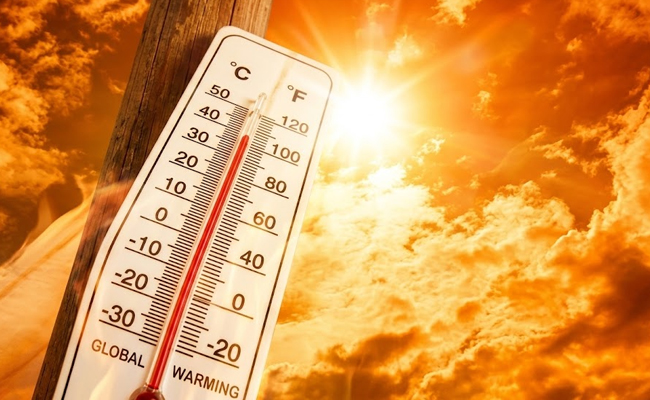
New Delhi (PTI): Delhi on Sunday recorded a maximum temperature of 41.9 degree Celsius, 1.5 notches above the seasonal average, according to the India Meteorological Department (IMD).
The minimum temperature settled at 25.9 degrees Celsius on Sunday morning, 0.6 notches below the seasonal average, the IMD stated.
The weather department predicted strong surface wind during the Monday morning, with the maximum and minimum temperature expected to hover around 44 degrees Celsius and 26 degree Celsius, respectively.
Relative humidity was recorded at 28 per cent at 5.30 pm.
The air quality was recorded in the 'moderate' category at 4 pm, with an Air Quality Index (AQI) reading of 174, Central Pollution Control Board (CPCB) data showed.
According to the CPCB, an AQI between zero and 50 is considered 'good', 51 to 100 'satisfactory', 101 to 200 'moderate', 201 to 300 'poor', 301 to 400 'very poor', and 401 to 500 'severe'.