Shobha Karandlaje urges Governor to withhold assent to Karnataka hate speech bill
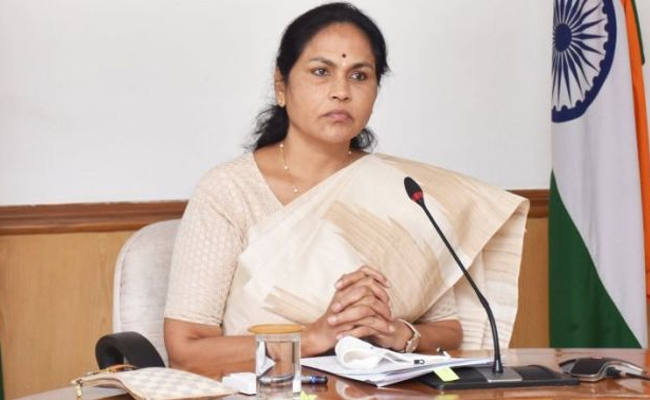
Bengaluru (PTI): Union Minister of State Shobha Karandlaje on Friday urged Governor Thaawarchand Gehlot to withhold assent to the Karnataka Hate Speech and Hate Crimes (Prevention) Bill, 2025, terming the Bill "vague, overbroad, and susceptible to misuse".
She also requested him to reserve the Bill for the consideration of President Droupadi Murmu under Article 200 of the Constitution of India, in the larger interest of constitutional governance, democratic freedoms, and the rule of law.
The bill, passed by both houses of the legislature, will be sent to the Governor for his assent.
Taking to social media 'X', the minister said, "The Karnataka Hate Speech and Hate Crimes (Prevention) Bill 2025 hands the State sweeping authority to silence opposition voices, restrain the media, and intimidate the citizens who defend Karnataka's land, language, and Dharma. This isn't a hate speech prevention bill, it's rather a bill that prevents the right to speech." "We will not let Congress turn the law into a tool to choke free speech and democratic dissent," she added.
In a letter to the governor, Karandlaje said the objective of the Bill is to address hate speech and hate crimes. However, upon careful examination, it becomes evident that the Bill, in its present form, establishes a "State-controlled mechanism" for monitoring, assessing, and penalising speech, rather than narrowly addressing expression that poses a clear and imminent threat to public order.
"The structure of the Bill enables executive authorities to determine the permissibility of expression, thereby transforming the law into a tool capable of suppressing voices critical of the government. Such an approach undermines the constitutional guarantee of democratic dissent and free expression," she said.
Citing reference of article 19(1)(a) of the Constitution of India that guarantees freedom of speech and expression to every citizen, she said, "The Bill departs from these constitutional limits by employing broad, vague, and subjective expressions such as "disharmony," "ill-will," and "prejudicial interest," which are not precisely defined. These terms confer excessive discretion on the Executive, enabling arbitrary and selective enforcement, which is inconsistent with constitutional safeguards."
She said the constitutional infirmities of the present Bill must be examined in light of the Supreme Court's judgment in Shreya Singhal v. Union of India, (2015), wherein the Court held that any law regulating speech must be clear, narrowly tailored and free from vagueness.
The minister alleged that the Bill further authorises executive authorities and law-enforcement agencies to assess and act upon speech without adequate judicial oversight. Penal consequences are linked to executive assessment, thereby concentrating investigative and adjudicatory functions within the Executive.
"Such an arrangement erodes procedural safeguards and is inconsistent with constitutional principles governing the protection of fundamental rights," she alleged.
Karandlaje also pointed out the potential impact of the Bill on "historically marginalised" and "constitutionally protected" voices.
"The vague and expansive language of the legislation is capable of being invoked to silence Kannada language activists, women's organisations, representatives of Scheduled Castes and Scheduled Tribes, backward classes, minorities, journalists, student groups, and civil society organisations that raise issues of governance, social justice, or administrative accountability," she said.
Instead of empowering vulnerable communities, according to the minister, the Bill risks becoming an instrument to deter them from articulating grievances and participating meaningfully in public discourse, thereby defeating the very constitutional promise of equality, dignity, and inclusive democracy.
The minister alleged that the cumulative effect of the Bill is likely to create a "pervasive chilling effect" on public discourse, which is incompatible with democratic governance.
Pointing out that the Bill directly impacts fundamental rights guaranteed under Part III of the Constitution, she said, "In view of the serious constitutional questions it raises, this is a fit case for the exercise of constitutional discretion under Article 200. Reserving the Bill for the consideration of the President would enable a broader constitutional examination of its implications for civil liberties and the federal constitutional balance."
Let the Truth be known. If you read VB and like VB, please be a VB Supporter and Help us deliver the Truth to one and all.
Man booked for duping 7 persons of Rs 91 lakh on promise of awarding govt works

Mumbai (PTI): The Mumbai police have registered a case against a man for allegedly duping seven persons of Rs 91 lakhs on the promise of awarding them works of different government departments, an official said on Tuesday.
The accused was identified as Satish Kadam, a resident of Nanded in Marathwada region, an official said.
A complaint was filed by Hanumant Vadje, who alleged that the accused cheated him and six others of around Rs 91 lakh by promising to give them various works of Urban Development and Social Justice Department, he said.
The fraud occurred between 2024 and 2026, with Kadam collecting money in cash and into his accounts, police said, adding he had returned some amount to them partially.
Multiple cheques issued by the accused bounced, prompting the victim to lodge a complaint at the Marine Drive police station. Based on the complaint, a case of cheating and criminal breach of trust was registered against him.
The case is under further investigation, the official said.