Siddaramaiah conspiring to win poll through ulterior motive: PM Modi
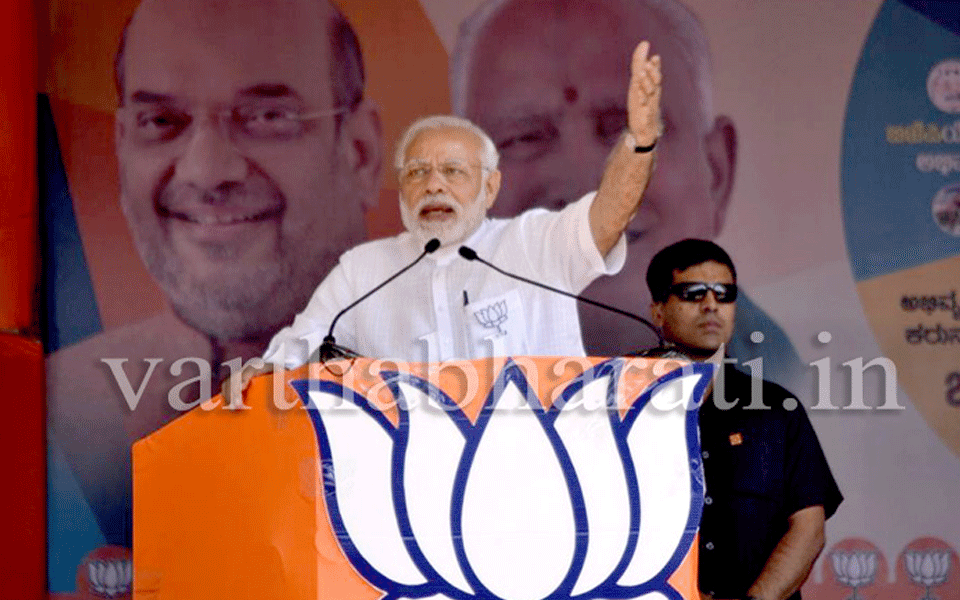
Chikmagaluru, May 9: Prime Minister Narendra Modi said that despite losing almost all states in the country, AICC president Rahul Gandhi, UPA Chairperson Sonia Gandhi and CM Siddaramaiah are behaving in arrogance.
Addressing the election rally organized here on Wednesday, PM Modi said that the time has to wipe out the Congress from the country. In the last four years, the Congress has lost all elections. It was defeated in almost all states in Uttar Pradesh. Even then, the arrogance of the Congress leaders has not come down, he said.
AICC president Rahul Gandhi camped in Karnataka for Assembly election. He has been criticizing the BJP government at the centre and praising Siddaramaiah government. But being the Lok Sabha Member, he has forgotten the development of his constituency Amethi. Now, he has eyed on PM chair. He has the concern only on PM chair and not the country. Congress party has become Gandhi family and in Congress, the PM chair belongs to only Gandhi family, he blasted.
Both Rahul Gandhi and Sonia Gandhi were on bail in Rs 5000 crore fraud. The Congress has lost its ground when this scam was exposed. In May 12 election, Karnataka people would permanently send mother-son duo to home. As Siddaramaiah came to know about this truth, Siddaramaiah has conspired to win the election through ulterior motive. But people would not accept it, he said.
When the Congress did not have ground in North India, Indira Gandhi had come to Chikmagaluru where she had won the election and entered the Lok Sabha. After she had won the election, she did not visit her constituency once. What was her contribution to Chikmagaluru which had given political rebirth to her? In the same way, Sonia Gandhi had promised Ballary people that she would bring Rs 3000 crore package to develop the constituency. Has she fulfilled her promise, he asked.
When Modi began his speech in Kannada and wished the people, people yelled in joy. Before the stage programme, BJP workers took out a bike rally and procession in the city.
BJP candidates CT Ravi, MP Kumaraswamy, DS Suresh, Belli Prakash and Suresh were present. Thousands of party workers from Hassan, Beluru, Sakaleshpur, Chikmagalur, Sringeri, Mudigere, Tarikere, Kaduru assembly constituencies were present.
‘Cong doesn’t believe in democracy’
Earlier, the Congress had misused the power given to them in the country and engaged in misrule. The entire world has accepted the working style of Election Commission of India. But the Congress has been saying that the Election Commission is not good. According to it, only Congress is good in this country. EVMs are wrong, they are right. It has been saying that even CBI and NIA are also not good, he said.
It is unfortunate that the Congress does not have belief on Army and defence system of the country. The Congress has tarnished the image of the country before the world through Bofors scandal. It does not have faith on the judiciary. If the naxalites, jihadis and terrorists were cracked, the Congress would find fault in that act also. When the RBI implemented new economic policies, the Congress is criticizing that. When the entire country expressed good thing about India, Congress has been alleging that Modi has purchased the entire world leadership, he charged.


Let the Truth be known. If you read VB and like VB, please be a VB Supporter and Help us deliver the Truth to one and all.
Man arrested for for raping mute woman in Jamshedpur

Jamshedpur (PTI): One person was arrested on the charge of raping a 30-year-old woman with speech impairment in Jamshedpur, a police officer said on Tuesday.
The incident occurred in the Azadnagar police station area of the city, and a case in this regard was registered based on the statement of the victim's brother on Monday.
The victim had gone to fetch water from the premises of a company on Monday evening. When she did not return even after a considerable time, family members went out in search of her and caught the accused red-handed, police said.
ALSO READ: BJP accuses Karnataka govt of 'failing' to prevent noise pollution caused by 'azaan'
The accused was a caretaker of the company.
Deputy Superintendent of Police (Patamda) Bachandeo Kujjur said due to scarcity of water in the area, the victim used to fetch water from the premises of the company.