Siddaramaiah fumes at opposition for targeting his wife in MUDA case
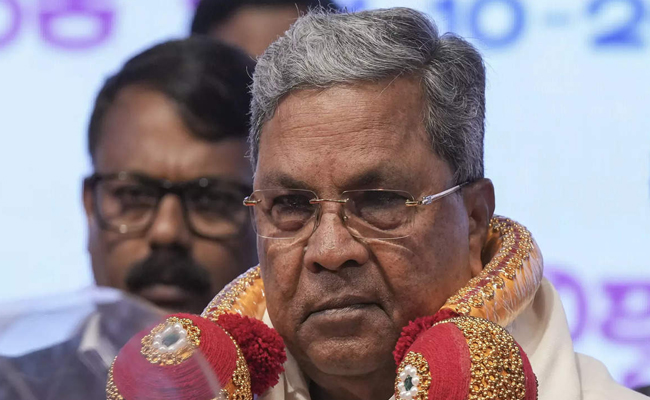
Raichur (Karnataka) (PTI): Karnataka Chief Minister Siddaramaiah on Saturday came down heavily on the opposition BJP and the JD(S) for dragging his wife Parvathi B M in the MUDA case, who had never stepped into public life and stayed within her house.
He also accused the opposition of targeting him because they could not tolerate a person from a backward community in the chief minister’s post.
Speaking at the ‘Swabhimani Samavesha’ (self-esteem convention) in Manvi Taluk, which was organised for the ‘AHINDA’ (minorities, backward and Dalit) communities, Siddaramaiah said the five guarantees introduced by the Congress government last year is strengthening the poor, backward, minorities, women and Dalits by raising their economical and social status, which the opposition BJP and the JD(S) could not tolerate.
"They (opposition) got so frustrated that they dragged my wife, who had never entered politics or stepped out of her house (in public life), on the road. You need to ask (opposition) this question whether this is justified," the chief minister said.
There is mounting pressure from the opposition parties on Siddaramaiah to resign from his post after a special court ordered the Lokayukta police on September 25 to investigate him in the Mysore Urban Development Authority (MUDA) site allotment case.
Accordingly, the Lokayukta police on September 27 registered an FIR against Siddaramaiah, his wife Parvathi, brother-in-law Mallikarjuna Swamy, Devaraju -- from whom Mallikarjuna Swamy purchased land and gifted it to Parvathi -- and others.
The order of the Special Court came a day after the High Court upheld the sanction granted by the Governor Thaawarchand Gehlot to conduct an investigation against Siddaramaiah.
The ED has also registered an Enforcement Case Information Report (ECIR), equivalent to an FIR by police, against the chief minister over the alleged irregularities in the allotment of 14 sites to his wife by the MUDA.
The MUDA on October 1 decided to take back the 14 plots allotted to Siddaramaiah's wife, following her decision to relinquish their ownership and possession. The MUDA has ordered to cancel the sale deed of these plots, its Commissioner A N Raghunandan had said.
Siddaramaiah asked the audience whether it was wrong to give them five guarantees and also Indira Canteens offering subsidised breakfast and meals, 'Ksheera Bhagya' scheme, 'Ksheera Dhaare' scheme, 'Vidya Siri' scheme and 'Mathrupoorna' scheme.
He alleged that the opposition wanted to tarnish his image and trouble him politically, though he did not commit any mistake.
"They want to topple the Siddaramaiah government for just one mistake, that I belong to a backward community. That’s their (opposition party leaders) heartburn. Can you tolerate this?" the chief minister charged.
"My mistake is that I worked towards giving the backward communities the kind of social freedom B R Ambedkar had dreamt of," he added.
Earlier speaking to reporters, Siddaramaiah said the ‘Swabhimani Samavesha’ was not against anyone but to increase the self-esteem of minorities, backward communities and Dalits (AHINDA communities) in the state.
Let the Truth be known. If you read VB and like VB, please be a VB Supporter and Help us deliver the Truth to one and all.
Sujit Nair raises concerns over speculation of DMK-AIADMK understanding to block TVK
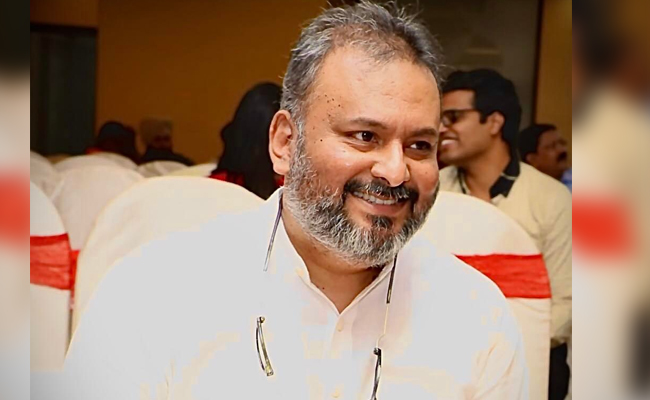
Chennai: Journalist and political commentator Sujit Nair has expressed concern over speculation that the Dravida Munnetra Kazhagam and the All India Anna Dravida Munnetra Kazhagam could explore a post-poll understanding to prevent Vijay-led Tamilaga Vettri Kazhagam from forming the government in Tamil Nadu.
In a social media post, Sujit Nair said the election verdict in Tamil Nadu reflected a clear public demand for political change and argued that the mandate should be respected irrespective of political preferences.
Referring to reports and political discussions surrounding a possible understanding between the DMK and AIADMK, he said he hoped such developments remained only speculative conversations and did not turn into reality.
Nair stated that if such an alliance were to take shape, it would raise serious questions about ideological politics in the country. He said TVK had emerged through a democratic electoral process and that the legitimacy to govern in a parliamentary democracy comes from the people’s verdict.
According to him, attempts to prevent an electoral winner from forming the government through unexpected political arrangements may be constitutionally valid, but many people could view them as politically opportunistic.
He further said that such a move could particularly affect the political image of the DMK, which has historically projected itself around ideology, social justice and opposition politics. Nair said that in ideological terms, the DMK appeared closer to TVK than to the AIADMK, and joining hands with its long-time political rival only to remain in power could weaken its broader political narrative.
He added that the same questions would apply to the AIADMK as well, as the party had spent decades positioning itself against the DMK and such an arrangement could create discomfort among its cadre and supporters.
Drawing a comparison with Maharashtra politics in 2019, Nair said he had expressed similar views when the Shiv Sena formed an alliance with the Indian National Congress and the Nationalist Congress Party after the Assembly elections.
He said post-poll alliances between long-standing political rivals often create a public perception that ideology and electoral mandates become secondary when political power equations come into play.
Nair also said such developments increase public cynicism towards politics and reinforce the belief among voters that ideology is often sidelined after elections.
He maintained that the Tamil Nadu verdict was emphatic and said respecting both the spirit and substance of the mandate was important for the credibility of democratic politics.