State only getting Rs. 2098 crore under 'Krishi Sanman': CM Kumaraswamy
State government is giving Rs 11K subsidy to farmers
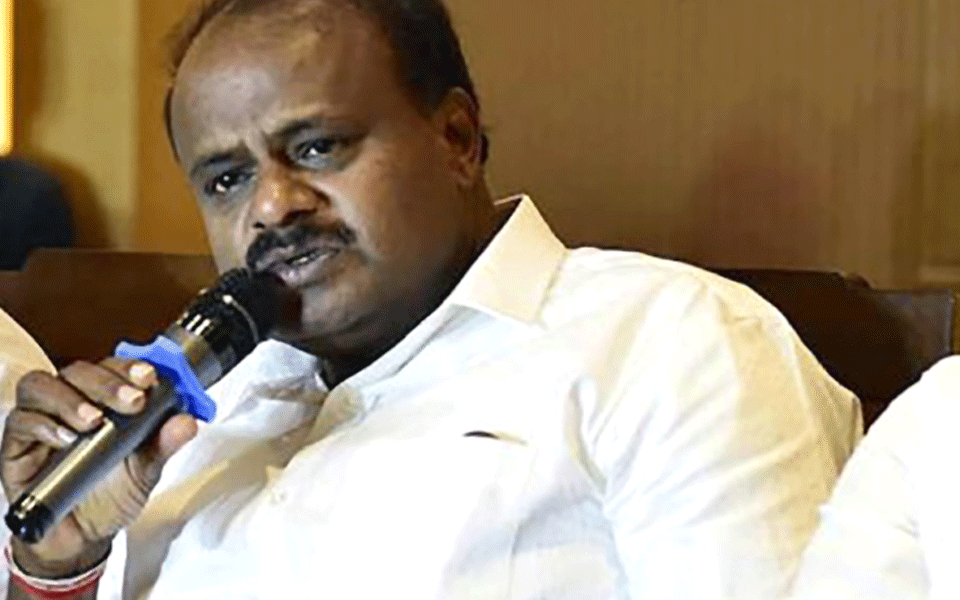
Bengaluru, Feb 5: Chief Minister HD Kumaraswamy said, the state will get only Rs 2098 crore under central government sponsored 'Krishi Sanman' scheme, while the state government has been giving Rs 11000 crore as subsidy to pump set users.
Speaking at the releasing of logo of BESCOM consumers awareness programme 2019, solar panel and power enabled vehicles recharging station, organised by the BESCOM at Halasur here on Tuesday, the Chief Minister said that the state was not getting much benefits from the scheme announced by the central government in its budget. Only 59-60 lakh farmers of the state would get the benefit. But the Energy department of the state government has been giving Rs 11000 crore subsidy to the farmers for their pump sets.
“With the free distribution of power, the power companies were under loss. The BESCOM itself was under loss at the time, of Rs. 4000 crore. So far it has not repaid it. The Chescom has Rs 800 crore loans and the KPTCL has the burden of Rs 16000 crore. Due to delay in payment of subsidy, the Escoms have been incurring minimum Rs 3000 crore to Rs 4000 crore loss. Farmers should also understand this. The farmers were being given free power since 2008 due to which, the subsidy dues have increased from Rs 4000 crore to Rs 11000 crore”, he said.
“In rural areas, the linemen and other staff should take precautionary measures for their safety. Awareness should also be created among consumers. The state was marching towards self sustainability in power production. But due to lapses, it was not succeeded”, he said.
BESCOM Ombudsman chairman SS Pattana Shetty said that consumer was important here as he was not dependent to anybody. He has given the opportunity to serve him. “We are not helping him through our service. Instead, we should thank them for giving us such an opportunity. So, we have to serve them better”, he said.
“Consumer Reddressal Forum was constituted in 2004 and the consumers should submit their grievances to the Forum. Every Saturday, the consumers could find solution to their problems. The forums were formed in all districts. But the consumers do not have information about it. The forums would report to the centre on complaints received and action taken. Surprisingly, there were no complaints in some districts. The consumers could lodge complaints if the companies have failed to provide around 15 services including delay in service, billing and others. The district level forums would give verdicts within 60 days and if the complaints were not resolved, they could move the state level Ombudsmen”, he said.
Power Department Additional Chief Secretary Ravi Kumar, BESCOM managing director Shikha, KASIA president Basavaraj Javali, Peenya Industrial Area Association president MN Giri, BESCOM citizens forum president Srinivas Marali, MLA Bhoje Gowda and others were present.
“If quality power and scientific price is ensured to their agriculture produces, the farmers would not ask free power. Steps have been taken to check the wastage of power by laying the power cable underneath. In future, the power cables laid already would be converted into underground cables. Along with this, internet Optical Fibre cable would also be laid”.
- HD Kumaraswamy, Chief Minister
Let the Truth be known. If you read VB and like VB, please be a VB Supporter and Help us deliver the Truth to one and all.
Cong slams Modi govt as 'anti-worker', calls for review of new Labour code
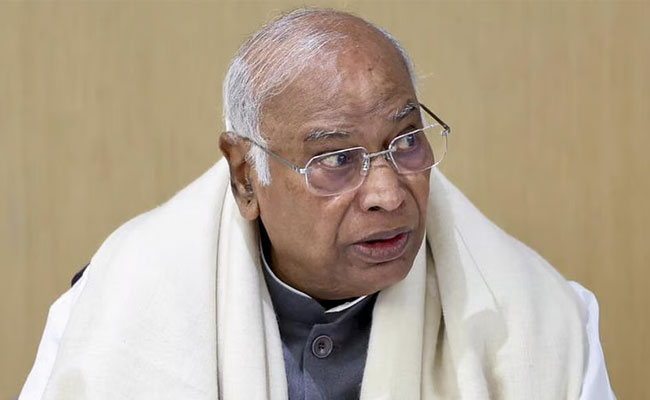
New Delhi (PTI): The Congress on Friday accused the Modi government of being "anti-worker" and demanded that the new labour code be reviewed, MGNREGA be revived as well as a national minimum wage of Rs 400 per day be established.
On International Labour Day, Congress president Mallikarjun Kharge took a swipe at the government and said unemployment in India today is a direct consequence of the 'Hum Do, Hamare Do' policies.
"Driven by the 'Hum Do, Hamare Do' policy, the Modi government implemented an anti-worker Labour Code. As a result, unrest has erupted everywhere - be it in Noida, at the IOCL facility in Panipat, Adani's factory in Raikheda, NTPC Patratu, or the Samsung factory in Sriperumbudur," Kharge said in a post in Hindi on X.
Instead of ensuring job security, this Code promotes policies such as contract labour and 'Hire & Fire' practices, Kharge said and called for a review of the new Labour Code.
The Modi government has effectively dismantled MGNREGA by forcibly pushing legislation through Parliament, he alleged.
"Mr. Modi has shifted 40% of the wage burden onto the State governments. State governments are unable to bear this financial strain and will eventually be forced to stop providing work," he claimed.
The Modi government has compelled workers into a state of unemployment and pushed them towards 'gig work', Kharge said.
Currently, 69% of the workforce is working for wages below the statutory minimum wage, he said.
The Modi government has engineered a crisis of stagnant wages, Kharge alleged.
"When adjusted for inflation, the wages of the majority of India's workers have grown by less than 1% annually over the last decade (from 2014-15 to 2022-23)," he said.
The Modi government has created a massive unemployment crisis among the educated workforce, specifically, among graduates, Kharge claimed and added that jobs have been eliminated through the sale of Public Sector Undertakings (PSUs).
"The government has refused to fill approximately 30 lakh vacant government positions. Furthermore, the government's policy blunders have led to the decimation of Micro, Small, and Medium Enterprises (MSMEs)," the Congress chief said.
The Congress reiterates its five demands for India's workers including revival of MGNREGA and its expansion to urban areas, Kharge said.
He said a national minimum wage of Rs 400 per day should be established, with MNREGA included within its scope.
Kharged demanded that a 'Right to Health' law must be enacted, providing Universal Health Coverage of up to Rs 25 lakh for laborers and workers.
"'Life Insurance and Accident Insurance' coverage must be provided for all unorganized workers. Preventing the contractualization of employment must be made a core priority of the government, and the new Labour Codes must be reviewed," Kharge asserted.