Storage shortage hits Karnataka’s onion farmers, may spike prices for consumers in lean season
_vb_47.jpeg)
Hubballi: A shortage of adequate storage facilities in Karnataka is taking a toll on onion farmers, who are unable to secure fair prices for their produce, while consumers face inflated prices during the lean season.
Karnataka, the country’s second-largest onion producer after Maharashtra, boasts an average annual output of 38.91 lakh tonnes. However, the lack of central storage facilities discourages farmers from growing onions as a rabi or summer crop, despite this being the optimal season for cultivation due to reduced risk of onions catching diseases and better shelf life, as reported by Deccan Herald on Sunday.
On an average, Karnataka can store only 3.75 lakh tonnes of onion in its central storage facilities. “In spite of favourable conditions for onion cultivation, we are unable to meet the demand and Maharashtra is benefiting from this,” DH quoted B. Ravi Shankar, Secretary of the Potato-Onion Merchants’ Association, Bengaluru, as saying.
He stressed the need for at least one large storage facility, with a 10,000-tonne capacity, in every district. Such infrastructure, he argued, would encourage more farmers to grow onions during the rabi season and regulate prices during the lean period between October and November.
The dry regions of Karnataka like Vijayapura, Gadag, Ballari, Koppal, Dharwad, Belagavi, Chitradurga and Kolar are some of the major onion growing districts in the state. However, these districts lack large storage facilities.
Meanwhile, onion prices have decreased across APMCs in Karnataka due to a bumper yield this year. In Bengaluru, wholesale prices are ranging between Rs 14 and Rs 21 per kg, while retail prices hover around Rs 25 to Rs 28. On an average, onions are priced at Rs 40 a kg, and can spike to Rs 100 during the lean months.
Let the Truth be known. If you read VB and like VB, please be a VB Supporter and Help us deliver the Truth to one and all.
Karnataka readies for deficit monsoon; CM Siddaramaiah orders water supply measures
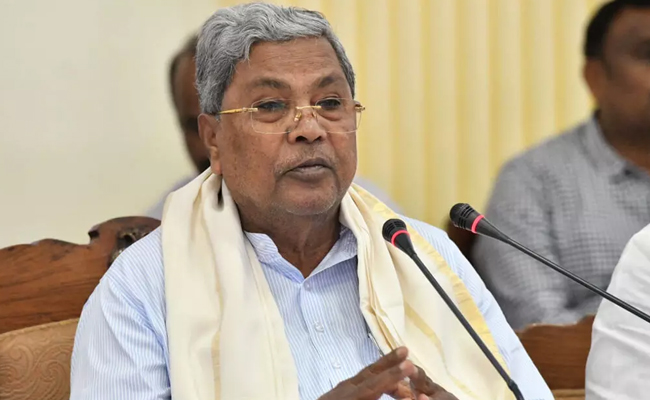
Bengaluru (PTI): Warning of a likely deficit monsoon across the state, barring five districts, Karnataka Chief Minister Siddaramaiah on Thursday instructed deputy commissioners to take precautionary measures to prevent disruption to the drinking water supply.
The CM chaired a meeting with district-in-charge ministers, deputy commissioners, and Zilla Panchayat chief executive officers to review drinking water supply in rural and urban areas during the peak of summer.
"The meteorological department has predicted below-normal monsoon rainfall this year. There is a possibility of normal rainfall in August, while less rainfall is expected in September," Siddaramaiah was quoted as saying in a statement issued by his office.
"If there is any disruption in the drinking water supply, the respective Deputy Commissioners will be held responsible," he said, directing the Revenue, Panchayat Raj and Urban Development departments to coordinate closely.
Stating that most districts in the north interior region are likely to experience more hot days than usual between April and June, the CM asked deputy commissioners to take appropriate precautionary measures.
He said forecasts by the meteorological department should be taken seriously.
Public shade and drinking water facilities should be provided, he said, adding that there is no shortage of funds to ensure water supply.
He also said the Finance Department has been instructed to release funds based on reports from deputy commissioners.
A total of 213 taluks and 2,410 gram panchayats have been identified as potentially facing drinking water shortages during summer. At present, 598 gram panchayats across 114 taluks are facing shortages.
Drinking water is being supplied to 137 villages through 129 tankers. As many as 585 private borewells have been rented to supply water to 515 villages.
The CM said shortages are likely in several districts, including Kalaburagi (147 gram panchayats), Bagalkot (114), Belagavi (127), Chikkamagaluru (115), Haveri (138), Mandya (130), Tumakuru (141) and Uttara Kannada (125).
At present, 27 urban local bodies are facing water shortages, while 95 have been identified as vulnerable. A total of 145 wards are being supplied water through 57 tankers, and 22 borewells have been taken on rent.
Tankers should be used only in emergencies, with priority given to renting private borewells, he said, adding that borewells can be drilled if necessary.
Highlighting that 321.93 TMC of water is currently available in the state’s 14 major reservoirs—36 per cent of total capacity—Siddaramaiah said this compares with 330.35 TMC during the same period last year. "Sufficient water is available in reservoirs for drinking purposes at present," he said.
With the monsoon likely to be delayed, he directed officials to ensure adequate drinking water availability in reservoirs till mid-July.
Drinking water supply should be prioritised over irrigation, he said, directing officials to identify and repair leakages in reservoirs.
Public grievances related to drinking water should be addressed promptly, with control rooms set up at the taluk and ward levels. District-level task forces should function actively, he added.
Cautioning about possible disruption in fertiliser supply due to the situation in the Middle East, the CM directed officials to prevent hoarding and ensure timely availability to farmers.
"Ensure proper distribution of urea and DAP and prevent their diversion to other states," he said, adding that inspections at check posts should be intensified.
He noted that due to good rainfall over the past two years, there is no immediate shortage of fodder, but availability should continue to be monitored. The CM directed that task force meetings on drinking water be held in all taluks and reports be submitted.
He also stressed the need to prevent the supply of contaminated water, saying deputy commissioners are responsible for ensuring safe drinking water and preventing related health issues.
Officials were asked to continuously monitor fertiliser sales to ensure an adequate supply for eligible farmers.
"Some districts, including Haveri, have recorded higher fertiliser sales than last year. What is the reason?" he asked, calling for close monitoring to prevent shortages.