Study flags crisis in state-run Moulana Azad Model Schools in Bengaluru
_vb_22.jpeg)
Bengaluru: A comprehensive ground-level study titled “A Study on the Condition of Moulana Azad Model Schools in Bangalore,” prepared by the Movement for Justice, has revealed severe structural, administrative, and academic shortcomings in the functioning of state-run Maulana Azad Model English Medium Schools (MAMS) across the city.
The study examines infrastructure, governance, enrollment patterns, teacher availability and learning outcomes in MAMS schools. It concludes that the gap between policy promises and ground reality is wide and growing.
The report warns that unless urgent corrective steps are taken, the original purpose of these minority schools may be completely weakened.
The Maulana Azad Model Schools were launched in 2017 by the Karnataka Minority Welfare Department and named after Maulana Abul Kalam Azad, India’s first Education Minister.
Known as English-medium government schools for Classes 6 to 10 under the State Secondary Education Board, the initiative aimed to provide quality education to students from minority communities. Students are entitled to free uniforms with complete kits and mid-day meals to improve attendance and nutrition, and free textbooks and basic stationery.
However, the study finds that the on-ground reality is far removed from these objectives.
The study was undertaken with three key objectives, to objectively assess the actual condition of government-run minority schools, to identify gaps in governance, infrastructure, and faculty welfare that hinder academic progress, and to propose corrective measures. Across almost all parameters, the findings point to deep and systemic deficiencies.
At the infrastructure level, the report documents an alarming absence of basic facilities in most schools.
Libraries, playgrounds, science laboratories, computer labs, clerical staff, watchmen, and sanitation workers are largely missing, the report added.
Acute space shortages have forced several schools to conduct classes in corridors, balconies, store rooms, and even staircases.
Classroom ventilation is consistently poor, and toilets are described as being in the “worst condition,” often without doors, lighting, or hygiene facilities, a situation that disproportionately affects girl students. Even the free uniforms supplied to students are reported to be of substandard quality, wearing out within six months.
Faculty-related issues are equally grave. Most MAMS schools do not have permanent teachers or permanent headmasters and instead depend heavily on guest faculty.
According to the report, these teachers are paid a monthly salary of just ₹12,500, have no job security, and frequently face delays in payment, severely affecting morale and teaching quality.
The report alleges that several schools lack Physical Training teachers and First Division Assistants. These constraints are reflected in academic outcomes, with SSLC pass percentages in several schools falling below 77 %, significantly lower than the state average.
Enrollment patterns further underline the crisis. Admissions remain low, and dropout rates are high across schools. The co-location of Urdu-medium schools for Classes 1 to 7 within the same premises delays students’ entry into MAMS, weakening continuity.
Migration-related irregular attendance further destabilises learning, while awareness about these schools is extremely poor. The report notes that 57 percent of MAMS schools are not even traceable on Google Maps. Governance failures are widespread, including the absence of School Development and Monitoring Committees, weak departmental oversight and minimal community engagement.
The report provides detailed school-wise findings that illustrate the depth of the problem. At the Kumbarpet, Kalasipalya MAMS, only 24 students are enrolled.
“The school has no permanent teachers or headmaster, suffers from poor sanitation, lacks a first-aid kit and toilet lighting, and operates with just two classrooms shared within an Urdu school building. An official letter has already been submitted seeking closure of the school,” added the report.
The report presents detailed school-wise findings. At Kumbarpet, Kalasipalya MAMS, only 24 students are enrolled. The school has no permanent teachers or headmaster, poor sanitation, no first-aid kit or toilet lighting, and operates with just two classrooms shared with an Urdu school. An official letter has already been submitted seeking the school’s closure.
At Shivajinagar (Black Palli) MAMS, which functions from a heritage building, only three classrooms are usable. During the monsoon, classes are held in corridors. The school has no laboratories and severely damaged toilets, making relocation urgent. Shantinagar (Jalakanteshwara Nagar) MAMS has relatively better infrastructure but no permanent staff, no laboratories or playground, no compound wall, poor ventilation, sanitation problems and frequent water overflow.
Kaggalipura MAMS shows a contrast. Despite achieving 100 percent SSLC results for two consecutive years, it operates with leaking roofs, no laboratories, no playground, insufficient classrooms and no attached PU college. The report notes that the school has received no government infrastructure support despite its strong academic performance. At KR Puram MAMS, construction work has remained stalled for over one-and-a-half years, leaving the school without laboratories, dining space or permanent staff.
Medahalli MAMS is described as being in extreme distress. The school runs five classes in just two rooms and has no playground, laboratories or dining space. Students eat their mid-day meals on the terrace under intense heat. The school recorded a 100 percent SSLC failure last year, with many non-native students struggling in Kannada. Uniforms reportedly deteriorate within half a semester.
Parangipalya MAMS suffers from overcrowding, foul-smelling and unhygienic conditions, lack of fans, and no laboratories or playground. Kannada learning difficulties are common, and enrollment has dropped sharply as students move into daily wage work. Arab Lane, Richmond Town MAMS, despite having adequate classrooms and permanent staff, functions at less than 50 percent capacity due to poor awareness and low interest among parents and students.
Shanti Nagar MAMS faces shortages of classrooms, poor toilet facilities, no laboratories and no permanent staff. Due to lack of space, its Class 10 students have been shifted to another school. Shikaripalya MAMS is identified as a comparatively better-performing school due to support from NGOs such as IIHS, ELCITA and the Upay Foundation, which have helped with remedial classes, computer labs, solar panels and infrastructure improvements. Even here, permanent staff are lacking and an attached PU college is needed.
Shivajinagar (Thimmaiah Road) MAMS has good infrastructure and permanent staff but continues to record low enrollment because of migrant student dropouts. The report also raises concerns about drug use by outsiders on the school campus. Anekal Town MAMS faces serious safety and health risks, as classes are held near a hospital mortuary with persistent chemical odours. The school lacks clean drinking water, CCTV cameras and has faced long construction delays.
Subhash Nagar MAMS struggles with combined classes, no playground or computer lab, poor sanitation and low student motivation. The headmaster is reportedly handling two schools at the same time. Ashok Nagar MAMS, despite having decent infrastructure, runs at only 50 percent capacity due to expansion limits linked to its heritage building.
Minhaj Nagar MAMS stands out as a success story, showing academic and infrastructure improvement due to strong leadership, community-funded remedial classes and official recognition. However, it still lacks a playground, library and computer lab.
MS Palya MAMS benefits from NGO and community support, including a science lab funded by World Vision and a good playground, but lacks clerical staff, a computer lab and needs Kannada remedial classes. Yelahanka Old Town MAMS has performed well academically due to stable leadership and community support, but does not have a playground.
Drawing lessons from better-performing schools, the report highlights that the presence of permanent headmasters, a higher proportion of permanent teachers, adequate infrastructure and active community and NGO participation directly correlate with improved enrollment and learning outcomes.
The study also analyses minority welfare budget allocations. For FY 2025–26, ₹126 crore has been allocated for MAMS maintenance and ₹100 crore for additional classrooms.
In 2024–25, ₹117.65 crore was earmarked for maintenance and ₹100 crore for construction, with ₹86 crore spent on building additional classrooms in 47 schools, averaging ₹1.8 crore per school.
In its concluding demographic analysis, the report points to a stark mismatch between need and capacity.
With Bengaluru’s Muslim population estimated at 16.25 lakh and around 1.14 lakh Muslim children in the 11–16 age group, only 2,033 students are currently enrolled in 17 MAMS schools, representing just 1.78 % coverage. To serve even 10 % of this population, the study estimates that at least 46 well-functioning MAMS schools, each with a capacity of 250 students, would be required.
The report urges the government to urgently address the structural, administrative and policy failures plaguing the Maulana Azad Model Schools. Without immediate and sustained intervention, it warns, the very purpose for which these minority schools, established as they are, stand at serious risk of being undermined.
Let the Truth be known. If you read VB and like VB, please be a VB Supporter and Help us deliver the Truth to one and all.
21 hours raid fetch nothing for ED, claims Karnataka Cong MLA’s son
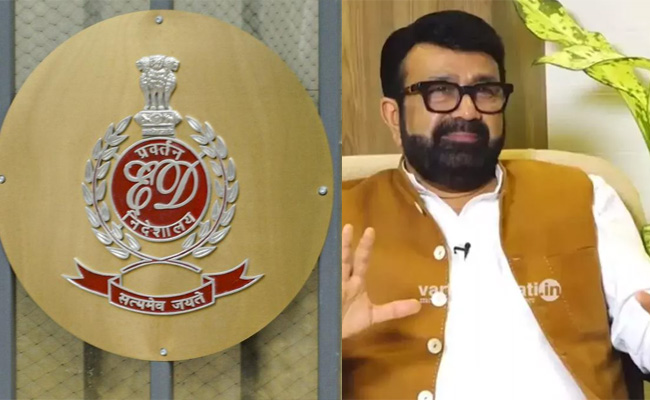
Bengaluru (PTI): Karnataka Congress MLA N A Haris' son Mohammed Haris Nalapad on Tuesday claimed that the 21 hours of search by the ED in his house and other locations did not fetch anything.
The Enforcement Directorate on Monday raided the premises of the two sons of Haris (Mohammed Haris Nalapad and Omar Farook Nalapad), Aqeeb Khan, grandson of ex-Union cabinet minister K Rahman Khan and an alleged crypto hacker named Srikrishna Ramesh alias Sriki in a crypto currency-linked money laundering case.
More than a dozen premises in the city have been covered as part of the action executed under the provisions of the Prevention of Money Laundering Act (PMLA).
"My grandfather is 89-year-old. There is not a single bad mark. My father (N A Haris) is a four-time MLA. There is not a single accusation against him. Their only intention was to target myself and my brother. As simple as that," Mohammed Nalapad, who is a former Karnataka Youth Congress president, told reporters.
According to him, the ED officials carried out raids for 21 hours.
"After 21 hours of search, they took away only two mobile phones from our house. They did not get a single paisa. The ED will testify it," the Congress leader said.
Exuding faith in the law, he said he is ready to fight the case in court.
"Me and my father have opted for politics and we are in public life. You can call me whatever you want but I have not done anything wrong," Mohammed Nalapad said.
Regarding his relationship with Sriki, he said he knew him but had no clue what he was doing.
"I have never said that either me or my brother do not know Sriki. But how will I know what he does in his house? Can his crimes be linked to us," he asked.
The money laundering case stems from some Karnataka Police FIRs and chargesheets filed in a 2017 case of hacking of national and international websites, stealing of bitcoins and sale of these 'stolen' virtual digital assets (VDA) through crypto platforms by the alleged hacker Sriki and his associates.
The Nalapad brothers and Aqeeb Khan are alleged to be the beneficiaries of the proceeds of crime generated through this alleged crypto-linked crime, the ED said.