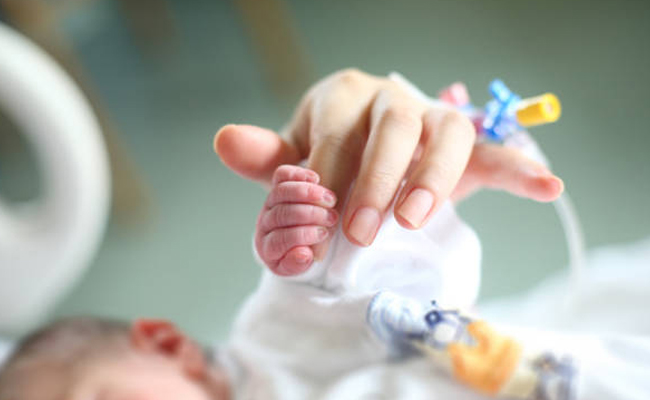
Bengaluru (PTI): Karnataka Health Department on Friday said the recent maternal deaths in Ballari are suspected to be due to the use of substandard ringer lactate solution that is administered intravenously to restore hydration and fluid balance in the body.
According to a statement, the solution was supplied by Paschim Banga Pharmaceutical Ltd to Karnataka State Medical Supplies Corporation Ltd.
The health department's officials said a sudden spurt in maternal deaths was reported from the Ballari district hospital between November 9 and 11. The deaths were reported to have occurred following caesarean operations at the hospital.
Of the 34 caesarean operations performed in those three days, seven cases developed complications.
In a statement, the health department said that out of the seven patients who developed complications such as acute kidney injury requiring haemodialysis and multi-organ dysfunction, four died.
Two have been discharged from the hospital and one patient is recovering at Vijayanagar Institute of Medical Sciences (VIMS), Ballari, it stated.
"There was a confidential review of the maternal deaths conducted by a team of specialists doctors constituted by the Rajiv Gandhi University of Health Sciences at the behest of the principal secretary of health and Family Welfare.
"On perusal of the report, it is evident that there has been no negligence or dereliction of duty by the team at District Hospital, Ballari," the statement said.
Citing the report, the officials said necessary protocols and guidelines for patient care, caesarean section procedure, recognition of complications and management were satisfactorily performed.
Despite the best team effort at the post-operative ward, ICU and dialysis unit of the District Hospital and VIMS Ballari, four patients could not be saved, they said.
"The onset of complications following caesarean operations is being suspected to the ringer lactate solution supplied by Paschim Banga Pharmaceutical Ltd to Karnataka State Medical Supplies Corporation Ltd (KSMSCL). Earlier, all 192 batches supplied by the said company were temporarily frozen by KSMSCL, even though two batches were declared not of standard quality on March 18, 2024, by the Drugs Control Department," a statement said.
"Later, following the certificate of standard quality by Central Drug Laboratories, the usage of ringer lactate of 84 batches was permitted by
KSMSCL on August 13, 2024," it said.
The statement added that currently, the ringer lactate solution batch has been withdrawn across the State and the fluids supplied to the Ballari district hospital have been sent for testing.
Let the Truth be known. If you read VB and like VB, please be a VB Supporter and Help us deliver the Truth to one and all.
New Delhi (PTI): From a climatology and diaster prediction system to a device that detects driver's fatigue to avert accidents, the India Army has showcased a slew of artificial intelligence-based applications at the AI Impact Summit here, with Defence Minister Rajnath Singh visiting the Army pavilion on Friday.
The Indian Navy has also put up a pavilion as part of the summit expo.
The AI Impact Summit is being held from February 16-20 at Bharat Mandapam, in which several heads of state, many global AI leaders, academicians and researchers, and heads of global tech giants, and philanthropists have taken part.
The Army has showcased several AI-based applications at its pavilion in Hall no. 4, and Defence Minister Singh interacted with military officials who gave him a tour of the pavilion, which has attracted both young and old-age visitors.
"Delighted to visit the AI Impact Summit at Bharat Mandapam today. India is rapidly emerging as a global leader in Artificial Intelligence and advanced technologies. The Summit showcases the immense talent of our innovators, researchers, startups, armed forces and industry leaders. India's AI vision MANAV, articulated by PM Shri @narendramodi at #IndiaAIImpactSummit2026, sets humanity’s direction towards a secure and future-ready world," Singh later posted on X.
"Guided by principles of morality, accountability, national data sovereignty, accessibility and robust systems, India is helping shape the next civilisational leap through responsible AI.
"AI is not just a driver of economic growth, but also a force multiplier for national security and good governance. I thank PM Modi for hosting the AI Summit in India. Compliments to the organising Teams and all participants for making this Summit a grand success," he added.
Prime Minister Narendra Modi inaugurated the summit on Thursday and unveiled the 'MANAV' vision for a human-centric approach and use of AI with a strong accent on sovereignty and inclusivity.
"Army officers and personnel, researchers and scholars, of course have come to our pavillion in the past few days, but youths too are showing keen interest in AI-based military applications. And, today the honourable defence minister visited and showed keen interest in knowing more about these applications," a senior Army official told PTI.
Some of the AI-based applications which have been showcased include 'Prakshepan' a military climatology and diaster prediction system; Xface -- a facial recognition system for rapid image and video-based verification in boosting security and surveillance mechanism; Nabhdrishti -- a telemetry reporting system which can capture positional data, imagery and orientation, "even based on images of an unidentified drone in flight"; and an AI-based device that detects driver's fatigue and alerts the person behind the wheels to avert accidents.
Lt Col A R Packianathan said 'Prakshepan' was launched by the defence minister last November.
The name draws from Sanskrit word 'Prakshepan', which means projection, he said.
At the Army pavilion, a dashboard has been displayed showcasing how the system works, with "near-live data".
"This application is a cutting edge military climatology application developed in-house by the Army's Directorate General of Information Systems. It has been powered by scientific and technical collaboration from several ministries with agencies like India Meteorological Department, National Centre for Medium Range Weather Forecasting, Central Water Commission, North East Space Application Centre, Geological Survey of India and Defence Geospatial Research Organisation," Lt Col Packianathan told PTI at the pavilion.
It has three prediction modules -- prediction of flood, of landslide and of an avalanche.
"This is India's first hybrid military climatology system capable of predicting landslides and avalanches 3-7 days in advance using multi-agency scientific datasets, terrain intelligence, and AI/ML (AI/machine learning) modelling," another Army official said.
The Indian Army in January had declared 2026 as the 'Year of Networking & Data Centricity' and said that this initiative will enhance connectivity, real-time decision-making and combat effectiveness, thereby strengthening resilience and agility for a future-ready force.
In line with the vision, the pavilion also showcases visual representations of Army assets and weaponry using holographic projections.
The Army has said that beyond military use, man of these application can have dual-use and help civilian administration and the masses as well,
So, 'Prakshepan' can provide early warnings to civil administration in remote areas, contributing to national disaster resilience and capacity building, Lt Col Packianathan said.
Similarly, the AI-based device that detects driver's fatigue and alerts the person behind the wheels can help avert accidents on highways for civilian drivers too, another official said.