There will be no multiple power centres: CM Basavaraj Bommai
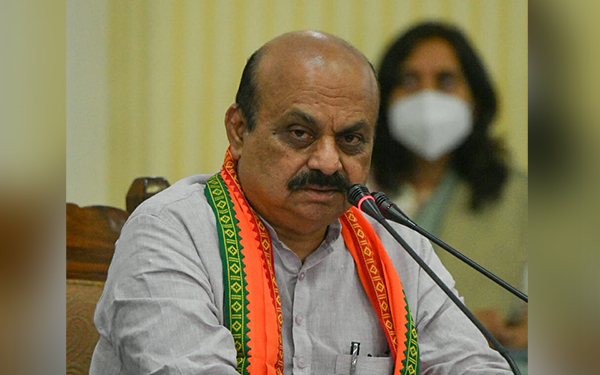
Bengaluru, Jul 28: Newly appointed Karnataka Chief Minister Basavaraj Bommai on Wednesday assured an efficient, honest and people-friendly government, as he asserted that there will be no multiple power centres in his administration and rejected suggestions about him being likely a "rubber stamp CM".
"My government will have the stamp of being a pro-people administration in the history of Karnataka and I will ensure it," Bommai told reporters here in response to a question on him being perceived in some quarters as a rubber stamp Chief Minister as he is a confidant of his predecessor B S Yediyurappa.
Responding to a question on power centres being created in the state with Yediyurappa still around in active politics, Bommai said in his administration the centre of power will be in the team not with individuals.
"In our system and the constitution there is the position of the Chief Minister, there is a cabinet, there is bureaucracy, executive and judiciary.The Chief Minister is first among equals, he is the team leader and I want to take everyone together," he said.
Bommai on Wednesday took oath as the new Chief Minister ending months of speculation about the change of guard in the state.
The Chief Minister said he will be visiting flood-ravaged Karwar on Thursday and was waiting for the Prime Minister's appointment for Delhi visit.
He also clarified that his first visit to Delhi is for meeting PM Narendra Modi, Home Minister Amit Shah, Defence Minister Rajnath Singh and BJP national president J P Nadda to thank them, and thereafter he will discuss with leaders on the cabinet expansion.
Asked about his statement on working under Yediyurappa's guidance, Bommai said, "When I say I will work under the guidance of Yediyuyrappa it means, following the strong and pro-people decisions taken by him during COVID.
Despite corona and financial distress he had formulated several schemes in the budget and has given a good administration."
The Chief Minister, who held a single member cabinet meeting and meeting with Additional Chief Secretaries and Principal Secretaries of various departments, said officials have been given a "broader picture on the orientation" of his government.
"There should be efficient, honest and people-friendly administration and with effective administration we should make people feel that the government is in favour of the last person of the society, the poor, the farmers, backward, women, and the downtrodden.Not by mere orders, but by its effective implementation."
He stressed the need for micro level management, owning responsibility for effective implementation of department's programmes, inter-department coordination and time bound implementation.
"We should work as a team."
Warning officials against "chalta hai" attitude, Bommai stressed the need for financial discipline, and asked officials to reduce unnecessary expenditure in departments to less than five per cent by March 31 next year, without affecting programmes.
To lessen the delay in file movements a new system will be introduced, and a file clearance drive will be held and detailed order will be issued in this regard, he said.
"Intention is to bring in an updated file clearance system, where files are cleared within 15 days."
Speaking on improving the state's financial condition, the Chief Minister said discussions will soon be held with the finance department on reducing committed expenditure along with planned expenditure, aimed at bringing in financial discipline.
"The immediate priority is COVID and floods management," he said, adding, steps that need to be taken on controlling the possible coronavirus third wave and vaccination, will be given utmost importance.
Let the Truth be known. If you read VB and like VB, please be a VB Supporter and Help us deliver the Truth to one and all.
Rupee falls 20 paise to 95.43 against US dollar in early trade

Mumbai (PTI): The rupee depreciated 20 paise to 95.43 against US dollar in early trade on Tuesday as market sentiments remained fragile after renewed military exchanges between US and Iranian forces in the Gulf region.
Forex traders said investor anxiety due to instability in the Gulf is causing massive capital flight into safe-haven assets, with the US dollar acting as the primary beneficiary.
Moreover, Brent oil prices is hovering near USD 113 per barrel, maintaining pressure on oil-importing economies like India.
At the interbank foreign exchange market the rupee opened at 95.30 then lost ground to touch 95.43 against the US dollar, in initial trade, registering a fall of 20 paise over its previous close.
Rupee fell 39 paise to close at an all-time low of 95.23 against the US dollar on Monday.
"With oil boiling rupee on Monday fell to a closing low of 95.0875 and this morning the opening was still lower as it becomes more and more vulnerable when dollar index rises due to safe-haven buying and oil prices rise due to the continuous fighting in the Gulf Region," Anil Kumar Bhansali, Head of Treasury and Executive Director, Finrex Treasury Advisors LLP, said.
The higher oil prices will keep rupee sold off against the dollar as oil companies and FPIs intensify dollar buying, Bhansali added.
Meanwhile, the dollar index, which gauges the greenback's strength against a basket of six currencies, was trading at 98.51, up 0.15 per cent.
Brent crude, the global oil benchmark, was trading lower by 1.07 per cent at USD 113.22 per barrel in futures trade.
"Market sentiments remained fragile after renewed military exchanges between US and Iranian forces when Iranian forces launched fresh attacks in the Gulf as both sides sought to assert control over the strategic waterway," Bhansali said.
On the domestic equity market front, Sensex declined 361.62 points to 76,907.78 in early trade, while the Nifty dropped 134.90 points to 23,980.60.
Foreign Institutional Investors purchased equities worth Rs 2,835.62 crore on Monday, according to exchange data.