
Those wearing 'hawai chappals' should travel in 'hawai jahaz', says PM Modi
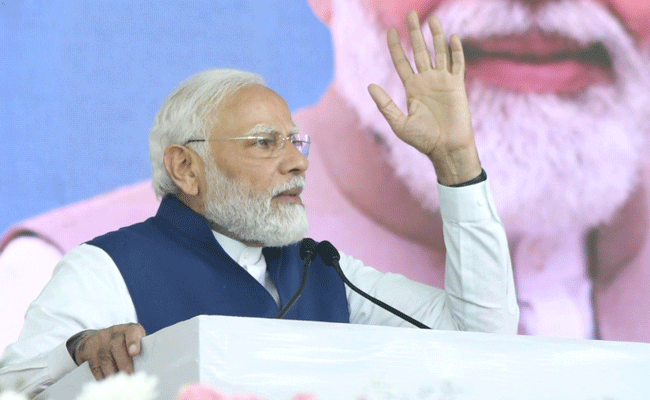
Shivamogga (Karnataka) (PTI): "Those wearing 'hawai chappals' should travel in 'hawai jahaz' (aircraft). I'm seeing it happening", Prime Minister Narendra Modi said on Monday as he highlighted that India's aviation market is growing rapidly.
Speaking at a public meeting after inaugurating the Shivamogga airport, he said in the coming days India will need thousands of aircraft, and the days of Made-in-India passenger aircraft are not far.
Modi also took a dig at the Congress, saying before 2014 Air-India was often discussed for negative reasons, and the company was recognised for scams during that party's rule. The inauguration of the airport coincided with the 80th birthday of Karnataka BJP strongman and four-time Chief Minister B S Yediyurappa, who hails from Shivamogga district.
Modi asked people to switch on their mobile flash lights to commemorate Yediyurappa's birthday.
Karnataka has made up its mind to repeatedly give opportunity to "double engine" government, he said. This is Modi's fifth visit this year to the State, where Assembly elections are due by May.
The new airport has been developed at a cost of around Rs 450 crore. The passenger terminal building of the airport can handle 300 passengers per hour.
The airport is expected to improve connectivity and accessibility from Shivamogga and other neighbouring areas in the Malnad region of Karnataka, officials said In all, the Prime Minister inaugurated and laid the foundation stone of multiple development projects worth more than Rs 3,600 crore here.
Union Minister Pralhad Joshi, Chief Minister Basavaraj Bommai and Yediyurappa were among those present on the occasion.
Let the Truth be known. If you read VB and like VB, please be a VB Supporter and Help us deliver the Truth to one and all.
Talks with Iran ended after 21 hours without reaching agreement, says US Vice President Vance
_vb_41.jpeg)
Islamabad (PTI): US Vice President JD Vance said on Sunday that the Islamabad Talks with Iran failed as the two sides could not bridge the gulf of differences despite hectic efforts spreading more than 21 hours.
Vance addressed a press conference here after “substantive discussions” in direct talks between the two sides -- the first since 1979 at this level --mediated by Pakistan.
“We have been at it now for 21 hours, and we have had a number of substantive discussions, that’s the good news,” Vance said.
“The bad news is that we have not reached an agreement,” he added.
“We have made very clear what our red lines are, what things we are willing to accommodate them on and what things we are not,” the US vice president said, adding that the Iranian delegation had “chosen not to accept our terms”.
He was asked to elaborate the main sticking points of what did the Iranians reject but he refused to go into specifics.
“I won’t go into all the details because I don’t want to negotiate in public after we negotiated for 21 hours in private. But the simple fact is that we need to see an affirmative commitment that they will not seek a nuclear weapon and that they will not seek the tools that would enable them to quickly achieve a nuclear weapon,” Vance said
He said stopping Iran from getting a "nuke" was the “core goal of the US president, and that’s what we have tried to achieve through these negotiations”.
Vance also praised Pakistan Prime Minister Shehbaz Sharif and Chief of Army Staff Field Marshal Asim Munir, terming them “incredible hosts”.
“Whatever shortcomings were in the negotiations were not because of Pakistanis, who did an amazing job and really tried to help us and the Iranians bridge the gap and get to a deal,” he said.
Separately, the spokesperson for Iran’s Ministry of Foreign Affairs, Esmaeil Baqaei, in an X message also confirmed that the two sides failed to make a deal and “numerous messages and texts have been exchanged between the two sides".
“In the past 24 hours, discussions were held on various dimensions of the main negotiation topics, including the Strait of Hormuz, the nuclear issue, war reparations, lifting of sanctions, and the complete end to the war against Iran and in the region,” he wrote.
“The success of this diplomatic process depends on the seriousness and good faith of the opposing side, refraining from excessive demands and unlawful requests, and the acceptance of Iran’s legitimate rights and interests.”
Baqaei also expressed appreciation to the “government and the warm-hearted and noble people of the Islamic Republic of Pakistan for hosting the negotiations and their benevolent efforts in advancing this process”.
_vb_48.jpeg)

_vb_17.jpeg)