Time will reveal if leadership change in Karnataka is imminent: Shivakumar
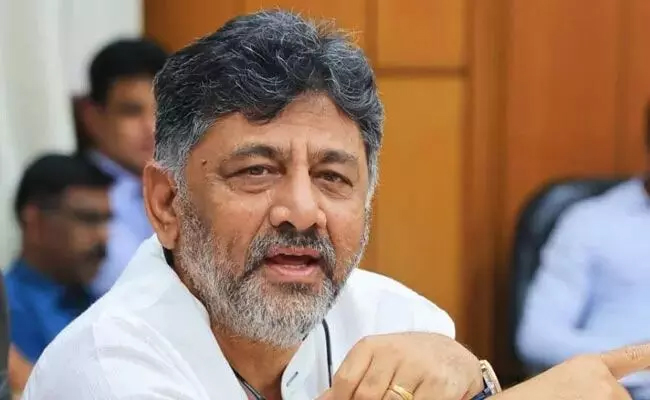
Hubballi (Karnataka) (PTI): Karnataka Deputy Chief Minister D K Shivakumar on Tuesday said time will tell if the state will see a new CM after the by-elections to two assembly seats.
Bypolls for the Bagalkot and Davanagere South Assembly constituencies will be held on April 9. The polls were necessitated following the deaths of senior Congress MLAs H Y Meti and Shamanur Shivashankarappa, respectively.
"Why are you worried about it? There is no need to make it an issue... I have already said that time will answer it," Shivakumar told reporters in response to a question about whether he would become the CM and if there would be a leadership change after the bypolls.
Responding to statements by some leaders, including Minister Zameer Ahmed Khan, that incumbent Siddaramaiah will be CM till 2028, he said, "I'm not ready to comment on statements made by others. I'm the party president... either the CM or I will have to speak on this matter. Other than what the two of us say, the rest is immaterial."
Asked about the secret behind his patience, Shivakumar replied, "Time will answer."
Recently, Siddaramaiah had said that the Congress government will remain in power for two more years and that he is the Chief Minister of the state.
The leadership tussle within the ruling party has intensified amid speculation about a possible change of chief minister after the Congress government completed the halfway mark of its five-year term on November 20, 2025.
The speculation has been fuelled by the reported "power-sharing" arrangement between Siddaramaiah and Shivakumar at the time of government formation in 2023.
Let the Truth be known. If you read VB and like VB, please be a VB Supporter and Help us deliver the Truth to one and all.
Two labourers killed in crane collapse at Link Road project site in Thane district

Thane (PTI): Two labourers were killed on Saturday when a crane collapsed at the under-construction Dahisar-Bhayander Link Road project site in Maharashtra's Thane district, police said.
According to the police, the “gantry crane coastal girders platform”, where labourers were working, suddenly collapsed at 12:30 PM in Bhayander (West), severely injuring Raghunath Das (38) and Kana Singh (45). They were declared dead at a hospital.
"Police have registered a case of accidental death and are investigating," said Bhayander police station senior inspector Jitendra Kamble.
Police said further investigation is underway to ascertain the exact cause of the crane collapse and to determine if any negligence was involved.
The Dahisar-Bhayander Link Road (DBLR) elevated coastal road project connects Dahisar (West) and Bhayander (West).