Tipu Sultan’s rockets found in abandoned well in Shimoga
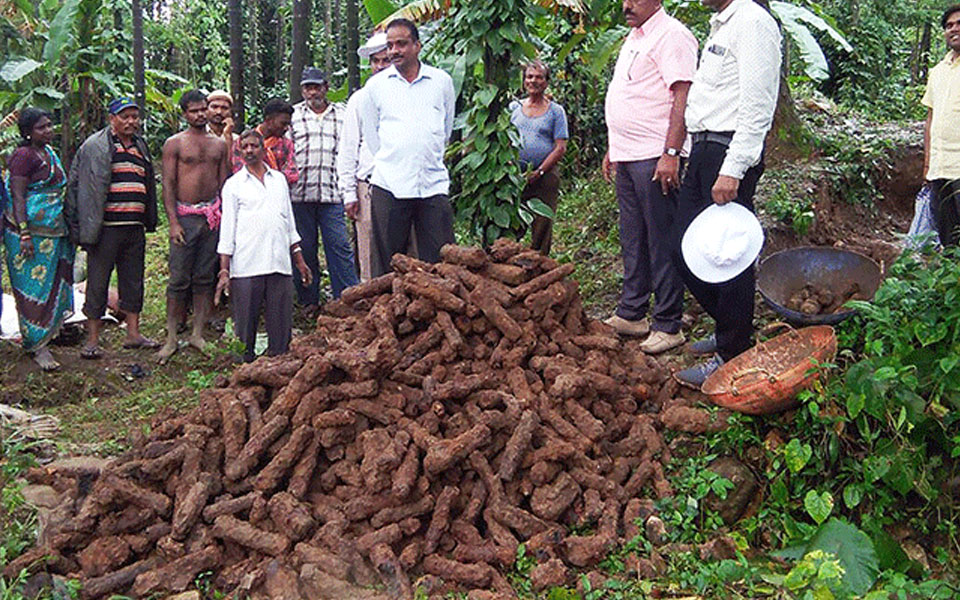
Shimoga: More than 1,000 rockets belonging to an 18th-century warrior king Tipu Sultan have been found by excavators in an abandoned well at Hosanagara taluk near Sagar in Shimoga.
The excavation of the open well in the Shimoga district led to the unearthing of rockets and shells stored by Tipu Sultan for use in wars, according to the state’s assistant director of archaeology.
According to archeological records, the fort area in Shimoga was part of Tipu Sultan’s kingdom. The powerful ruler was martyred in the fourth Anglo-Mysore war in 1799 after a string of victories in battle against the British East India Company.
He is credited with developing an early, indigenous rocket known as the Mysorean, a prototype of British Congreve rockets used in the Napoleonic wars.
“Excavation of the open well led to unearthing of over 1,000 corroded rockets that were stored during Tipu’s times for use in wars,” R Shejeshwara Nayaka told an International news agency.
“Digging of the dry well where its mud was smelling like gunpowder led to the discovery of the rockets and shells in a pile.”
It took three days for the 15-member team of archaeologists, excavators and labourers to unearth the armoury and ammunition. The rockets, measuring 23-26cm (9-10ins), will go on display at a museum in Shimoga.
Let the Truth be known. If you read VB and like VB, please be a VB Supporter and Help us deliver the Truth to one and all.
BJP eyes gains in polls to five assemblies; West Bengal main challenge

New Delhi (PTI): Stakes are high for the BJP in the upcoming polls to five assemblies, with West Bengal being the major test case for the saffron party.
In the 2021 West Bengal assembly polls, the BJP emerged as the main opposition with its tally surging to 77 seats in the 294-member assembly from three in 2016.
With a recalibrated poll strategy, the BJP is confident of unseating the TMC from power this time by cashing in on the anti-incumbency sentiments against the Mamata Banerjee government. The party is also hoping to gain public sentiment by raising the issue of corruption and infiltration in the state.
The TMC has been in power in West Bengal for 15 years.
However, the biggest challenge for the BJP is the absence of a local charismatic leader in West Bengal. While the saffron party is banking on Prime Minister Narendra Modi's leadership to win the battle there, Banerjee continues to be a formidable face in the state.
In Assam, the BJP-led NDA is confident of scoring a hat-trick under the leadership of Chief Minister Himanta Biswa Sarma, banking on its governance record and organisational strength.
But its march to victory may not be a cakewalk, with the Congress-led opposition making efforts to cash in on anti-incumbency and local grievances against the ruling dispensation.
The BJP-led NDA may also face resistance from sections of minority voters, particularly Bengali-speaking Muslims, amid criticism from the opposition over the government's eviction drives and rhetoric around illegal immigration.
Issues such as long-pending demands of six communities for Scheduled Tribe status could also figure in the electoral discourse.
The BJP has been on the rise in Assam since the 2014 Lok Sabha polls and came to power in the state for the first time in 2016 by winning 60 seats in the 126-member assembly. It improved its tally to 64 in the 2021 assembly elections.
Its allies AGP, UPPL and BPF have nine, seven, and three MLAs in the outgoing assembly.
In the opposition camp, the Congress has 26 MLAs, AIUDF has 15 members, and CPI(M) has one MLA. There is an Independent legislator as well.
In the south, the BJP has been making renewed efforts to expand its toehold in Kerala, Tamil Nadu and Puducherry, banking on its performance in past elections. But its success depends on its allies.
The BJP, which could not win any seat in the last assembly polls in Kerala, is hoping to gain some ground this time, riding on its success in the recent civic body polls, even as the Congress-led UDF and CPI(M)-led LDF are the prime contenders in the state.
Assembly elections in Assam, Kerala and Puducherry will be held on a single day on April 9, in Tamil Nadu on April 23, and in two phases in West Bengal on April 23 and 29, while votes will be counted for all polls on May 4, the Election Commission announced on Sunday.