Twitter user schools MP Tejasvi Surya over Bengaluru history
"BJP insulting Legacy of Karnataka and Kempe Gowda"
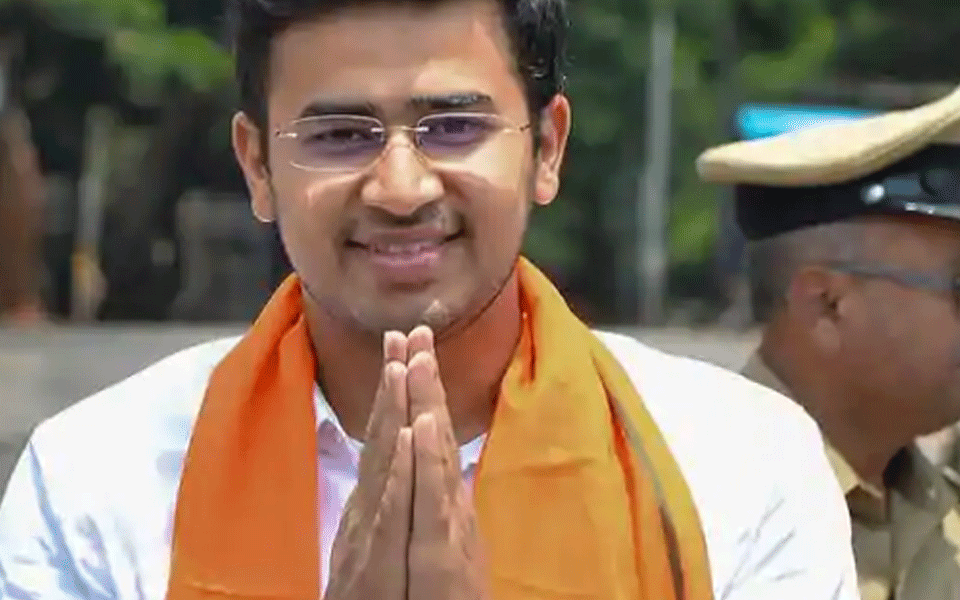
BJP MP Tejasvi Surya was once again in troubled waters on micro-blogging site Twitter as he posted a tweet while replying to a post by another twitter user, where the MP went on to add that until Afzal Khans are ‘romanticised’ Shivaji’s vigil must continue.
He was replying to a tweet posted by user Farah Khan where in the user who had added that the people of the country are refuting the facts that under Mughals the Indian economy boasted a 24.4 percent World GDP share, higher than even China and Europe.
“I lie & d whole world does 2. But u Mr Pai know best. Are u still refuting d fact that under d Mughals d Indian Economy had 24.4 percent world GDP share higher than even China or Europe?The Mughals contributed to d period of Golden Art &Architecture &History hold that true not me” Farah had tweeted while replying to another tweet.
Tejasvi Surya jumped into the debate and added that even educated, liberal and modern Muslims romanticize Mughal rule and added that they describing ‘atrocious’ period as India's golden age proves, beneath the apparent modernism, sophistication & polish lies 16th century bigotry.
“That even 'educated', 'liberal' & 'modern' Muslims romanticise Mughal rule & describe atrocious period as India's golden age proves, beneath the apparent modernism, sophistication & polish lies 16th century bigotry. Till Afzal Khans are romanticised, Shivaji's vigil must continue” Surya wrote in his tweet.
Taking note of Surya’s remarks, another twitter user Rakshit Ponnathpur schooled Tejasvi Surya and provided his insight over the history of Bengaluru. In a series of tweets, Rakshit questioned Suray’s statement and added that Bengaluru was taken away from Kempegowda II by the joint army led by Shivaji’s father and Ranadullah Khan of Bijapur.
Here are the tweets of Rakshit while replying to Tejasvi Surya. He elaborated his insights in eight tweets’ thread that has received mixed reactions by other users. Surya however is yet to reply to Rakshit’s thread.
“The Bengaluru you represent in Parliament was taken away from Kempegowda II by the joint army led by Shivaji's father & Ranadullah Khan of Bijapur. Wodeyars got Bengaluru back 60 years later from Shivaji's brother by paying 3 lakhs to the Mughal king Aurangzeb. Whose vigil again?” Rakshit wrote in his first tweet.
“Kempegowda had to flee Bengaluru to save his life and remain in exile for a while, sign treaties and settle for a small, barren area that was Magadi. Hence, Magadi Kempegowda. The horrors of the invasion are vividly described in Bengalurina Itihasa, a magnum opus on the city.” He further added
“History is complicated. Not simple Hindu Muslim binary which is the only lens you can apply. Marathas, partnered with Nizams, Bijapur & Mughals alternatively and wreaked havoc on many of Karnataka's Hindu rulers and kingdoms. Can you talk about it? Whose history is jaundiced?” he went on to add.
“I wonder why @INCKarnataka & @JanataDal_S haven't exposed the history of Maratha rulers in Karnataka yet. The next time Tejasvi Surya talks of Shivaji, DKS & HDK should ask why Shivaji's father did what he did to our Kempegowda, despite the latter being a devout Hindu.
“This entire charade of showering adulation on Maratha rulers by @BJP4Karnataka is tremendously disrespectful to the state, her self-respect, and her rich legacy and history. They are all celebrated enough in Maharashtra. So leave that job to the people of Maharashtra.
“This thread is not intended to demonise Maratha rulers in any way. It is only intended to expose the over simplification of history. For that, even I have chosen only selected events. So in a way, mine is also an oversimplification. They only did what everyone else did back then-
“Ally with whom they felt they needed to consolidate & expand power. Friends turned foes and became friends again. This was the story of all the kingdoms and empires. Muslim rulers had Hindu commanders and vice versa. Muslim & Hindu kingdoms allied also, fought also.
“In summary, the politics of that time was very complicated. Reducing all of that to Hindu vs Muslim to paint a very flawed and inaccurate picture of the existence of a valiant Hindu unity against Islamic brutality, is very wrong. Shivaji & Shivaji's family allied with many Khans” Rakshit added in his thread while concluding.
That even 'educated', 'liberal' & 'modern' Muslims romanticise Mughal rule & describe atrocious period as India's golden age proves, beneath the apparent modernism, sophistication & polish lies 16th century bigotry
— Tejasvi Surya (@Tejasvi_Surya) May 3, 2020
Till Afzal Khans are romanticised, Shivaji's vigil must continue https://t.co/7PI9DzNgOu
The Bengaluru you represent in Parliament was taken away from Kempegowda II by the joint army led by Shivaji's father & Ranadullah Khan of Bijapur. Wodeyars got Bengaluru back 60 years later from Shivaji's brother by paying 3 lakhs to the Mughal king Aurangzeb. Whose vigil again? https://t.co/gwDha5lL6q
— Rakshith ಪೊನ್ನಾಥಪುರ (@PonnathPuraaNa) May 3, 2020
The Bengaluru you represent in Parliament was taken away from Kempegowda II by the joint army led by Shivaji's father & Ranadullah Khan of Bijapur. Wodeyars got Bengaluru back 60 years later from Shivaji's brother by paying 3 lakhs to the Mughal king Aurangzeb. Whose vigil again? https://t.co/gwDha5lL6q
— Rakshith ಪೊನ್ನಾಥಪುರ (@PonnathPuraaNa) May 3, 2020
History is complicated. Not simple Hindu Muslim binary which is the only lens you can apply. Marathas, partnered with Nizams, Bijapur & Mughals alternatively and wreaked havoc on many of Karnataka's Hindu rulers and kingdoms. Can you talk about it? Whose history is jaundiced?
— Rakshith ಪೊನ್ನಾಥಪುರ (@PonnathPuraaNa) May 3, 2020
I wonder why @INCKarnataka & @JanataDal_S haven't exposed the history of Maratha rulers in Karnataka yet. The next time Tejasvi Surya talks of Shivaji, DKS & HDK should ask why Shivaji's father did what he did to our Kempegowda, despite the latter being a devout Hindu.
— Rakshith ಪೊನ್ನಾಥಪುರ (@PonnathPuraaNa) May 3, 2020
This entire charade of showering adulation on Maratha rulers by @BJP4Karnataka is tremendously disrespectful to the state, her self-respect, and her rich legacy and history. They are all celebrated enough in Maharashtra. So leave that job to the people of Maharashtra.
— Rakshith ಪೊನ್ನಾಥಪುರ (@PonnathPuraaNa) May 3, 2020
This thread is not intended to demonise Maratha rulers in any way. It is only intended to expose the over simplification of history. For that, even I have chosen only selected events. So in a way, mine is also an oversimplification. They only did what everyone else did back then-
— Rakshith ಪೊನ್ನಾಥಪುರ (@PonnathPuraaNa) May 3, 2020
Ally with whom they felt they needed to consolidate & expand power. Friends turned foes and became friends again. This was the story of all the kingdoms and empires. Muslim rulers had Hindu commanders and vice versa. Muslim & Hindu kingdoms allied also, fought also.
— Rakshith ಪೊನ್ನಾಥಪುರ (@PonnathPuraaNa) May 3, 2020
In summary, the politics of that time was very complicated. Reducing all of that to Hindu vs Muslim to paint a very flawed and inaccurate picture of the existence of a valiant Hindu unity against Islamic brutality, is very wrong. Shivaji & Shivaji's family allied with many Khans.
— Rakshith ಪೊನ್ನಾಥಪುರ (@PonnathPuraaNa) May 3, 2020
Let the Truth be known. If you read VB and like VB, please be a VB Supporter and Help us deliver the Truth to one and all.
Massive turnout in assembly polls across states, women voters outnumber men: EC data
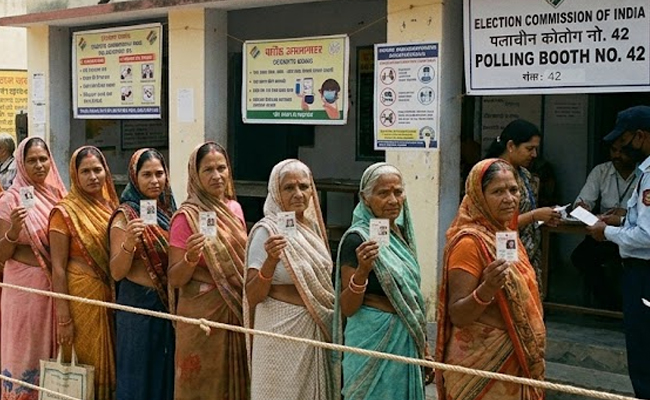
New Delhi (PTI): The recently-concluded assembly elections witnessed exceptionally high voter participation across states, with women voters outnumbering men in turnout percentages, according to Election Commission data.
West Bengal recorded the highest voter turnout among states, with 93.71 per cent polling in 293 constituencies where counting has been completed. The state saw over 6.38 crore votes cast, including postal ballots, against a total of more than 6.81 crore electors.
Women voters recorded a turnout of 93.8 per cent in the West Bengal Assembly polls, slightly higher than the 92.06 per cent participation among men.
The data for West Bengal does not include the figures for the Falta assembly constituency, which is scheduled for repolling.
Tamil Nadu registered an 85.01 per cent turnout, with nearly 4.8 crore votes polled from an electorate of 5.74 crore. Women voters recorded a turnout of 86.2 per cent, higher than the 83.77 per cent among men.
Assam also witnessed robust participation, with the final turnout touching 85.74 per cent. More than 2.15 crore votes were cast in the state, while female turnout at 86.53 per cent marginally exceeded the 84.95 per cent recorded among male voters.
Kerala registered a turnout of 78.11 per cent, with over 2.12 crore votes polled. Female voter participation stood at 81.17 per cent against 74.9 per cent among men.
Puducherry recorded a turnout of 89.82 per cent, with women voters again leading participation at 91.39 per cent. More than 8.5 lakh votes were polled in the Union territory.
Yet, women's representation among elected candidates remained modest.
Tamil Nadu elected 23 women MLAs (9.83 per cent) out of 234 members, West Bengal elected 37 women legislators (12.62 per cent) out of 293, while Kerala returned only 11 women MLAs (7.85 per cent) in the 140-member House.
Only two third-gender candidates contested the elections - one each from Tamil Nadu and Kerala, and both lost, forfeiting their deposits.
The elections also reflected extensive electoral mobilisation infrastructure. West Bengal had the highest number of polling stations at 85,092, followed by Tamil Nadu with 75,064 and Assam with 31,490.
In terms of candidates, Tamil Nadu saw the largest contest with 4,023 candidates in the fray across 234 constituencies, averaging 17 candidates per seat and peaking at 79 contestants in one constituency.
West Bengal pitted 2,920 candidates for 293 constituencies, while Kerala had the fewest contestants among the major states, with 883 candidates for 140 seats.
The data also showed relatively low NOTA votes across states. Tamil Nadu recorded the lowest NOTA share at 0.4 per cent of total votes polled, while Assam recorded the highest at 1.23 per cent. In West Bengal, 0.78 per cent of the total votes polled were NOTA, while it 0.77 per cent and 0.57 per cent of the electorate opted for None of the Above (NOTA) in Puducherry and Kerala, respectively.