Two years of ‘abnormal monsoon’ puts North Karnataka farmers in crisis: Report

Hubballi: Two consecutive years of excessive monsoon rainfall have pushed farmers across North Interior Karnataka (NIK) into severe distress, with the region recording significantly more rainy days than South Interior Karnataka (SIK) and other parts of the state.
Karnataka recorded 149 rainy days in 2025, making it the state’s third-wettest year in the last five years. While NIK logged 102 rainfall days in 2025 and 108 in 2024, South Interior SIK reported 89 and 97 rain days during the same period. The coastal and Malnad regions, meanwhile, experienced their usual average of around 160 rainy days, as reported by Deccan Herald on Sunday.
The prolonged wet spell has severely affected dry-agriculture crops of north Karnataka region, especially tur, green gram, and maize.
Data from the agriculture department, cited by DH, shows that nearly 13.65 lakh hectares of farmland were impacted this monsoon, with 70% of the damage concentrated in Kalaburagi, Yadgir, Vijaypur, Gadag, Bagalkot, Bidar and Dharwad districts.
Farmers are grappling not only with waterlogged fields but also crop infections triggered by continuous rain. Tur, a staple crop across the seven NIK districts, has been struck by phytophthora stem blight, macrophomina blight and dry root rot diseases.
Mallikarjun Kenganal, senior plant pathology scientist, said excessive rainfall has also led to nutrient leaching, forcing farmers to spend more on cultivating crops. “The long duration of rains has also adversely impacted crop growth. Tur, which had to flower by now and get harvested by December, is still in vegetative stage,” DH quoted him as saying. He added the state could witness at least 50% lower yield of tur this year.
The excess rainfall will not only raise cultivation costs for farmers but also contribute to higher food inflation.
Climate variability and shifting wind patterns are among the factors behind the increasing number of rainy days in north Karnataka. “Monsoon arrived in Karnataka much before its usual first week of June. Rains have continued till October. In a normal rainfall year, the state used to record 65-70 days of rainfall. However, this year, it has been higher in all four regions,” DH quoted N. Puviarasan, head, Bengaluru Meteorological Centre, as saying.
Karnataka cultivates kharif crops on 81.22 lakh hectares, of which more than 13.65 lakh hectares have suffered damage this year. Tur fields, spread across 5.36 lakh hectares, are the worst affected, followed by cotton (2.68 lakh ha), green gram (2.63 lakh ha), maize (1.21 lakh ha) and soybean (97,810 ha).
Let the Truth be known. If you read VB and like VB, please be a VB Supporter and Help us deliver the Truth to one and all.
Opposition plans to move fresh notice seeking removal of CEC Gyanesh Kumar
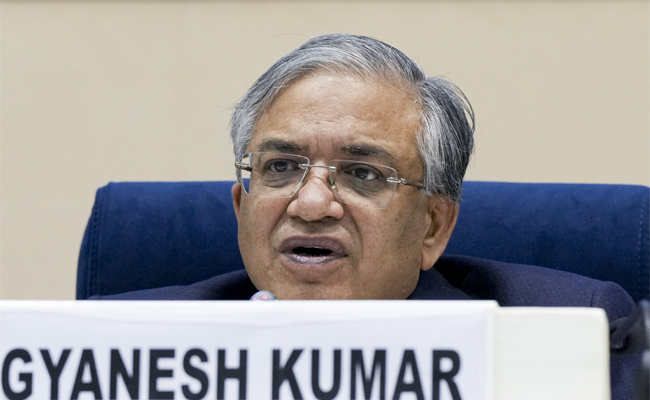
New Delhi (PTI): Undeterred by the rejection of their earlier notices, opposition parties are planning a fresh move to seek the removal of Chief Election Commissioner Gyanesh Kumar, sources said on Saturday.
According to highly placed sources, leaders from several opposition parties are in talks, and at least five senior MPs from different parties -- including the Congress, the Trinamool Congress, the Samajwadi Party and the DMK -- are working on drafting a new notice to initiate removal proceedings.
It has, however, not yet been decided which House the notice would be moved in, or whether it would be introduced in both Houses as was done last time, the source added.
Buoyed by the defeat of The Constitution (131st Amendment) Bill, 2026 in Lok Sabha on Friday, opposition leaders are aiming to secure more MPs' signatures on the notice and are looking at garnering at least 200, the source said.
"We want to make a statement. We first need to prove that the number last time was underestimated," the source added.
In its earlier notices, the opposition had accused CEC Kumar of a "failure to maintain independence and constitutional fidelity" and of acting under the "thumb of the executive".
The notices levelled sweeping charges against the CEC, alleging “proved misbehaviour” on grounds including a compromised and executive-influenced appointment, partisan functioning -- such as the alleged “graded response” doctrine targeting opposition leaders -- obstruction of electoral fraud investigations, and erosion of transparency through refusal to share data and materials.
They further accused him of enabling large-scale disenfranchisement via Special Intensive Revision (SIR) exercises in Bihar and elsewhere, defying or delaying compliance with Supreme Court directions, and acting in alignment with the political executive, thereby undermining the independence of the Election Commission.
However, in almost similar responses, Lok Sabha Speaker Om Birla and Rajya Sabha Chairman C P Radhakrishnan rejected the notices, holding that even if the allegations were assumed to be true, they did not meet the high constitutional threshold of “misbehaviour” required for removal.
They reasoned that appointment-related issues or prior government service do not constitute misconduct; differences in public statements or administrative decisions lack evidence of wilful abuse of authority; and actions like data-sharing or electoral roll revisions fall within the commission’s constitutional mandate and are subject to judicial review.
The responses also stressed that many issues cited were either speculative, politically interpretative, or sub judice, and that removal proceedings cannot be based on disagreement or perceived political consequences but require clear, specific, and provable misconduct, which, they concluded, was absent in this case.