Union Minister Ashwini Vaishnaw unveils prototype version of Vande Bharat sleeper coach
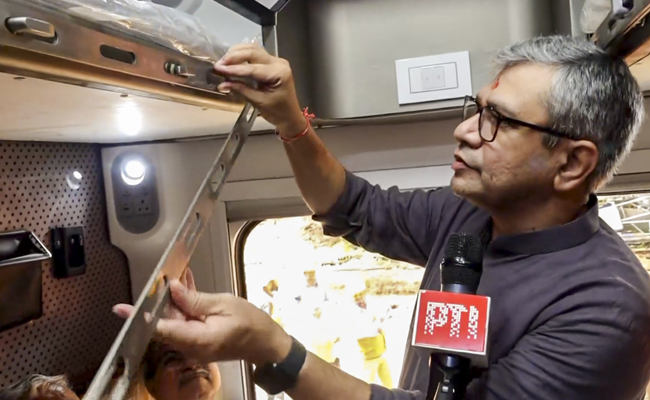
Bengaluru (PTI): Railway Minister Ashwini Vaishnaw on Sunday unveiled the prototype version of the Vande Bharat sleeper coach here at the BEML's facility.
The coach will undergo rigorous trials and tests for the next ten days before rolling it out on the track for further testing, Vaishnaw told reporters.
The train is expected to be open for passenger operation in the next three months, he added.
"After Vande Bharat chair cars, we were working on Vande Bharat sleeper cars. Its manufacturing has now been completed. This train will go out for the trial and testing from the BEML facility today," Vaishnaw said.
Once the prototypes of Vande Bharat sleeper cars are properly tested, then the series of production will start.
"We will start the series of production after one-and-half years. Then it will be like practically every month two to three trains will start rolling out," he added.
Designing a new train is a very complex job, the minister said, adding that many new features have been introduced in the Vande Bharat sleeper cars.
"We are continuously improving the design of the Vande Bharat train. We are learning from the experience and are improving it further. The same philosophy will be adopted for Vande Bharat Metro," he added.
Vaishnaw said the Railways is working on four configurations -- Vande Bharat chair cars, Vande Bharat sleeper cars, Vande Bharat Metro cars and Amrit Bharat -- which will change the way people travel.
According to him, the Vande Bharat sleeper train with 16 coaches is meant for overnight journeys and will cover 800 km to 1,200 km. The oxygen level inside the train and virus protection, a lesson learnt from COVID-19 pandemic, are added features of the train.
"It will be a train meant for the middle class and the fares will be on par with Rajdhani Express," Vaishnaw said.
On the complaints about poor food quality being served in Vande Bharat, the minister said the Indian Railways serve 13 lakh meals a day and the complaints are less than 0.01. "But still we are very, very concerned about the complaints which come and we have taken very strong action against the caterers as well as the suppliers."
The minister laid the foundation stone for a new Vande Bharat manufacturing facility on the Bharat Earth Movers Limited (BEML) premises.
Vaishnaw also laid the foundation stone for a new Hangar facility spanning 9.2 acres near BEML’s Bengaluru complex.
"This facility is dedicated to the export of standard and broad-gauge rolling stock, further expanding BEML's global reach," BEML said in a statement.
Let the Truth be known. If you read VB and like VB, please be a VB Supporter and Help us deliver the Truth to one and all.
Op Sindoor demonstrated India's progression towards 'domain jointness,' says Army Chief
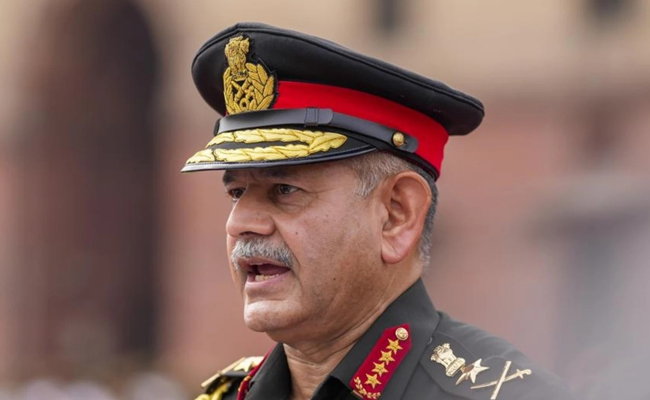
Bengaluru (PTI): Army Chief General Upendra Dwivedi on Thursday said Operation Sindoor demonstrated India's progression towards "domain jointness" and called the military offensive carried out inside Pakistani territory a "defining case study" of operational significance of integration.
In May last year, India had launched a military response targeting terror launchpads in Pakistan post the April 22 Pahalgam terror attack that killed 26 Indian tourists.
"Operation Sindoor was India's most powerful tool of progression towards domain jointness. But we need to achieve domain integration and fusion," General Dwivedi said.
He was addressing the "Ran Samvad" forum on "Land Forces visualisation of Multi Domain Operation (MDO)," here.
The army chief also highlighted the creation of an information warfare organisation and a psychological defence division following Operation Sindoor.
He said, "15 per cent of our effort was on managing the disinformation campaign."
He cautioned, however, that key challenges remain, particularly in synchronising operations across strategic, operational and tactical levels and addressing the growing prevalence of hybrid or grey-zone warfare.
"These are typically below the conventional military threshold, with the goal to exploit adversary vulnerability," he said, adding that non-kinetic operations are increasingly taking precedence.
"Operation Sindoor was India's most powerful tool of progression towards domain jointness. But we need to achieve domain integration and fusion," he said.
The Chief of Army Staff said his visualisation of MDO is not of six domains operating in parallel but all of them "in constant dynamic interaction where the weight shifts and the lead changes".
The Army chief stressed that modern warfare is no longer confined to geographical boundaries or single-service dominance, but is instead defined by continuous interaction across domains, stakeholders and levels of conflict.
"We are living through a dispersed, undeclared, multi-theatre, multi-domain war of our times. The question is not whether domains interact, it is how the interface is orchestrated across the battle space," he said.
General Dwivedi drew a distinction between land domain and land forces, explaining that while the former refers to the operational space, the latter represents the actors, comprising all six domains—land, air, maritime, cyber, space and cognitive—operating in a shared environment.
He underlined that these domains are no longer siloed but function through dynamic synergy.
Elaborating on the evolving battlefield, General Dwivedi noted that MDO has transformed warfighting into a layered, three-dimensional construct.
"In MDO, the battlefield is no longer a line on a map. It's a 3D -- cyber effects shaping the cognitive space, space assets cueing targets, and electronic warfare contesting every frequency simultaneously," he said.
He emphasised that commanders must develop cross-domain situational awareness from the tactical to strategic level.
Highlighting the operational significance of integration, General Dwivedi referred to Operation Sindoor as a "defining case study".
"It was a ground intelligence network coupled with cyber and EW (electronic warfare) inputs that gave the joint army-air force targeting, while the navy's repositioning shaped the strategic calculus simultaneously. No single domain decided the operation," General Dwivedi added.
He described such mutually enabling actions as the essence of MDO.
The Army Chief observed that while domains like cyber, space and cognitive operations benefit from centralised control, land warfare continues to rely on decentralised execution, creating a complex and adaptive system that must be aligned through central intent and technological integration.
On capability development, he said the Indian Army is transitioning steadily from concept to execution under a structured transformation roadmap.
He pointed to dedicated MDO war-gaming exercises since 2024 and the joint doctrine issued in August 2025 as milestones that have provided a unified operational framework across the three services for the first time.
General Dwivedi detailed several structural reforms underway, including the operationalisation of integrated battle groups, Rudra brigades, drone units, electronic warfare formations and cyber operations nodes.
He further underscored the importance of the "three Is" —integration, informatisation and intelligentisation—driven by technology but anchored in human decision-making.
"The human must remain in the loop exercising the judgment," he asserted.
The Army Chief emphasised the need for leadership transformation in the digital age.
"Commanders must evolve into techno-commanders, to build a force that does not know where one domain ends and another begins," he said.
Outlining the future roadmap, he identified "six Ds" shaping the MDO environment—dispersion, democratisation and diffusion among them—leading to imperatives such as diversification of assets, delegation of command and distributed response.
He called for a shift from "domain silos to domain fusion", describing a six-stage progression from domain purity to complete integration.