Whether I go to the Kumbh Mela or not is matter of personal belief: Karnataka Dy CM DK Shivakumar
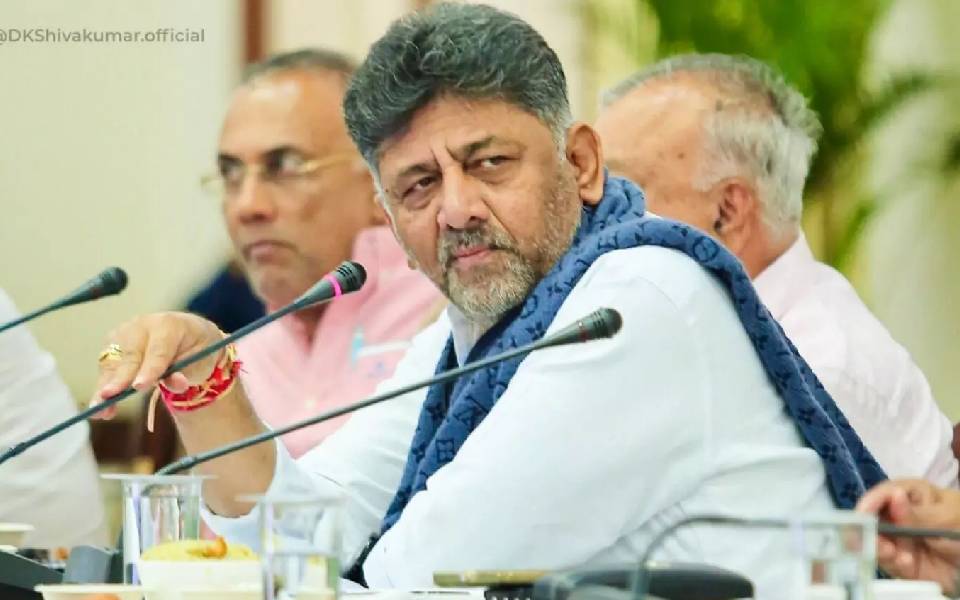
Bengaluru, Feb 5 (PTI): Karnataka Deputy Chief Minister D K Shivakumar on Wednesday said his plans to visit the ongoing Kumbh Mela in Prayagraj, Uttar Pradesh, was part of his personal beliefs and devotion and that no one had the right to question them.
Shivakumar was responding to remarks by Leader of the Opposition in the Karnataka Legislative Assembly, R Ashoka, who commented on reports about the deputy CM's plans to visit the Kumbh Mela while attempting to link it to Congress President Mallikarjun Kharge’s recent statement.
Kharge had questioned whether poverty could be eradicated by taking a dip in the Ganga, alleging that BJP leaders were competing to take dips for the cameras.
"He (Ashoka), the Opposition Leader, thinks he will gain respect in his party by making comments against me. Let anyone say whatever they want—it is a matter of our dharma and karma, our practices, traditions, and beliefs," Shivakumar said.
Speaking to reporters here, he stated that rivers like the Ganga, Cauvery, Krishna, Brahmaputra, Arkavathi, and Vrishabhavathi belong to no one.
"Water has no colour, taste, or shape, and everyone needs water. People say whatever they want—I don’t know what his (Ashoka’s) issue is. Maybe he has some problem. No one has the right to speak about my personal beliefs. My belief and devotion are my personal matters," he said.
BJP leader Ashoka, in a post on 'X', asked, "Won't Kharge now question—will all the sins of Dy CM Shivakumar be washed away as soon as he bathes in the Ganges? Will poverty be eradicated in Karnataka as soon as KPCC President Shivakumar takes a holy dip at the Kumbh Mela?"
When asked about his plans, Shivakumar said that whether he goes to the Kumbh Mela or not is entirely his decision. "It is a matter of my personal belief. Whether I go or not is my personal matter."
Responding to a question about Kharge’s statement, he said, "He said it in a certain context, so why is the media making it an issue?"
"Let Ashoka comment on the Prime Minister’s participation in the Kumbh, not me. Whether I go or not is my personal belief. Let him comment on whether the Prime Minister, Home Minister (Amit Shah), and various leaders from across the country and the world visiting the Kumbh is right or wrong," he added.
When asked about plans for a second airport in Bengaluru, the Deputy Chief Minister, who is also in charge of Bengaluru’s development, said that the matter would be discussed and decided after the Global Investors Meet next week.
"Our Infrastructure Minister (M B Patil) is looking into it. The issue has not yet been discussed and finalised with me and the Chief Minister, though a preliminary meeting has taken place. After the Global Investors Meet, the Chief Minister and all of us will discuss and decide," he said.
Regarding a proposal for a water tariff hike in Bengaluru, Shivakumar said it would be discussed during the next Cabinet meeting.
Let the Truth be known. If you read VB and like VB, please be a VB Supporter and Help us deliver the Truth to one and all.
RCB beat MI by 18 runs after batters fire
Mumbai (PTI): Royal Challengers Bengaluru skipper Rajat Patidar, Phil Salt and Virat Kohli blasted half-centuries as the defending champions beat Mumbai Indians by 18 runs in an Indian Premier League match here on Sunday.
Salt (78 off 36 balls) and Kohli (50 off 38 balls) stitched together a 120-run stand for the opening wicket before Patidar scored a rapid 53 off just 20 balls as RCB posted 240 for 4.
In response, Mumbai Indians were restricted to 222 for 5, with RCB spinner Suyash Sharma (2/47) putting the skids on the home side with a double strike in the eighth over, from which they could not recover.
Sherfane Rutherford top-scored for MI with an unbeaten 71 off 31 balls.
While opener Rohit Sharma appeared to be struggling with a hamstring issue and had to retire hurt on 19, his partner Ryan Rickelton made 37, while Suryakumar Yadav (33) and Hardik Pandya (40) were the other contributors for MI.
Brief scores:
Royal Challengers Bengaluru 240 for 4 in 20 overs (Phil Salt 78, Virat Kohli 50, Rajat Patidar 53, Tim David 35 not out).
Mumbai Indians: 222 for 5 in 20 overs (Sherfane Rutherford 71 not out, Ryan Rickelton 37, Hardik Pandya 40; Suyash Sharma 2/47).